
Shukla demonstrates how surface tension brings floating water droplets together and explains why the experiment matters for space missions.
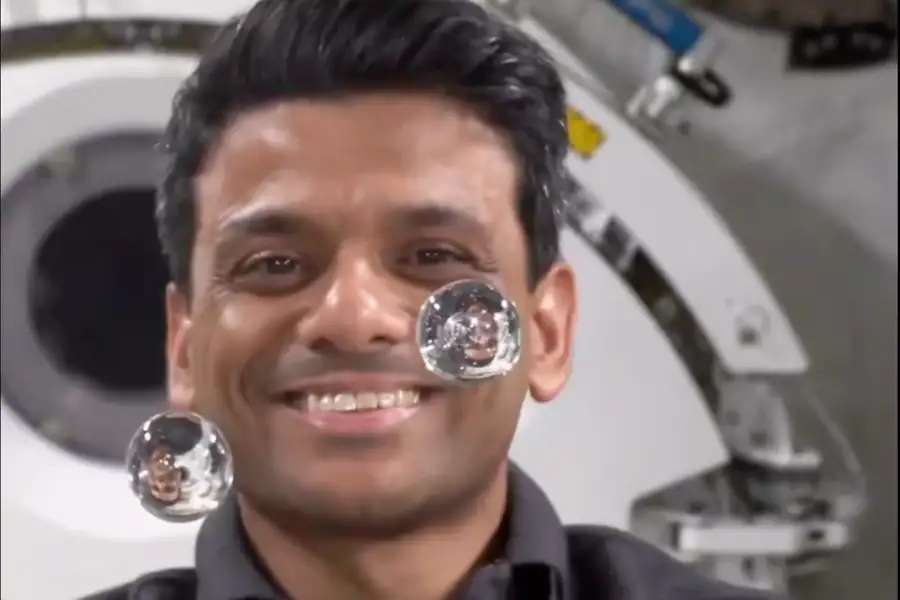
New Delhi: What happens when two drops of water touch in space? Indian astronaut Shubhanshu Shukla has shared a fascinating video showing two floating drops of water coming together to form one larger drop. He has also explained the simple science behind the experiment.
In the video shared on X on November 16, Shukla brings two blobs of water floating in space close to each other. As soon as they touch, they join to form a single, larger droplet.
The experiment shows how water behaves differently in space, where the pull of gravity is extremely weak compared with what we experience on Earth.
Also read | Beyond the solar system: Voyager 1's incredible 49-year journey through space
Why do two water droplets merge in space?
Shukla explained that the merging happens because of a force called surface tension. It is the force that makes water behave as though it has a thin, elastic skin on its surface.
On Earth, gravity pulls water downwards, causing it to flow and settle. In space, where gravity has very little influence on the droplets, surface tension plays a much bigger role.
Water naturally tries to reduce the area of its surface. When two floating droplets touch, this force pulls them together, forming one larger droplet. This process is called coalescence.
The newly formed droplet does not become still immediately. Shukla explained that the merging process creates movement, causing the larger drop to wobble and change shape. These movements gradually slow down as the liquid loses energy through internal resistance, known as viscosity.
Also read | Could these bacteria-killing viruses help fight antibiotic resistance? A new discovery takes us closer
How does the water experiment help space missions?
The experiment is not just about watching water float and merge in space. It can also help scientists understand how liquids behave when gravity has very little effect on them.
By observing how quickly two droplets merge and how the resulting droplet moves, scientists can study two important properties of liquids: surface tension and viscosity.
This understanding is useful in designing spacecraft fuel systems. Fuel inside a spacecraft's tank does not behave in the same way as it does in a tank on Earth. Engineers need to know how liquids move and collect inside these tanks in microgravity so that fuel can be stored and supplied properly during a mission.
Shukla also pointed out that similar experiments have been conducted aboard the International Space Station (ISS). Scientists have used merging water droplets to measure the viscosity of liquids.
Sharing the video, the astronaut highlighted how an apparently simple activity can offer valuable scientific lessons.
"Who said playing with water was just child's play? Sometimes, it is science in disguise!" he wrote.
Published: 17 Nov 2026, 03:56 pm IST


ABOUT THE AUTHOR

Disclaimer: Kindly avoid objectionable, derogatory, unlawful and lewd comments, while responding to reports. Such comments are punishable under cyber laws. Please keep away from personal attacks. The opinions expressed here are the personal opinions of readers and not that of Mathrubhumi.