
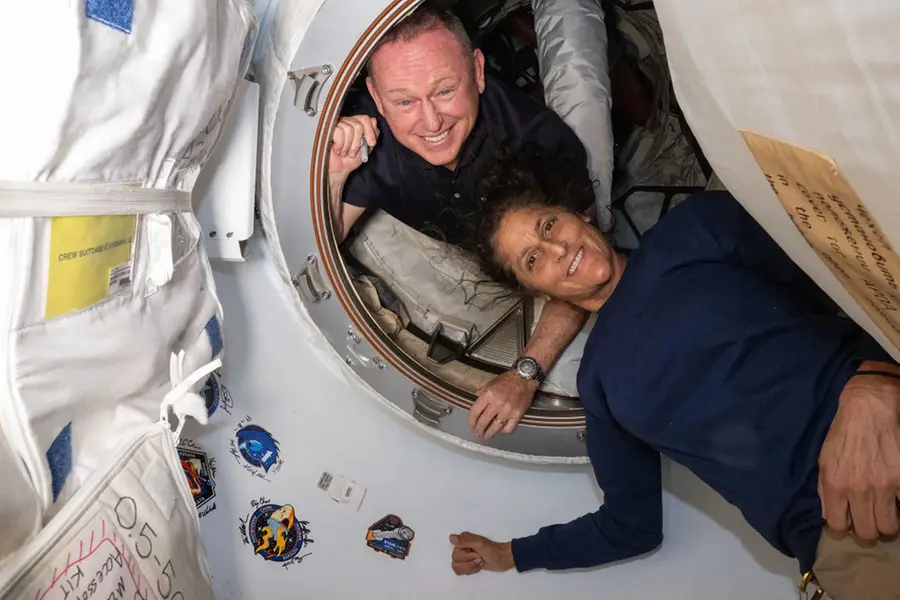
It was supposed to be an 10-day trip, but it's been over two months since NASA test pilots Butch Wilmore and Sunita Williams have been stuck at the International Space Station due to technical problems plaguing their Boeing Starliner spacecraft.
US Space agency NASA is still deciding whether to bring the astronauts back from the ISS in the Boeing Starliner capsule or use the SpaceX Crew Dragon. This was Boeing Starliner's first test flight with a crewed mission.
Also Read

Five of Starliner's 28 reaction control thrusters (RCT) had problems before it docked with the ISS on June 6. Reaction control thrusters are small engines on a spacecraft that help it change direction or position. They work by expelling gas or other material, which pushes the spacecraft in the opposite direction, following Newton’s Third Law of Motion.
These thrusters are crucial for manoeuvring the spacecraft in space, such as adjusting its orientation or docking with other spacecraft.
Boeing and NASA have been investigating what went wrong and whether Starliner can safely bring Butch and Suni back to Earth. Starliner is designed to leave the ISS in emergencies. However, after months of testing the thrusters, NASA's programme control board still lacks confidence in the propulsion system.
The main problem seems to be overheating thrusters, but there is disagreement about how serious the issue is, what causes it and how risky it may be.
Different Options Being Considered
One option is to reduce the number of astronauts on SpaceX's Crew-9 mission from four to two. This would allow space for Starliner's astronauts to return on the SpaceX Crew Dragon next year. The launch of Crew-9 was postponed by five weeks to September 24, partly to keep that option available.
Alternatively, Starliner’s astronauts may fit underneath the four seats of Crew-8's Dragon and travel back with the astronauts currently on the ISS, who will be heading home soon. Although this situation is unusual, it is not the first time that NASA has considered asking SpaceX to carry extra people during a mission.
Space.com reported that the Crew Dragon can carry more than four people. A version shown to the public in May 2014 had seven seats. In 2019, NASA asked for a change to four seats because of the installation angle. Officials were worried about the g-forces on astronauts during landing, according to Spaceflight Now.
The installation angle refers to how seats are positioned inside the spacecraft. G-forces are the forces of gravity or acceleration that astronauts feel, similar to the pressure felt during rapid acceleration or deceleration, which can affect their comfort and safety during landing. Acceleration is the rate at which something speeds up or slows down.
For example, when a car starts moving faster, it is accelerating. Similarly, when it slows down, it is experiencing negative acceleration or deceleration.
A spacecraft can travel from Earth to the International Space Station (ISS) in as little as four hours. However, the return trip from the ISS back to Earth typically takes longer, usually upto six hours, depending on the mission and landing conditions.
With more spacecraft available at the ISS, NASA is exploring various ways to transport people to and from the station. They are considering options that allow astronauts to return to Earth in different spacecraft than the ones they used to arrive, NASA officials said in the August 7 briefing.
How NASA Prioritizes Backup Plans
This situation became clear in late-2022 when a docked Russian Soyuz spacecraft developed a coolant leak, which partially compromised its ability to safely bring astronauts back to Earth. Fortunately, there was a backup spacecraft available at the time -- a Crew Dragon.
NASA has, indeed, stated that the ISS can accommodate up to eight spacecraft docked at any given time. This includes a combination of crewed vehicles like the SpaceX Crew Dragon and Soyuz, as well as cargo vehicles such as the Cygnus and others.
The station's docking ports are designed to support various international spacecraft, allowing for flexibility in operations and crew rotations.
Between 2011 and 2020, Soyuz was the only spacecraft used to travel to and from the ISS after NASA’s space shuttle was retired. To restore the ability to launch astronauts from the US, NASA funded the development of the Space-X Crew Dragon and Boeing Starliner spacecraft.
SpaceX launched its first crew into space in 2020 following one un-crewed test flight. Meanwhile, Starliner is currently on its first mission with astronauts after completing two un-crewed test flights to the ISS, one in 2019 and another in 2022, despite facing several development delays.
Dana Weigel, ISS program manager, told media persons that the Soyuz coolant leak taught a lot. Unexpected issues can occur on the station, but problems can also occur with a crew vehicle, such as a micrometeoroid strike or other issues.
It is wise to have multiple backup plans ready. A micrometeoroid is a tiny fragment of a meteor -- a small piece of a comet or asteroid֫ -- that travels at high speeds in space. Despite their small size, they can cause damage to spacecraft if they collide.
Until a new Soyuz spacecraft can reach the station a few months later, NASA and SpaceX have worked together on a plan to place a Soyuz seat liner in the cargo area of the Dragon spacecraft, beneath the four seats.
A Soyuz seat liner is a custom-molded insert made to fit an astronaut’s body, providing comfort and protection during launch and landing. It ensures the astronaut is securely positioned and helps absorb the forces experienced during these phases of flight and ensures they are securely positioned in their seat.
The seat liner was used in the SpaceX Dragon spacecraft as part of a contingency plan, allowing a Soyuz-trained astronaut to have a backup option for returning to Earth. This arrangement provided NASA astronaut Frank Rubio with an alternative way to return to Earth if an emergency evacuation from the ISS became necessary.
Rubio's two Russian crewmates were permitted to return to Earth in the damaged Soyuz since having two astronauts onboard would generate less heat inside the spacecraft compared to having three.
Weigel mentioned that SpaceX's new task orders this summer were partly influenced by the experience of installing the seat liner for Rubio. She said that they realized that, ideally, they should not move the Soyuz seat liner because it was at risk of being damaged.
SpaceX's new solution involves using foam for cushioning astronauts on the cargo pallet, which 'provides more flexibility and avoids risking damage to the Soyuz seat liner'.
Steve Stich, NASA’s Commercial Crew Program manager, said the Soyuz backup plan was one of three recent task orders carried out by SpaceX.
The other two task orders are more directly related to the Starliner’s situation.
First Option: One plan involves launching two astronauts on Crew-9 with 'metal ballast' in the other two seats. The ballast is meant to mimic the weight and centre of gravity of two astronauts. Ballast refers to a heavy material used to provide stability and balance to a vehicle or structure. In the context of spacecraft, ballast is used to simulate the weight and distribution of a typical load, helping maintain the correct centre of gravity for stable flight. The ballast would be taken out to make room for Butch and Suni to return to Earth on the Dragon in February 2025, when Crew-9 returns.
Second Option: In the second scenario, Crew-8 would return with its four astronauts, with 'up to three crew members' riding on its cargo pallet. Two of the seats would be for the Starliner astronauts. The third seat, if needed, would be for NASA astronaut Tracy Dyson, who travelled to the ISS on a Soyuz in March 2024. So far, it looks like she will return home on the Soyuz as planned, but NASA is keeping all options open in case of an emergency.
As of August 6, 2024, six spacecraft are docked at the ISS. These include Boeing’s Starliner, SpaceX Dragon Endeavour (used for Crew-8 mission taking 4 crew members on March 4, 2024), a Northrop Grumman resupply ship, the Soyuz MS-25 crew ship (which took a crew of 3 members docked at ISS on March 25) and the Progress 87 and 88 resupply ships.
Published: 12 Aug 2024, 01:56 pm IST
Disclaimer: Kindly avoid objectionable, derogatory, unlawful and lewd comments, while responding to reports. Such comments are punishable under cyber laws. Please keep away from personal attacks. The opinions expressed here are the personal opinions of readers and not that of Mathrubhumi.