

In an exclusive interview with Mathrubhumi English, Kozhikode-born scientist V Aswathi Balagopal explains her contribution to Nobel-recognised neutrino research.
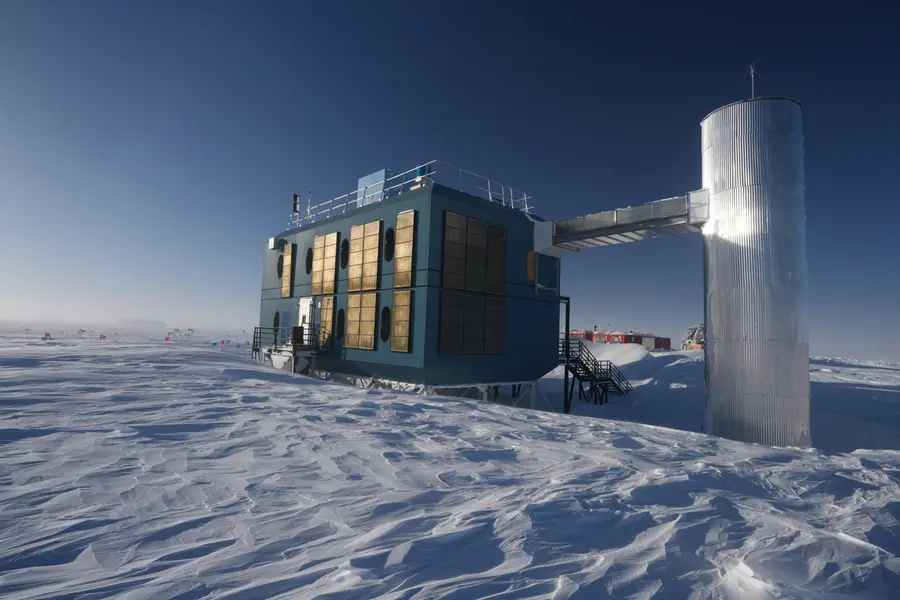
Kozhikode: What can particles travelling from distant cosmic sources tell us about the universe? For V Aswathi Balagopal, a scientist from Kozhikode whose research contributed to work recognised by the Nobel Committee, answering that question has meant years of analysing data from one of the world's most unusual scientific observatories -- buried deep beneath Antarctic ice.
In an exclusive conversation with Mathrubhumi English, Aswathi spoke about the research, the finding of a new pattern in cosmic neutrino energies, her journey from Kozhikode to international research and the opportunities available to young scientists in Kerala.
“I was elated to hear about this win,” she said, recalling the recognition of the work on astrophysical neutrinos. “All of us, from the IceCube collaboration, have been waiting for this win for some years now. The recognition finally happening was incredible.”
The recognition was especially meaningful because the finding itself had been a major achievement for the scientific community. Aswathi said high-energy neutrinos of astrophysical origin were detected after just two years of the IceCube observatory's full operation.
“The fact that the Nobel committee realised that and decided to acknowledge this with a well-deserving Nobel was exciting,” she said.
Finding a pattern in cosmic neutrinos
Aswathi's own contribution involved studying the energy spectrum of cosmic neutrinos detected by the IceCube Neutrino Observatory. Working with graduate student Vedant Basu over several years, she used new data-analysis techniques to examine how many neutrinos reach Earth at different energy levels.
Explaining the work, she described the energy spectrum as “a count of the number of neutrinos coming into Earth at each energy ‘slice’”.
The analysis produced a finding that differed from earlier measurements.
“Using new data-analysis techniques, we made this measurement and found that the cosmic neutrino energy spectrum is unlike what we measured until then,” she said. “We found some structure in its energy spectrum.”
The change in the pattern between lower and higher energies was identified for the first time through their work, she said, bringing researchers closer to understanding where these neutrinos originate.
“The significance of this work was recognised by the Nobel Committee and they highlighted this in the scientific document that accompanies the press release,” Aswathi said.
She described being part of the research as an honour, adding that she was happy to contribute to work considered relevant to the wider scientific community.
How Antarctic ice helps scientists study the universe
The IceCube Neutrino Observatory is located at the South Pole, where more than 5,000 light sensors have been drilled deep into Antarctic ice. The sensors detect faint flashes produced when neutrinos interact with matter and generate charged particles that emit light.
Because these interactions are rare, researchers need a vast detector to capture enough signals to study the particles. IceCube covers a volume of approximately one cubic kilometre.
Aswathi said the observatory searches for neutrinos from cosmic sources — anything originating beyond Earth.
The first confirmation of astrophysical neutrinos at peta-electronvolt energies, equivalent to (10^{15}) electronvolts, was a major step forward. These are energies that human-made experiments can only dream of creating, she explained.
For Aswathi, the importance of the work extends beyond the immediate discovery.
“Human beings, on a whole, have been curious about their place in the Universe, since time immemorial,” she said. “Any new discovery brings us closer to the truth as a collective.”
She believes the long-term value of fundamental science can be difficult to measure when a discovery is first made.
“The impact of this on human civilisation is hard to assess in a short time scale, and unfolds along very long time scales,” she said.
As an example, she pointed to the internet, which was developed by scientists at CERN to make communication and information transfer easier before becoming a technology used across the world.
From Kozhikode to Germany and the United States
Aswathi studied at Devagiri College in Kozhikode before moving abroad for further research. She later earned her doctorate in Germany and went on to become a postdoctoral scholar at the University of Wisconsin-Madison in the United States.
The move across countries brought its own challenges, particularly the need to adapt to different cultures and navigate unfamiliar systems.
“I think the biggest challenge was always to blend into the culture of wherever I ended up,” she said.
Understanding local customs, adjusting to new people and finding her place in each new environment took time. Visa requirements were another challenge for an Indian researcher working abroad.
“Navigating the bureaucracy, particularly the visa requirements which is always strict, complicated, and often time consuming for Indian citizens,” was among the difficulties she faced, she said.
She credited the colleagues and friends she met along the way with helping her through these transitions.
“But I have always been lucky to be surrounded by some wonderful colleagues and friends who remained an integral part of this journey and helped navigate the system,” she said.
Her advice to young scientists in Kerala
For students in Kerala who want to pursue a career in science but feel that opportunities are limited, Aswathi's advice is to begin by actively looking for them.
“Networking always matters in finding opportunities for pursuing a career in science,” she said.
Students can start by asking their teachers to direct them towards useful resources, she explained. Internships at universities and research centres are another option, giving students the chance to explore different fields and discover which areas interest them most.
She also suggested looking into national-level portals and examinations, while pointing out that directly contacting a professor at a desired institution can sometimes open doors.
“Sometimes even contacting a professor at the desired institute works,” she said.
For aspiring researchers, her message is practical: seek guidance, explore opportunities and build connections. Her own journey from Kozhikode to international scientific research reflects the years of study, collaboration and analysis that can lie behind a discovery.
Published: 26 Oct 2026, 03:50 pm IST
ABOUT THE AUTHOR
Related Topics
Disclaimer: Kindly avoid objectionable, derogatory, unlawful and lewd comments, while responding to reports. Such comments are punishable under cyber laws. Please keep away from personal attacks. The opinions expressed here are the personal opinions of readers and not that of Mathrubhumi.