
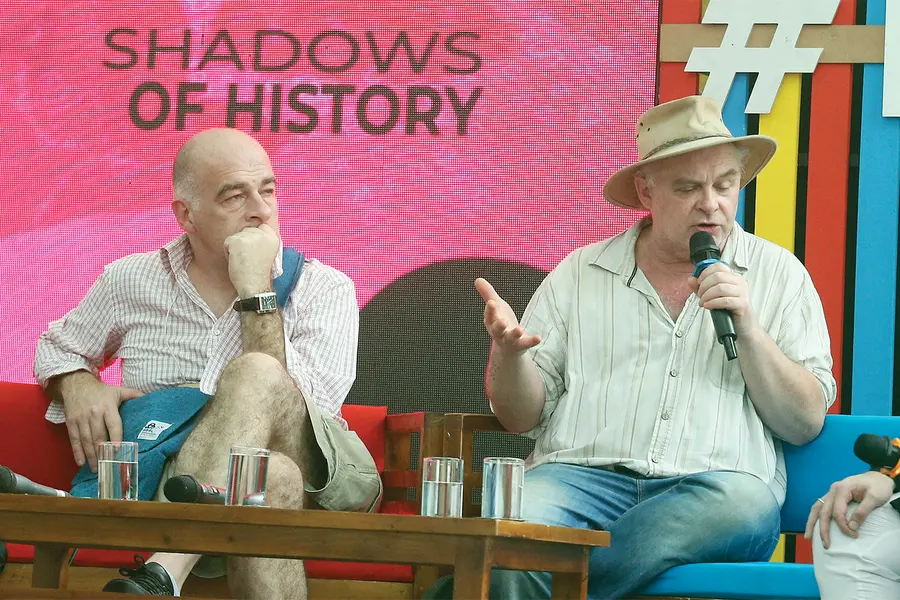
The Russian invasion of Ukraine dominated the topics discussed at ‘European Voices’ at MBIFL.
The words of Latvian playwright and author Rasa Bugavicute-Pece and Georgian fiction writer and screenwriter Archill Kikodze reflected the pity of war.
Bugavicute-Pece and Kikodze, however, stated that Russia had played a major role in their lives. They spoke of how Russia influenced their writings.
Kikodze spoke about his childhood and schooling in Russia and how he got access to European literature when he grew up.
“My family members were great storytellers and that is how I was inclined to writing,” he said. “I don’t believe literature can change the world, but it will create an impression that good people are not alone in the world. Literature is important to know about the past as we tend to forget the past. Literature becomes important in documenting different ages of the world as official history is full of lies.”
Bugavicute-Pece said that she believed in the therapeutic value of literature. “Love binds human beings. This is the crux of my writing,” she added.
English author Niall Griffiths said that reality was now a negotiable concept. “People in power say what we have to believe. We are forced to believe what we did not see or what we did not hear. Reality, now, is something that you can mould to your will and to your ideological angle.
Polish poet, multi- instrumentalist and activist Szczepan Kopyt recited poems at MBIFL. The themes of his poems include colonization and capitalism, and how human beings robotically work to attain conflicting goals.
Published: 09 Feb 2023, 01:13 pm IST
Related Topics
Disclaimer: Kindly avoid objectionable, derogatory, unlawful and lewd comments, while responding to reports. Such comments are punishable under cyber laws. Please keep away from personal attacks. The opinions expressed here are the personal opinions of readers and not that of Mathrubhumi.
