
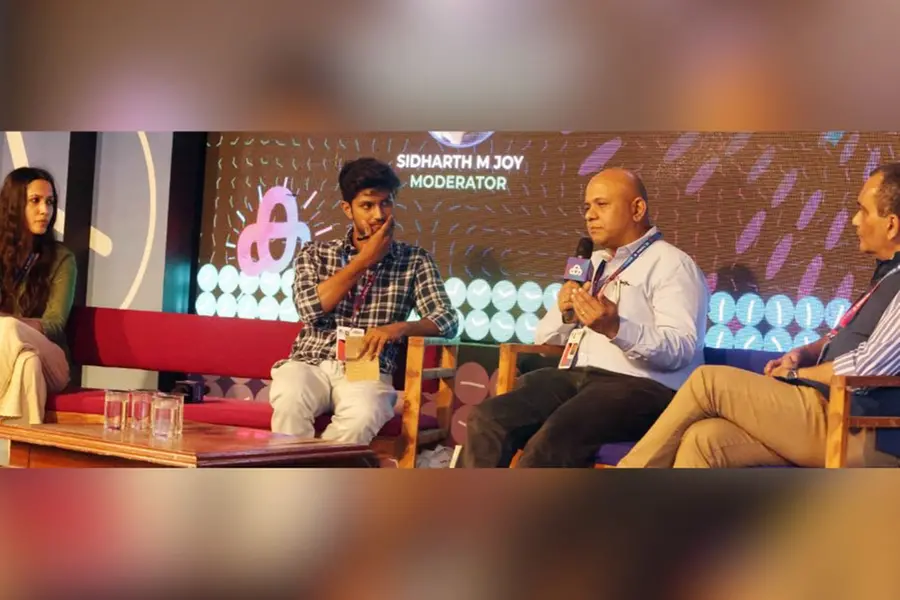
At the Mathrubhumi International Festival of Letters (MBIFL) at the Kanakakkunnu Palace in Thiruvananthapuram, Kerala, a compelling discussion titled 'India, Beyond the Patina' featured author Megha Rao, political commentator Sudeep Chakravarti, former Caravan executive editor Vinod K Jose, and moderator Sidharth M Joy, delving into the complexities of India’s socio-political landscape. From various angles and lenses, it questioned binary narratives and exposed the layers of reality hidden beneath the surface.
Illusion of Apathy and Power of Misinformation

Megha Rao began the session by stating that she doesn't understand the notion of being apolitical, arguing that only those who benefit from systemic oppression can afford such a stance. "They exist in a space of privilege," she asserted.
Rao also touched on the topic of 'bad art', defining it as art created with a defined propaganda -- a strategised approach to spreading hate and communalism. She delved into how films and literature are increasingly being used to spread misinformation and stir up hate. Recalling an incident involving 'The Kerala Story', when one of her friends who had watched the film called in to check if she was safe. With this example and others, she noted how quickly propaganda art can influence public perception and thereby the socio-political atmosphere of the nation.
Idea of Nationalism and the Erasure of History
Sudeep tackled the contentious issue of nationalism, questioning the meaning of terms like “anti-national” and “urban naxal.” He pointed out how reporting on government failures is often misconstrued as an attack on the nation itself. “These are not counter-narratives,” he said. “They’re just narratives that exist alongside others.”
Highlighting the country’s dismal ranking of 159 in the World Press Freedom Index, Chakravarti warned of the growing trend of historical erasure. When asked about history being rewritten to erase marginalised communities, he commented that with misinformation spreading at unprecedented speeds, the rewriting of history has become a consistent phenomenon, happening even in seemingly innocuous spaces like family WhatsApp groups. “In essence, we are all citizen rewriters of history,” he said, and urged the audience to admit that they were also part of the problem.
Journalism and the Withholding of Truth
Vinod K Jose, a veteran journalist, expressed concerns about the role of media in shaping public discourse. He pointed out that media organisations often refrain from publishing certain stories, not because they lack merit, but because they are “too good.” He criticised mainstream journalism for withholding crucial information that citizens have a right to know.
He also emphasised that most ambitious journalists settle for mediocre journalism because of their limited situations -- bills to be paid and stomachs to be fed.
Need for Structural Change in Women's Rights
When asked about the existence of women in the patina, Megha expressed frustration with tokenistic representation in policy-making. While statistical representation may appear progressive, she argued, it often lacks genuine intent and fails to drive real change.
Rao shed light on the plight of LGBTQ+ individuals, citing the lack of basic facilities like public restrooms for trans women even in metropolitan cities like Bangalore. Recalling the tragic case of Anannyah Kumari Alex, a trans Kerala woman who died by suicide after a failed gender-affirming surgery, she emphasised the systemic failures that continue to endanger marginalised communities.
She also addressed what she called the “obnoxious hero complex” among Indian men. “Women are capable of living on their own,” she asserted. Instead of focusing on “rescuing” women, she argued, the work done should be towards creating safe spaces for women, LGBTQ+ individuals, and other marginalised sections of society.
The discussion concluded with a consensus on the need for clarity, honesty, and action in navigating India’s socio-political realities, to uncover the India that lies beyond the patina. The panelists emphasised the importance of acknowledging one’s own role in societal structures, challenging outdated norms, and being brave enough to demand and bring about change.
Published: 09 Feb 2025, 09:52 pm IST
Related Topics
Disclaimer: Kindly avoid objectionable, derogatory, unlawful and lewd comments, while responding to reports. Such comments are punishable under cyber laws. Please keep away from personal attacks. The opinions expressed here are the personal opinions of readers and not that of Mathrubhumi.