
Chinese President Xi Jinping revived discussion around the “Thucydides Trap” during talks with US President Donald Trump, highlighting fears that rivalry between rising and established powers could lead to conflict
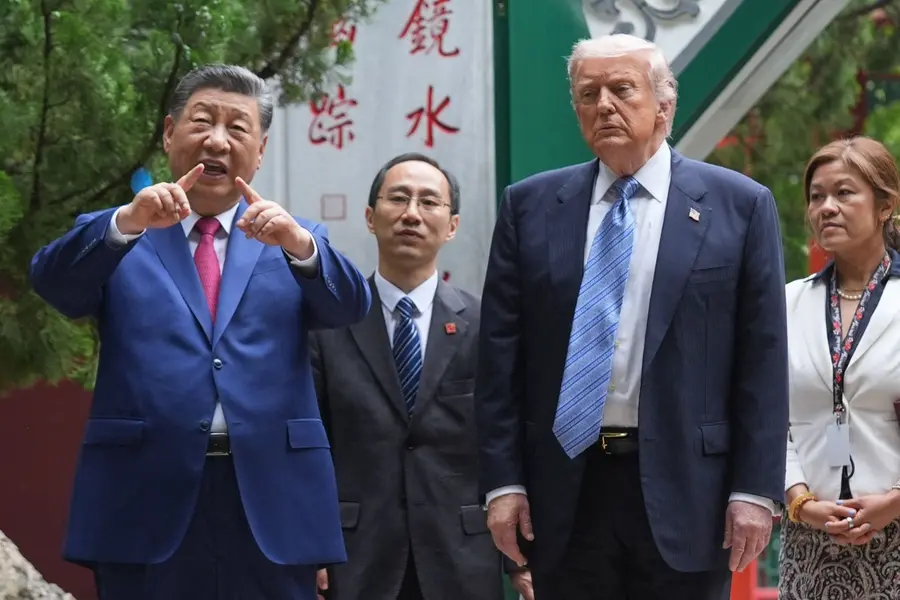
Beijing: Chinese President Xi Jinping referred to the “Thucydides Trap” during his high-profile meeting with US President Donald Trump in Beijing, using the concept to underline the risks surrounding growing rivalry between China and the United States.
During discussions, Xi reportedly questioned whether both countries could “overcome the Thucydides Trap and create a new paradigm of major country relations,” as tensions over Taiwan, trade, technology and military influence continue to shape ties between the world’s two biggest powers.
Also Read

What is the ‘Thucydides Trap’?
The “Thucydides Trap” is a political science theory popularised by Harvard scholar Graham Allison. The concept is based on the writings of ancient Greek historian Thucydides, who documented the Peloponnesian War between Athens and Sparta.
Thucydides argued that the rise of Athens created fear in Sparta, making war increasingly likely. His famous observation stated that “the rise of Athens and the fear that this instilled in Sparta made war inevitable.”
The theory has since been used to describe situations where an emerging global power challenges an existing dominant power, creating strategic tensions that could eventually lead to conflict.
In modern geopolitics, the theory is most commonly applied to relations between the United States and China.
The US is viewed as the long-standing global superpower, while China is increasingly seen as a rapidly rising economic, technological and military force. As China’s influence expands globally, tensions between both countries have intensified across several areas.
These include trade disputes, competition over semiconductors and artificial intelligence, military activity in the Indo-Pacific region, and disagreements over Taiwan.
Taiwan remains major flashpoint
Xi’s remarks came alongside strong comments from Beijing regarding Taiwan, which China claims as its territory.
Chinese officials reportedly stated during the talks that “Taiwan independence” and peace across the Taiwan Strait are fundamentally incompatible. Taiwan continues to remain one of the most sensitive and dangerous issues in US-China relations.
The United States maintains unofficial ties with Taiwan and is legally obligated to support its defensive capabilities, while China has repeatedly warned against foreign involvement in the issue.
Although the “Thucydides Trap” suggests rivalry between great powers can increase the likelihood of war, the theory does not claim conflict is unavoidable.
Graham Allison studied 16 historical examples of rising powers challenging established powers and found that 12 ended in war. However, several cases managed to avoid direct military conflict.
One major example often cited is the Cold War between the United States and the Soviet Union, where intense rivalry existed for decades without escalating into a direct large-scale war between the two powers.
Xi has referenced concept before
Xi Jinping has referred to the “Thucydides Trap” multiple times in previous speeches and diplomatic engagements. Chinese leaders have often used the phrase to argue that competition between China and the US should be managed carefully to avoid dangerous escalation.
The concept has become increasingly relevant as both countries compete for influence in global politics, technology, economics and security.
The renewed reference to the theory during the Trump-Xi summit reflects growing global concern over the future direction of US-China relations.
Analysts say how both countries manage strategic competition over the coming years could significantly shape global economic stability, regional security and international diplomacy.
Published: 15 May 2026, 09:46 am IST
Related Topics
Disclaimer: Kindly avoid objectionable, derogatory, unlawful and lewd comments, while responding to reports. Such comments are punishable under cyber laws. Please keep away from personal attacks. The opinions expressed here are the personal opinions of readers and not that of Mathrubhumi.