
Chinese President Xi Jinping will meet Donald Trump in Washington on September 24, with US-China trade, tariffs, AI, rare earth minerals and Taiwan among the key issues surrounding the summit.
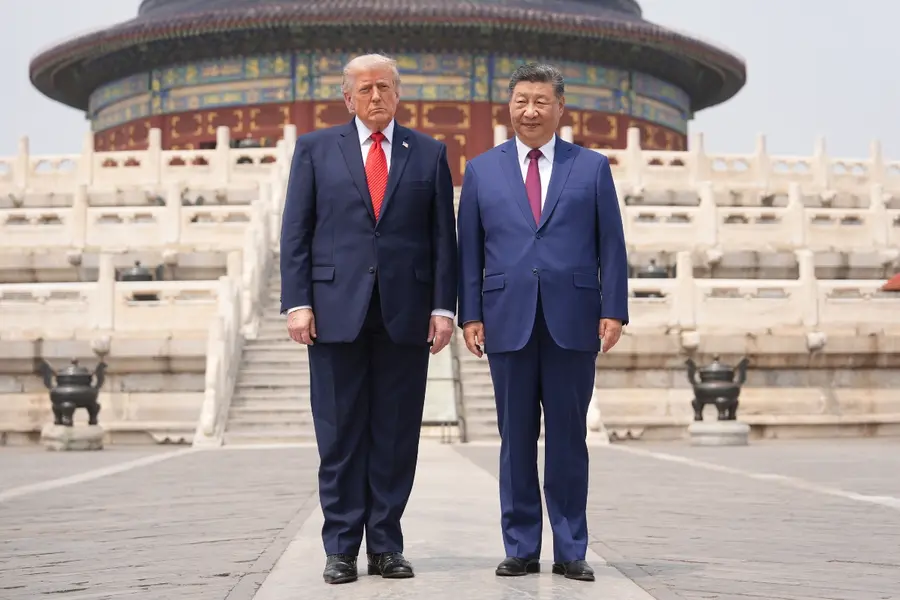
Chinese President Xi Jinping will travel to Washington next week for a state visit and talks with US President Donald Trump, marking Xi's first visit to the United States in more than a decade. The two leaders are scheduled to meet at the White House on September 24.
The visit will combine formal diplomatic events with negotiations on some of the most sensitive areas of the US-China relationship, including tariffs, rare earth supplies, artificial intelligence and technology controls.
Also Read

Trump is expected to personally greet Xi when the Chinese leader arrives at Joint Base Andrews on Wednesday. The White House programme includes a formal arrival ceremony, a military review, bilateral talks and a state dinner hosted by Trump and first lady Melania Trump.
Several major technology and business executives are expected at the state dinner, including Jeff Bezos, Elon Musk, Sundar Pichai, Jensen Huang, Sam Altman, Michael Dell, Jane Fraser and Tim Cook. Their presence reflects the importance of technology and business ties in the broader US-China relationship.
Trade and tariffs
Trade will be a central issue as the two countries seek to manage their tariff dispute. Officials are discussing the possibility of reducing tariffs on a limited range of non-strategic goods.
The existing US-China trade and technology truce is due to expire in November, increasing pressure on both sides to determine whether it should be extended. Treasury Secretary Scott Bessent and Chinese Vice Premier He Lifeng are also scheduled to hold talks in New York ahead of the Trump-Xi meeting.
Trump has said Washington is "doing very well with China" and expects discussions on multiple agreements during Xi's visit. His comments come as both governments try to prevent renewed tariff escalation while negotiating unresolved trade issues.
Rare earths remain a key sticking point
Rare earth minerals and critical minerals are another major issue. China plays a dominant role in the global refining and processing of many rare earth materials, making supply security important for technology and manufacturing industries.
US officials have indicated that Washington wants reliable flows of rare earth minerals but does not currently expect to exchange its export controls for Chinese concessions on mineral supplies. Discussions are instead expected to focus on maintaining access and reducing disruptions.
Bessent and He are also expected to discuss rare earths during their preparatory talks in New York.
AI moves to the centre of US-China ties
Artificial intelligence has become another major area of competition. The upcoming talks are expected to cover AI development, safety and the growing technological divide between the two countries.
Bessent has said the US is open to discussions with China on shared AI risks and avoiding a deeper division between the two countries' technology ecosystems. (The Straits Times)
The discussions come as Washington continues to use export controls and other measures to restrict access to some advanced technologies, while China seeks to expand its domestic technology capabilities.
Taiwan remains a sensitive issue
Taiwan is another major fault line in the US-China relationship. Although trade and technology are expected to dominate the economic discussions, Taiwan remains an important security issue between Washington and Beijing. Reuters identified Taiwan, alongside trade, AI and other geopolitical issues, as part of the broader context surrounding the summit.
What it means for the global economy
The Trump-Xi meeting comes as businesses and markets monitor the future of tariffs, critical-mineral supplies and technology restrictions.
Any changes to US-China trade arrangements could affect global supply chains, while developments involving rare earths could have consequences for industries ranging from electronics and electric vehicles to advanced technology. The outcome will also be closely watched by economies such as India that are connected to global manufacturing and technology supply chains.
The September 24 meeting is taking place against a backdrop of managed economic competition rather than a complete resolution of US-China disputes. The two governments are attempting to keep trade and economic channels open while continuing to compete over advanced technology and strategic supply chains.
Three areas will be particularly important to watch:
- Trade: Whether the existing tariff truce is extended and whether additional non-strategic goods receive tariff reductions.
- Rare earths: Whether China can provide greater supply certainty without Washington changing its technology and export-control policies.
- AI: Whether the two sides establish practical channels for discussing AI risks while continuing their technological competition.
The meeting is therefore significant not only for Washington and Beijing but also for companies and economies exposed to global trade, semiconductor, AI and critical-mineral supply chains.
Published: 19 Sept 2026, 07:49 am IST
ABOUT THE AUTHOR
Related Topics
Disclaimer: Kindly avoid objectionable, derogatory, unlawful and lewd comments, while responding to reports. Such comments are punishable under cyber laws. Please keep away from personal attacks. The opinions expressed here are the personal opinions of readers and not that of Mathrubhumi.