
Chinese President Xi Jinping arrived in Washington on September 23 for a three-day state visit, with US President Donald Trump personally welcoming him at Joint Base Andrews in an unusual planeside reception. The leaders are set to discuss trade, technology, Taiwan, artificial intelligence and Iran.
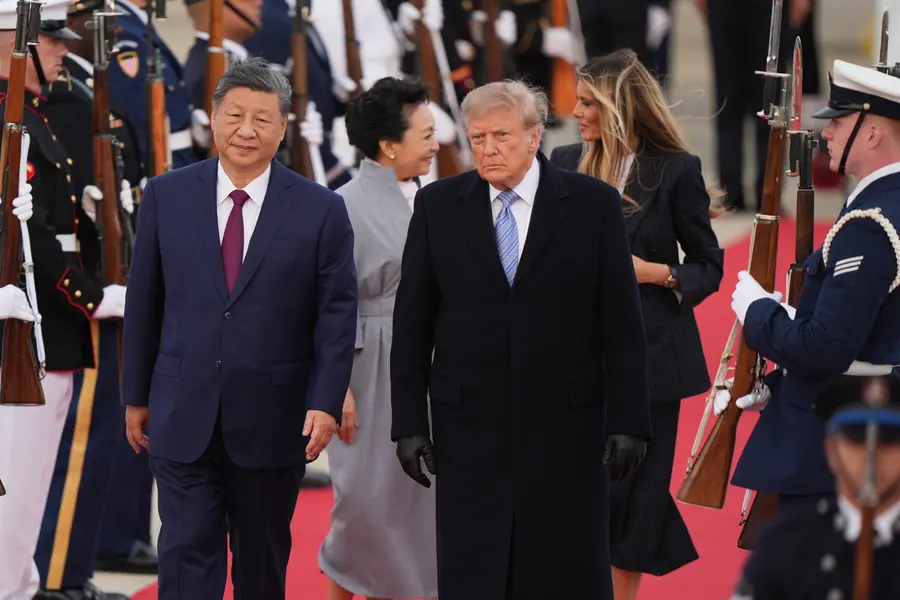
Washington DC: Chinese President Xi Jinping arrived in Washington on Wednesday for a three-day state visit, with US President Donald Trump giving him an unusually high-profile welcome at Joint Base Andrews in Maryland.
Trump and First Lady Melania Trump were at the military base to receive Xi and his wife, Peng Liyuan. The welcome included a military band, ceremonial cannon fire and other formalities. Trump’s decision to personally greet Xi at the airport was unusual, as US presidents rarely receive foreign leaders there.
Also Read

Xi and Trump exchanged handshakes and brief remarks before leaving the base separately. Their formal talks are scheduled for Thursday.
The visit comes at a sensitive time for relations between the US and China. The two countries continue to disagree over trade, technology, Taiwan and several global issues, while also trying to keep communication open.
Trade remains a key issue
Trade is expected to be one of the main topics during the talks. The US-China trade truce, which was due to expire on November 10, has reportedly been extended by two months until January 10, giving both sides more time to negotiate.
The two governments could also discuss targeted tariff agreements, efforts to tackle drug trafficking and stronger communication between their militaries.
Artificial intelligence is another possible area of discussion. Washington and Beijing are competing for a leading position in AI while also looking at ways to manage the risks created by rapidly developing technology.
Taiwan could be one of the toughest issues
Taiwan is expected to be among the most difficult subjects at the meeting.
China claims Taiwan as part of its territory, while Taiwan has its own government and operates separately from Beijing. The US has long maintained unofficial relations with Taiwan and provides it with military support.
Xi is expected to raise the issue of US arms sales to Taiwan and push Washington to reduce such support. The Trump administration approved an $11 billion arms package for Taiwan in December, while another package worth about $14 billion has remained on hold.
The US, meanwhile, is expected to maintain restrictions on the export of sensitive technology to China, making technology and national security another major point of discussion.
Iran adds another complication
Iran is also likely to come up during the talks.
China maintains close ties with Tehran and is the world's largest oil importer. Washington believes Beijing could use its influence to help ease tensions surrounding the conflict with Iran, although Trump has said he does not need China's help.
China has taken steps that have helped stabilise oil markets during the conflict, including reducing demand and releasing strategic oil reserves.
The US has also so far held back some secondary sanctions against major Chinese banks, despite earlier threats against countries continuing business with Iran.
A state visit filled with ceremony
Xi’s visit is not only about negotiations. The programme includes a formal state dinner at the White House, a military ceremony, jet flyovers and a visit to the National Archives.
Several major technology executives, including Apple CEO Tim Cook, Nvidia CEO Jensen Huang and OpenAI CEO Sam Altman, are expected to attend the state dinner.
The elaborate programme is also seen as a reciprocal gesture following Trump’s visit to China in May.
Despite the grand welcome and carefully planned ceremonies, the two leaders still face major differences.
Trump has argued that the US economy will strengthen over time, while Chinese President Xi has maintained that China is becoming stronger on the global stage. Their governments continue to compete over trade, technology and strategic influence.
The meeting also comes as Trump faces domestic pressure over rising energy prices and the war with Iran ahead of the November congressional elections. China, meanwhile, continues to deal with weak household spending and a prolonged property-market downturn despite strong foreign trade.
Trump and Xi could meet again later this year, potentially at the Asia-Pacific Economic Cooperation summit in China in November or the G20 meeting in the US in December.
Published: 24 Sept 2026, 06:25 am IST
ABOUT THE AUTHOR
Related Topics
Disclaimer: Kindly avoid objectionable, derogatory, unlawful and lewd comments, while responding to reports. Such comments are punishable under cyber laws. Please keep away from personal attacks. The opinions expressed here are the personal opinions of readers and not that of Mathrubhumi.