
The war has increasingly centred on control of the Strait of Hormuz, through which roughly one-fifth of the world's crude oil and natural gas normally passes.
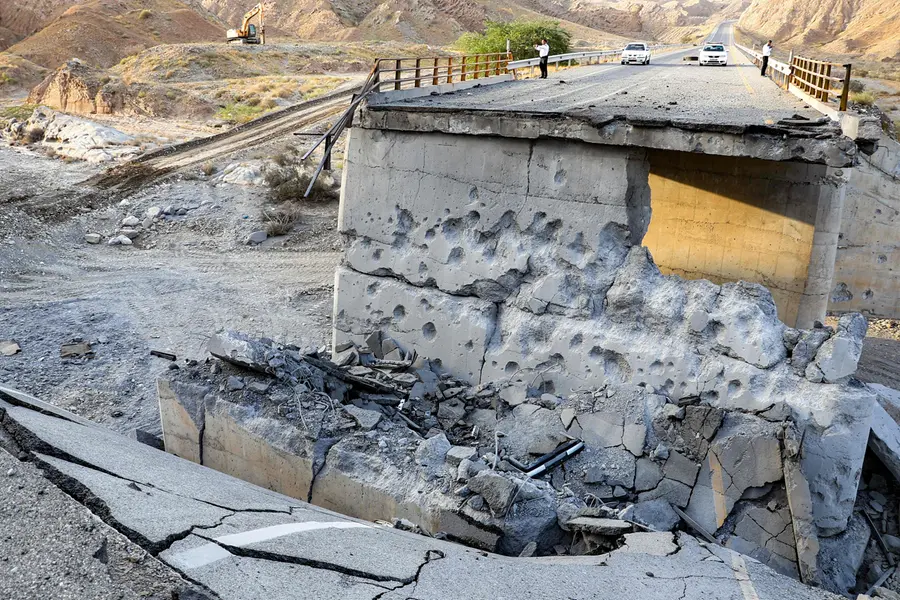
Dubai: The United States carried out an 11th consecutive night of airstrikes on Iran early Wednesday, with President Donald Trump declaring that Washington was "not finished" with its military campaign as the conflict widened across the Middle East, drawing Gulf states deeper into the confrontation and overshadowing diplomatic efforts to revive a collapsed ceasefire.
The US Central Command (CENTCOM) said the latest strikes targeted aircraft hangars, drone storage facilities and other military infrastructure aimed at further degrading Iran's ability to threaten commercial shipping through the Strait of Hormuz.
Also Read

Speaking from the Oval Office on Tuesday, Trump indicated that the military campaign would intensify.
"If we left right now, it would take Iran 20, 25 years to rebuild," he said. "We're not finished at all... we're not leaving right now."
Trump also revealed that the next target could be Pickaxe Mountain, an underground complex near Natanz that Western intelligence agencies suspect is linked to an undeclared uranium enrichment programme.
"We'll be hitting that area pretty soon, and very heavily," Trump said, adding that he would not normally announce military targets but "there's not a thing they can do about it."
Iran swiftly warned of retaliation. The Khatam Al-Anbiya military command said any strike on sensitive nuclear facilities would be considered a major escalation, with state broadcaster IRIB reporting that Tehran threatened attacks on "all the interests of America, the allies and supporters."
As US strikes continued, Iranian state television reported that air defence systems were activated around Tehran overnight.
Iran widens regional attacks
The conflict spread further across the Gulf as Bahrain, Kuwait and Jordan reported intercepting Iranian missiles and drones.
Iran's Revolutionary Guards confirmed launching an attack on Jordan, saying it targeted a facility in Rukban that allegedly housed US forces. The Iranian military also claimed to have struck American assets in Kuwait and Bahrain, including radar systems, air defence installations and administrative buildings.
The Guards warned that "the enemy should prepare for even more decisive and powerful waves of drone and missile attacks."
Kuwait's military said its air defences remained engaged against incoming Iranian drones, while sirens sounded repeatedly in Bahrain.
Shipping routes under pressure
The war has increasingly centred on control of the Strait of Hormuz, through which roughly one-fifth of the world's crude oil and natural gas normally passes.
Iran claimed two tankers transiting the waterway were hit by explosions that triggered massive fires, while the United Kingdom Maritime Trade Operations (UKMTO) reported that an "unknown projectile" struck a tanker off the coast of Oman, forcing the crew to abandon the vessel.
The Revolutionary Guards later claimed responsibility for attacks on multiple commercial ships.
Meanwhile, CENTCOM said US forces had redirected several commercial vessels to safer routes in an effort to maintain maritime traffic through the strategically vital waterway.
Houthis threaten Saudi ports
Adding another front to the conflict, Yemen's Iran-backed Houthi rebels threatened to impose a naval blockade on Saudi Arabia's ports.
Trump warned Washington would respond if the Houthis followed through.
"If something like that happens, we take care of it," Trump said. "We've done that with the Houthis before, and we haven't heard from them in a while since we did what we did originally."
Saudi Arabia condemned the threat, calling the Houthis a "terrorist militia."
Maritime intelligence firm Vanguard Tech reported that at least two oil tankers reversed course in the Red Sea after loading crude at Saudi Arabia's Yanbu port, highlighting growing concerns over shipping security.
Diplomacy struggles amid escalating war
Despite continued military operations, diplomatic efforts remained underway.
Iranian Interior Minister Eskandar Momeni travelled to Pakistan, which brokered last month's interim ceasefire agreement, holding talks with Pakistan's army chief Field Marshal Asim Munir and Prime Minister Shehbaz Sharif.
In a statement, Sharif urged all parties to de-escalate.
"Refrain from actions that could further destabilise the region."
However, Trump signalled little optimism about renewed negotiations.
"They want to desperately meet. And until they're ready to meet in a meaningful way, we have no interest in meeting."
Iranian Foreign Ministry spokesman Esmaeil Baqaei nevertheless said indirect diplomatic contacts with Washington through mediators were continuing.
War costs mount
US Defence Secretary Pete Hegseth told senators the conflict has now cost the United States $37.5 billion, significantly higher than previous estimates.
A US official also told The Associated Press that the number of American troops wounded during the conflict has risen to well over 500, exceeding the Pentagon's publicly available casualty figures due to reporting delays.
The escalating conflict has also rattled global energy markets, with international crude prices climbing above $92 a barrel, while average US gasoline prices reached about $4 a gallon amid concerns over prolonged disruptions to Gulf shipping routes.
Published: 22 Jul 2026, 07:35 am IST
Related Topics
Disclaimer: Kindly avoid objectionable, derogatory, unlawful and lewd comments, while responding to reports. Such comments are punishable under cyber laws. Please keep away from personal attacks. The opinions expressed here are the personal opinions of readers and not that of Mathrubhumi.