
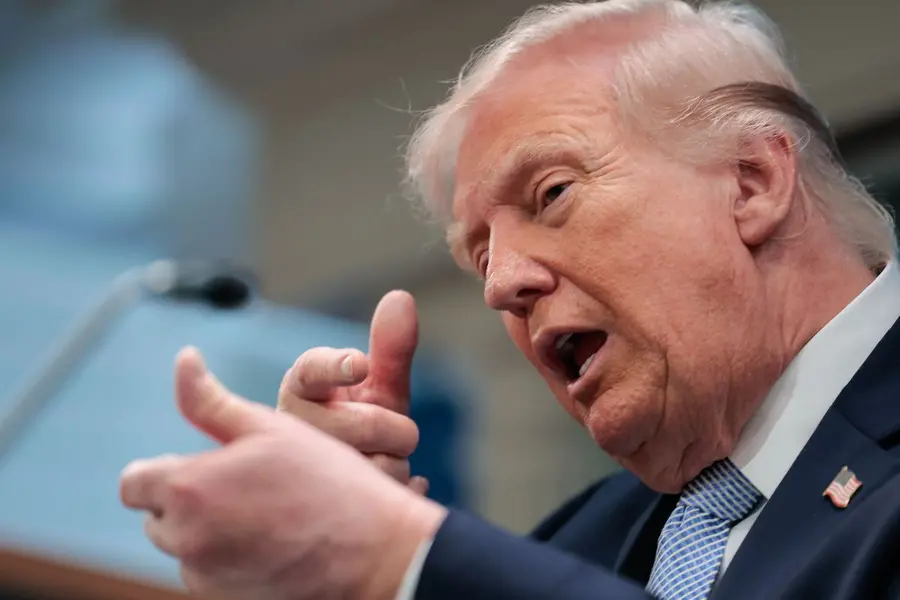
Washington: US President Donald Trump has warned that Iran would “no longer exist” if the United States is forced to resume military action, accusing Tehran of repeatedly violating a ceasefire agreement amid renewed hostilities in the Gulf.
In a post on Truth Social on Saturday, Trump announced fresh US strikes on Iranian military targets, saying they were carried out in response to alleged breaches of the ceasefire.
Also Read

“United States aircraft just struck Iranian missile and drone storage locations, and coastal radar sites, for violating the Cease Fire Agreement, AGAIN!” Trump wrote.
He added: “There may come a point when we are no longer able to be reasonable, and will be forced to militarily complete the job that we very successfully started. If that happens, the Islamic Republic of Iran will no longer exist!”
The latest exchange has further strained negotiations aimed at ending the conflict launched by the United States and Israel in late February, while raising concerns over security in the strategically vital Strait of Hormuz.
According to US Central Command, Saturday’s strikes targeted “surveillance infrastructure, communication systems, air defence sites, drone storage facilities, and minelayer capabilities” in response to an Iranian drone attack on the Panama-flagged oil tanker *Kiku*, which was carrying around two million barrels of crude oil.
Iranian media reported explosions in the Sirik and Qeshm regions in southern Iran following the strikes.
The US had also carried out military action on Friday, saying it was responding to another Iranian attack on the merchant vessel *Ever Lovely*.
Iran, meanwhile, claimed it had retaliated by striking US targets in the Gulf. Bahrain said several Iranian drones targeted the country early on Saturday and accused Tehran of “sabotaging peace efforts”.
Iran’s Revolutionary Guards warned that “if the aggression is repeated, our response will be broader”.
Tehran condemned the US military action, calling “these brutal attacks... a blatant violation” of the interim ceasefire agreement.
Strait of Hormuz tensions persist
The renewed violence has once again placed the Strait of Hormuz at the centre of regional tensions. Iran has warned ships against transiting the waterway without its authorisation, although commercial traffic has continued, with some vessels reportedly using routes not approved by Tehran.
H.A. Hellyer, a researcher at the Royal United Services Institute in London, said Iran was likely to continue “calibrated, low-level coercive activity in and around the Strait of Hormuz... to create persistent pressure on international shipping without triggering a wider conflict”.
He added that the approaching US midterm elections gave Washington “incentives for a quicker agreement”, while for Iran “a drawn-out negotiation accompanied by controlled pressure in the strait can work to its advantage”.
Despite the flare-up, global oil prices have declined on expectations that shipping through the Strait of Hormuz, which handles roughly a fifth of the world's oil and liquefied natural gas exports, will continue.
Iran’s official statistics agency also reported that annual inflation had surged to 88.6 per cent, up sharply from 68 per cent in February.
Lebanon conflict complicates peace efforts
The regional crisis has also spilled into Lebanon, where Israel carried out fresh airstrikes on Saturday despite a US-backed agreement signed a day earlier aimed at securing long-term peace.
Hezbollah leader Naim Qassem rejected the deal, describing it as “humiliating, shameful and a surrender of sovereignty”. He instead called for full implementation of Washington’s agreement with Tehran, including an end to fighting in Lebanon.
Israeli Prime Minister Benjamin Netanyahu hailed the agreement as historic, calling it “a blow to Iran and Hezbollah”. However, his far-right National Security Minister Itamar Ben Gvir criticised the deal as “a big mistake”, insisting that only Israeli forces could disarm Hezbollah.
The Israeli military confirmed it had struck suspected militant targets in southern Lebanon on Saturday, marking its first attack since the agreement was announced. Lebanon’s National News Agency later reported additional Israeli strikes, while the country's health ministry said at least one person was killed and two others injured in an airstrike on Nabatieh al-Fawqa.
Published: 28 Jun 2026, 06:37 am IST
Related Topics
Disclaimer: Kindly avoid objectionable, derogatory, unlawful and lewd comments, while responding to reports. Such comments are punishable under cyber laws. Please keep away from personal attacks. The opinions expressed here are the personal opinions of readers and not that of Mathrubhumi.