
Iran has never published the price of a Kheibar Shekan, but analysts believe it costs far less than the interceptor that must stop it
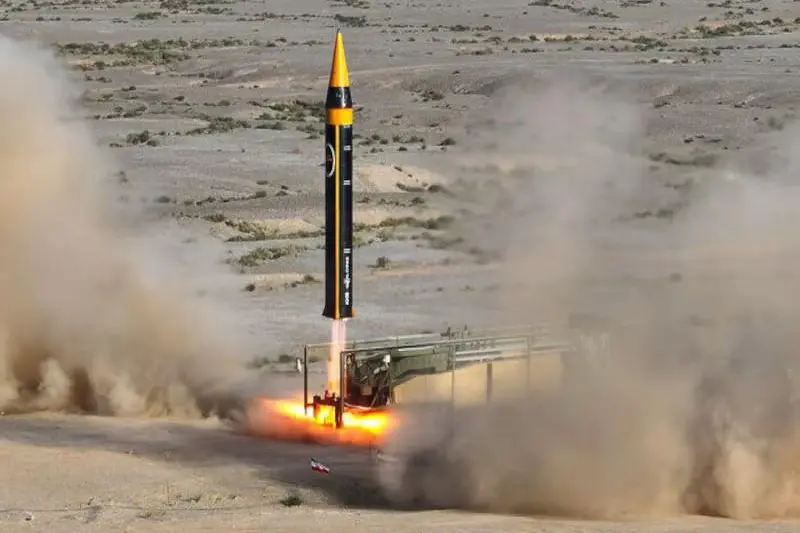
Picture a rocket that climbs almost to the edge of space, then releases a warhead that comes screaming back to earth, twisting and turning like a fighter plane while falling at thousands of kilometres an hour. That one picture explains why Iran's Kheibar Shekan missile has become such a headache for air-defence engineers.
The Kheibar Shekan, sometimes written Kheybar Shekan, is a medium-range ballistic missile that Iran first showed publicly in 2022. Its name comes from a famous seventh-century battle. Iran says the missile has been designed and built entirely at home.
It runs on solid fuel, travels about 1,450 kilometres, roughly 900 miles, and carries a warhead weighing around 500 to 550 kilograms. It is also much lighter than Iran's older missiles, nearly one-third the weight of some earlier models, so more fit inside underground tunnels and can be rolled out faster.
Also read | Trump says Iran faces 'last chance before decapitation' as talks continue
To see what makes it special, look at the missile's nose. A ballistic missile does not fly like an aeroplane from start to finish. It is thrown up on a high arc, goes near or beyond the edge of the atmosphere, then falls to its target. The front portion that carries the explosive is called the re-entry vehicle, or RV. This part must survive terrible heat and speed while coming back into the thick air, and still land where it was aimed.
In most older missiles, this re-entry vehicle behaves like a stone thrown across a field. Its path is fixed by physics, so anyone with a good radar and a fast computer can work out where it will land. Defenders then send an interceptor to that spot. The Kheibar Shekan breaks this comfortable arrangement. Its re-entry vehicle is built to steer itself during the last stage of the fall. Engineers call such a warhead a manoeuvrable re-entry vehicle, or MaRV.
Iran has given this warhead section a shape known as a tri-conic design. Think of a cone with extra steps or shoulders along its body instead of one smooth slope. This shape helps the warhead stay steady while changing direction at great speed. Larger movable fins, or control surfaces, are fitted to the re-entry vehicle, and these allow it to bend its path after re-entry.
Also read | ‘We will neither be surprised nor remain passive’: Iran responds to US military threats
Some reports suggest certain versions carry tiny thrusters in the nose, giving the warhead a final nudge in the closing seconds. Estimates of its speed at impact range from Mach 2 to Mach 3. Mach is simply a way of counting speed against sound: Mach 1 is the speed of sound itself, roughly 1,200 kilometres an hour near the ground. So this warhead arrives two to three times faster than sound travels. The result is a warhead that does not fall in a neat line. It can shift sideways, zigzag, and refuse to be where the interceptor expects.
Solid fuel adds another advantage. Liquid-fuel missiles must be filled just before launch, which takes time and leaves them exposed. A solid-fuel missile sits ready on a mobile truck for months. It can be fired within minutes, and the launcher can drive away and hide before enemy drones arrive.
This matters because modern air-defence systems such as the American Patriot and THAAD, or Israel's Arrow, work by tracking a missile's path and meeting it in the air. When the warhead makes sharp turns in the final minutes or seconds, the interceptor has very little time and spare energy left to correct itself. Iran has been testing different speeds, flight paths and manoeuvres to confuse these systems.
Reports from 2026 note the Kheibar Shekan has been used in attacks across the Middle East. Most were shot down, but a few managed to get through. There is also evidence that similar technology has reached Houthi fighters in Yemen, and photographs released by intelligence agencies show missiles that look almost identical.
Money is the quiet part of this story. Iran has never published the price of a Kheibar Shekan, but analysts believe it costs far less than the interceptor that must stop it. A single Patriot or THAAD interceptor can cost between two and fifteen million US dollars. Before the recent fighting, Iran was believed to hold thousands of medium-range ballistic missiles, plus shorter-range missiles, cruise missiles and space rockets fit for military use. Defending against many cheap, twisting missiles becomes painfully expensive.
The Kheibar Shekan is not a true hypersonic glide vehicle, whatever strong words are used about it. Its real strength lies in the mixture: quick-launching solid fuel, a lighter body, and above all a warhead that steers itself in the final moments.
The lesson is simple. Missiles are no longer fire-and-forget objects following a fixed path. Designers are now placing brains and agility inside the warhead itself, and the ability to dodge after re-entry will remain one of the toughest challenges for defenders.
The author is a defence, aerospace & geopolitical analyst.
Published: 06 Aug 2026, 11:55 am IST
Related Topics
Disclaimer: Kindly avoid objectionable, derogatory, unlawful and lewd comments, while responding to reports. Such comments are punishable under cyber laws. Please keep away from personal attacks. The opinions expressed here are the personal opinions of readers and not that of Mathrubhumi.
