
Dhaka violence erupts after Sharif Osman Hadi’s killing, reviving protests and deepening Bangladesh’s anti-India sentiment.
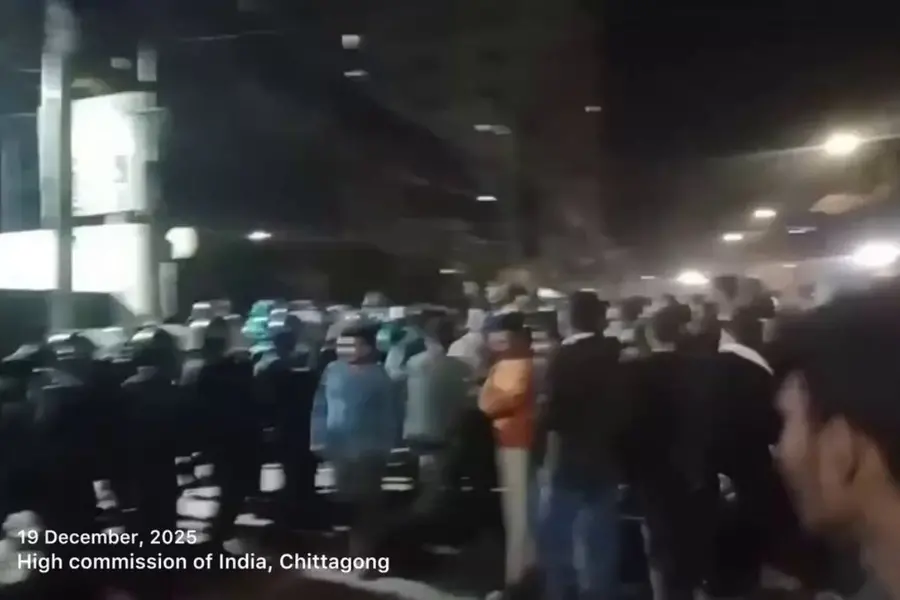
Violence erupted across Dhaka following the death of 32-year-old Sharif Osman Hadi, a key youth leader of Bangladesh’s 2024 pro-democracy uprising. Shot by masked assailants outside a mosque on December 12, Hadi succumbed to injuries in a Singapore hospital. Thousands of protesters flooded the streets, demanding justice, and several buildings—including those housing the nation’s largest newspapers, Daily Star and Prothom Alo—were set ablaze.
Reporters were trapped amid the chaos, with one describing choking on smoke while hearing protesters chanting slogans outside. The house of India’s deputy ambassador was also surrounded during a sit-in, prompting police to fire tear gas to disperse the crowd. The unrest spread to Chittagong and cultural hubs in Dhaka, reflecting the intensity of public anger.
A history of alliance and unease
India’s role in Bangladesh’s 1971 liberation was decisive, sheltering nearly 10 million refugees and engaging militarily to end Pakistan’s regime. Yet, anti-India sentiment has steadily grown, fueled by political dynamics, economic imbalances, and perceived overreach.
Migration and border tensions remain flashpoints, with Indian policies like the Citizenship Amendment Act and National Register of Citizens viewed in Bangladesh as exclusionary. Water disputes, notably over the Teesta River and the Farakka Barrage, amplify perceptions of inequality. Economic trade, while deepening interdependence, is uneven—Bangladesh exported $1.76 billion to India in FY2024–25 but imported $9 billion—highlighting structural disparities that feed public scepticism.
Politics, perception, and protest
The fall of Prime Minister Sheikh Hasina in August 2024, her refuge in India, and the interim government’s rollback of India-linked projects intensified nationalist and anti-India sentiment. Demonstrations often carried slogans questioning Dhaka’s autonomy versus Delhi’s influence. Yet trade and industrial links remain robust: land and sea routes, energy supply, and shared industrial needs keep India central to Bangladesh’s economy despite political friction.
A generation shaping the narrative
For Bangladesh’s youth, scepticism toward India is often experiential, shaped by political transitions, border incidents, and perceived interference. Admiration for India’s culture and achievements persists, but what many seek today is parity, respect, and a bilateral relationship that honours both nations’ sovereignty and shared history.
Published: 19 Dec 2025, 08:41 am IST
Related Topics
Disclaimer: Kindly avoid objectionable, derogatory, unlawful and lewd comments, while responding to reports. Such comments are punishable under cyber laws. Please keep away from personal attacks. The opinions expressed here are the personal opinions of readers and not that of Mathrubhumi.
