
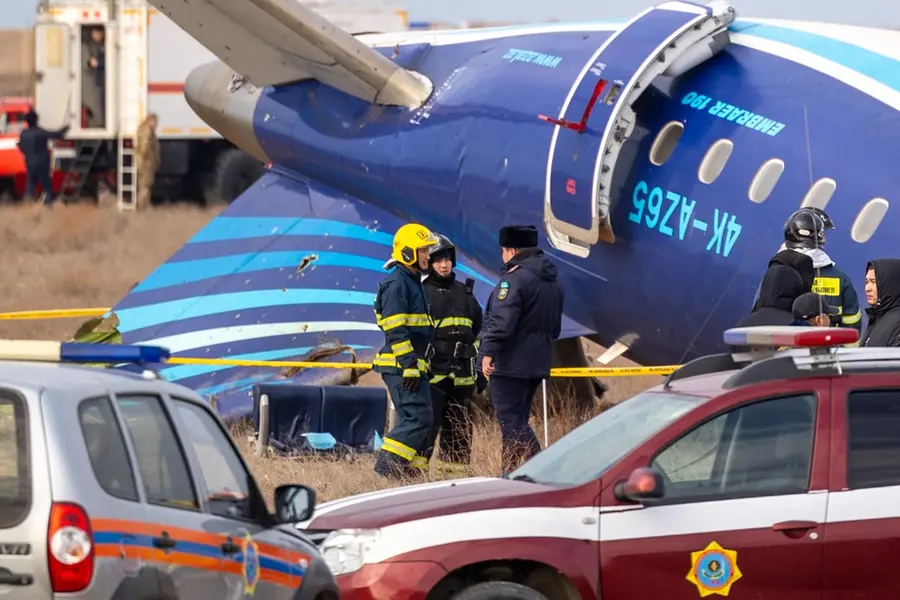
Moscow: A US official indicated on Friday that Russian air defense systems could have been responsible for downing an Azerbaijani airliner earlier this week. This followed a statement from Azerbaijan’s Digital Development and Transportation Minister, Rashan Nabiyev, who suggested the plane was hit by a weapon, based on expert analysis and testimony from survivors.
Both officials’ assessments aligned with those of independent aviation experts, who have pointed to Russian air defense systems reacting to a Ukrainian attack as a possible cause of the crash. These remarks have increased pressure on Russia, where local officials acknowledged a drone attack in the vicinity of the crash site but did not directly address the claims regarding air defense systems.
Also Read

White House National Security Spokesman John Kirby stated that the US had "seen some early indications" suggesting the possibility that Russian air defense systems brought down the jet. However, Kirby did not offer further details, citing an ongoing investigation into the crash. When asked whether the US intelligence played a role in this conclusion, Kirby confirmed the suggestion but refrained from providing specifics, stating, “I’ll leave it at that.”
Timeline of the tragedy
The crash occurred on Wednesday when an Azerbaijani Airlines flight was en route from Baku, Azerbaijan, to Grozny, the capital of the Russian republic of Chechnya. While attempting to land, the aircraft diverted toward Kazakhstan and crashed, killing 38 people and leaving 29 others injured.
Azerbaijan’s Minister Nabiyev revealed that preliminary conclusions from experts and eyewitness accounts suggest an "external impact" caused the crash. He added that the type of weapon used would be determined during the investigation.
Survivors of the crash provided conflicting accounts that point to external impacts as the cause. Flight attendant Aydan Rahimli shared that the oxygen masks deployed after a loud noise, and moments later, another bang was heard. She assisted a colleague, Zulfugar Asadov, before hearing another explosion-like sound. Asadov described a sudden injury to his arm, which he likened to a deep wound caused by an external strike, dismissing the claim that the injury was caused by an internal oxygen canister explosion.
Two other survivors reported hearing explosions before the crash. Jerova Salihat recalled hearing an explosion near her leg, while Vafa Shabanova described two explosions in the sky before the plane went down.
Russia’s position and ongoing investigations
Dmitry Yadrov, the head of Russia's civil aviation authority Rosaviatsia, confirmed that Ukrainian drones were targeting Grozny as the plane attempted to land. Authorities had to close the airspace for safety reasons. Yadrov suggested that after two failed landing attempts, the captain redirected the flight toward Kazakhstan.
However, Yadrov did not address the suggestion from aviation experts that the damage to the plane’s tail might have been caused by Russian air defense systems. Russian forces have previously encountered Ukrainian drones in the North Caucasus region.
Azerbaijan Airlines attributed the crash to "physical and technical interference" but did not elaborate on the source of the interference. The airline temporarily suspended flights to several Russian airports. Following the incident, it was revealed that the company would continue operations to six Russian cities, including Moscow and St. Petersburg, despite the ongoing threat of Ukrainian drone attacks in these areas.
In response to safety concerns, several international carriers also adjusted their flight schedules. Kazakhstan's Qazaq Air announced a suspension of flights from Astana to Yekaterinburg, Russia, while FlyDubai halted service to Sochi and Mineralnye Vody in southern Russia for several days. Additionally, Israel's El Al suspended flights between Tel Aviv and Moscow, citing security concerns in Russian airspace.
Legal precedent: Previous incidents involving Russian air defense
If investigations confirm that the crash was caused by Russian air defense systems, it would mark the second deadly civil aviation incident linked to the ongoing conflict in Ukraine. The downing of Malaysia Airlines Flight 17 in 2014, which killed 298 people, was attributed to a Russian surface-to-air missile. Although Russia denied responsibility, a Dutch court in 2022 convicted three individuals for their involvement in the incident, including two Russians and a pro-Russian Ukrainian.
Azerbaijani officials are working in Grozny as part of the investigation into the crash. The Azerbaijani Prosecutor General's office confirmed the collaboration. Meanwhile, Russian officials have refrained from commenting on claims of Russian air defense involvement, stating that the investigation must determine the cause of the crash.
Kremlin spokesperson Dmitry Peskov emphasized that the investigation must reach its conclusions before any definitive statements are made, underscoring the need for careful review.
Agency
Published: 28 Dec 2024, 07:47 am IST
Related Topics
Disclaimer: Kindly avoid objectionable, derogatory, unlawful and lewd comments, while responding to reports. Such comments are punishable under cyber laws. Please keep away from personal attacks. The opinions expressed here are the personal opinions of readers and not that of Mathrubhumi.