
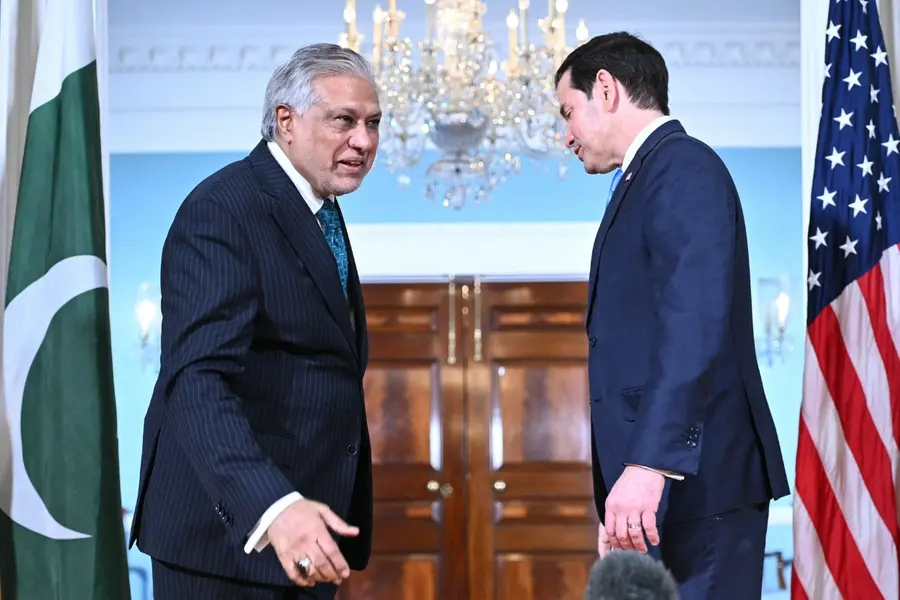
Pakistan Foreign Minister Ishaq Dar and US Secretary of State Marco Rubio left a meeting in Washington without responding to a reporter's question on whether Pakistan would recognise Israel, a topic that has gained renewed attention after Donald Trump urged several Muslim-majority nations to join the Abraham Accords.
Islamabad: A brief but pointed exchange during a high-level meeting in Washington has once again brought Pakistan's long-standing position on Israel into focus.
Pakistan Foreign Minister and Deputy Prime Minister Ishaq Dar and US Secretary of State Marco Rubio were leaving a meeting on Friday when a reporter shouted a question that neither official chose to answer.
Also Read

"Will Pakistan recognise Israel?" the journalist asked as the two leaders walked away.
The question came amid renewed international discussion over diplomatic recognition of Israel following recent remarks by US President Donald Trump.
What happened at the meeting?
The interaction occurred during talks between Dar and Rubio in Washington, where both sides discussed regional developments and diplomatic issues.
As the officials exited, a reporter from The Pakistan Daily raised the question regarding Pakistan's willingness to establish diplomatic relations with Israel.
Neither Dar nor Rubio responded publicly, and the query remained unanswered.
However, the incident quickly attracted attention because it touched on one of Pakistan's most sensitive foreign policy positions.
Pakistan does not formally recognise Israel and has no diplomatic relations with the country.
Islamabad has historically linked any change in its position to the creation of an independent Palestinian state and a resolution of the broader Israeli-Palestinian conflict.
Speaking to reporters later, Dar reiterated Pakistan's long-standing stance.
According to Pakistani media reports, he stated that Pakistan remains committed to supporting the Palestinian cause and that Israel must move towards the establishment of a Palestinian state before Islamabad could consider revising its policy.
Trump's push for Abraham Accords expansion
The issue resurfaced after Trump reportedly urged several Muslim-majority countries to join the Abraham Accords as part of wider diplomatic efforts linked to the ongoing tensions involving Iran.
Trump said he had encouraged countries including Pakistan, Saudi Arabia, Qatar, Turkey, Egypt and Jordan to normalise relations with Israel.
Pakistan subsequently rejected the proposal, while several other countries mentioned by Trump have not publicly commented on the suggestion.
What are the Abraham Accords?
The Abraham Accords were brokered by the United States during Trump's first term in office.
The agreements aimed to normalise diplomatic, economic and security relations between Israel and Arab nations.
Under the accords, the United Arab Emirates, Bahrain and Morocco established formal diplomatic relations with Israel.
Sudan also agreed to participate in the process, although full diplomatic normalisation has not yet been completed.
The accords were widely viewed as a significant shift in Middle Eastern diplomacy because they enabled Arab states to establish ties with Israel without waiting for a final Israeli-Palestinian peace settlement.
Pakistan's role in regional diplomacy
The question about Israel comes at a time when Pakistan has been attempting to present itself as a mediator in wider regional tensions involving Iran and the United States.
Much of Islamabad's recent diplomatic outreach has been led by Asim Munir, who has engaged with regional and international stakeholders amid efforts to reduce tensions in West Asia.
However, despite its diplomatic initiatives, Pakistan continues to maintain that support for Palestinian statehood remains central to its foreign policy.
Although no direct answer was given at the Washington meeting, the exchange highlighted growing international interest in whether Pakistan could eventually reconsider its position on Israel.
For now, Islamabad's public stance remains unchanged. Pakistani leaders continue to insist that recognition of Israel would require meaningful progress towards an independent Palestinian state and a broader resolution to the conflict in the region.
With Trump pushing for an expansion of the Abraham Accords and diplomatic realignments continuing across the Middle East, questions about Pakistan's future policy towards Israel are likely to remain under scrutiny.
Published: 30 May 2026, 09:42 am IST
Disclaimer: Kindly avoid objectionable, derogatory, unlawful and lewd comments, while responding to reports. Such comments are punishable under cyber laws. Please keep away from personal attacks. The opinions expressed here are the personal opinions of readers and not that of Mathrubhumi.