
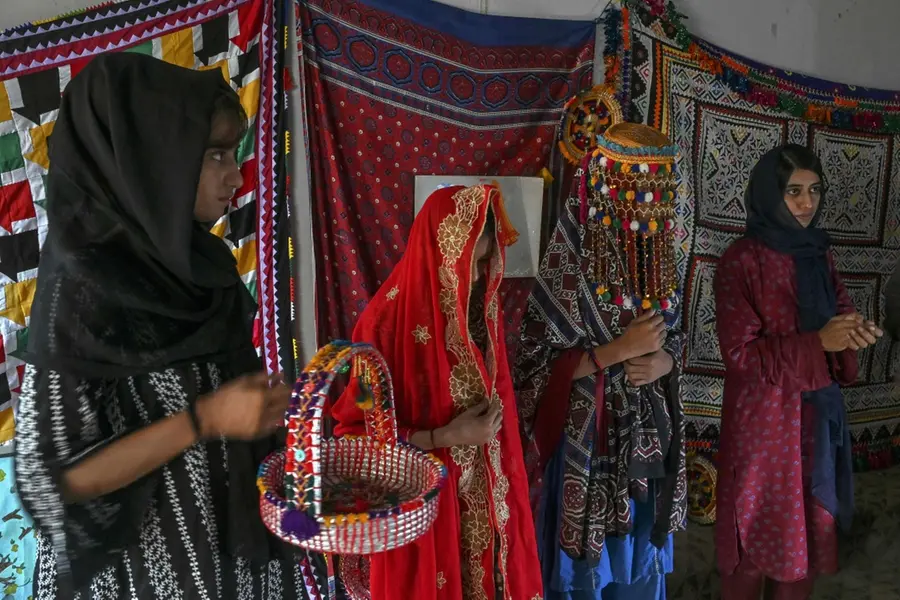
Dadu: As monsoon rains approached Pakistan, 14-year-old Shamila and her 13-year-old sister Amina were married off in exchange for money. Their parents made this decision to help their family cope with the threat of flooding.
"I was happy to hear I was getting married... I thought my life would become easier," said Shamila after her wedding to a man twice her age in hope of a more prosperous life.
Also Read

"But I have nothing more. And with the rain, I fear I will have even less, if that is possible."
While Pakistan had seen a decline in child marriages in recent years, this trend is reversing due to the economic strain caused by extreme weather. Rights activists warn that child marriages are increasing as families face financial hardship from climate-induced disasters.
The summer monsoon, crucial for farmers and food security, is becoming more severe due to climate change, leading to heavier rains, floods, and crop damage. The 2022 floods devastated large parts of Pakistan, submerging a third of the country, displacing millions, and destroying crops. Many villages, especially in Sindh, are still struggling to recover.
"This has led to a new trend of 'monsoon brides'," said Mashooque Birhmani, the founder of the NGO Sujag Sansar, which works with religious scholars to combat child marriage.
"Families will find any means of survival. The first and most obvious way is to give their daughters away in marriage in exchange for money."
In Dadu district, one of the hardest-hit areas, there has been a significant rise in child marriages since the floods. In Khan Mohammad Mallah village, where Shamila and Amina were married in June, 45 underage girls have been married off since last year. Parents often hurry these marriages to escape poverty, frequently in exchange for money. "Before the 2022 rains, there was no such need to get girls married so young in our area," said village elder Mai Hajani, 65.
"They would work on the land, make rope for wooden beds, the men would be busy with fishing and agriculture. There was always work to be done".
Shamila's family received 200,000 Pakistani Rupees (about $720) for her marriage, a substantial amount in a region where many families live on less than a dollar a day.
Najma Ali, who married at 14 in 2022, initially felt excited about her new life but now faces bleak conditions. "My husband gave my parents 250,000 rupees for our wedding. But it was on loan (from a third party) that he has no way of paying back now," she said.
"I thought I would get lipstick, makeup, clothes and crockery," she told AFP, cradling her six-month-old baby.
"Now I am back home with a husband and a baby because we have nothing to eat."
Her village, situated along a polluted canal, is desolate with no fish and a pervasive stench.
"We had lush rice fields where girls used to work," said Hakim Zaadi, 58, the village matron and Najma's mother.
"They would grow many vegetables, which are all dead now because the water in the ground is poisonous. This has happened especially after 2022," she added.
"The girls were not a burden on us before then. At the age girls used to get married, they now have five children, and they come back to live with their parents because their husbands are jobless."
Pakistan has one of the highest rates of child marriages globally, with the legal marriage age varying from 16 to 18, though enforcement is lax. UNICEF reports progress in reducing child marriages, but extreme weather events continue to put girls at risk.
"We would expect to see an 18 percent increase in the prevalence of child marriage, equivalent to erasing five years of progress," it said in a report after the 2022 floods.
Dildar Ali Sheikh, 31, considered marrying off his daughter Mehtab while living in an aid camp after the floods. "When I was there, I thought to myself 'we should get our daughter married so at least she can eat and have basic facilities'," the daily wage labourer told AFP.
With Mehtab only 10 years old, he hoped marriage would provide her with basic needs. "The night I decided to get her married, I couldn't sleep," said her mother, Sumbal Ali Sheikh, who was 18 when she married.
Thanks to the NGO Sujag Sansar, the marriage was postponed, and Mehtab was enrolled in a sewing workshop to support herself while continuing her education. However, as the monsoon rains approach, Mehtab fears her wedding might still be imminent.
"I have told my father I want to study," she said. "I see married girls around me who have very challenging lives and I don't want this for myself."
Agency
Published: 21 Aug 2024, 12:47 pm IST
Related Topics
Subscribe to our Newsletter
Disclaimer: Kindly avoid objectionable, derogatory, unlawful and lewd comments, while responding to reports. Such comments are punishable under cyber laws. Please keep away from personal attacks. The opinions expressed here are the personal opinions of readers and not that of Mathrubhumi.