
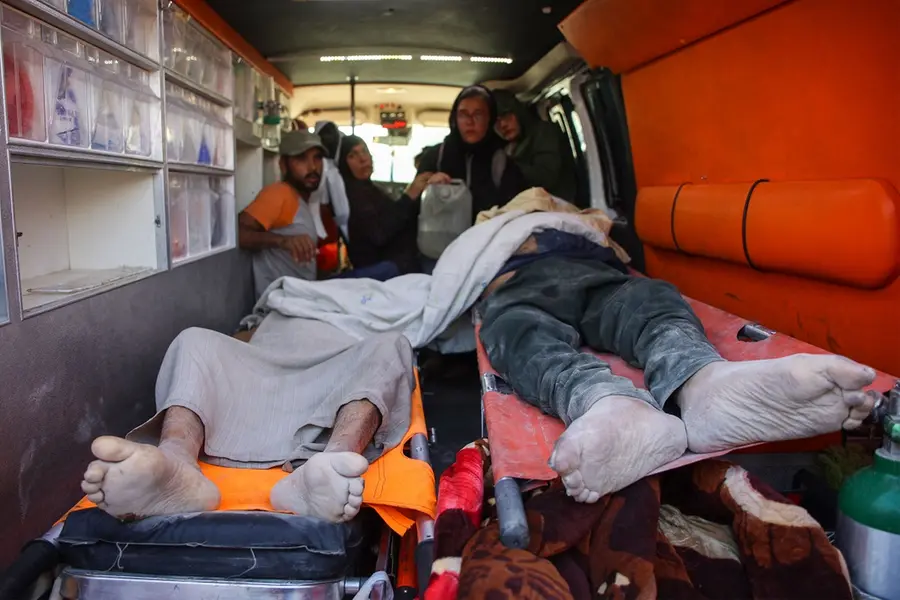
Gaza Strip: An Israeli airstrike in northern Gaza killed at least 20 people, predominantly women and children, Palestinian officials reported on Tuesday. The attack comes as many Palestinians flee Israel's ongoing assault, with reports of widespread hunger due to aid being cut off for weeks in the most isolated and heavily devastated areas of the territory.
Ongoing Offensive
Israel has been conducting a sustained offensive in the northern region of Gaza, asserting that its military targets Hamas militants who have regrouped in the area. The U.N. has indicated that Israel has not permitted food or other supplies into the territory north of Gaza City since the assault began, even as tens of thousands remain trapped there. This situation has prompted rebukes from the Biden administration, which has warned that U.S. laws may require it to restrict military aid to Israel if more humanitarian assistance is not allowed.
Casualties and Conditions
The airstrike late on Monday struck a home in Beit Lahiya where several displaced families were seeking refuge, according to Hossam Abu Safiya, director of the Kamal Adwan Hospital, which is barely operational following recent raids. The Israeli military contended that it targeted a weapons storage facility used by militants, asserting that "numerous steps were taken to mitigate the risk of harming civilians."
The fatalities included eight women and six children, as reported by the Gaza Health Ministry’s emergency service. Additionally, separate strikes in other parts of Gaza on Tuesday claimed another ten lives, according to health officials.
Humanitarian Crisis
As the bombardment continued, dozens of Palestinians emerged from Beit Lahiya on Tuesday—mainly women and children—carrying rucksacks filled with their few belongings. Many entered Gaza City, where they encountered streets lined with flattened and heavily damaged buildings.
“We came barefoot. We have no sandals, no clothes, nothing. We have no money. There is no food or drink,” lamented Huda Abu Laila, an elderly woman. “We are hungry. Hunger has killed us. We were under siege for one month without water or food,” she added, breaking into tears.
Um Nidal Abu Laila, another woman fleeing the area, reported that bodies of Palestinians killed in the assault remained in the streets, stating, “No one is able to retrieve them.”
Rescue Efforts Impeded
Gaza’s civil defense agency reported that it had received distress calls regarding individuals trapped alive under the rubble of buildings destroyed by Israeli forces in Beit Lahiya. However, it has been unable to send rescue teams due to military restrictions in the area for the past two weeks. The Palestinian Health Ministry noted that there are currently no operational ambulances north of Gaza City.
Tragically, two elderly patients, one suffering from cancer, died while attempting to leave Beit Lahiya as they waited to cross an Israeli military checkpoint, according to the Palestinian Red Crescent.
Displacement and Military Orders
The Israeli military has ordered the complete evacuation of Beit Lahiya, Beit Hanoun, and the Jabaliya refugee camp. Despite the evacuation orders, the U.N. estimated last week that around 100,000 people remain in these areas, even after tens of thousands have fled in the last month. Approximately 90% of Gaza's 2.3 million residents have been displaced during the ongoing conflict, often multiple times.
The Israeli army has frequently returned to various locations in Gaza following earlier operations, as Hamas continues to execute hit-and-run attacks on troops and sporadically launches rockets into Israel.
Hospital Accessibility and Allegations
The three hospitals in the area have remained largely inaccessible due to the fighting, and ambulance services have come to a halt. Israeli forces raided the Kamal Adwan Hospital last month, alleging that Hamas militants were sheltering there—an assertion denied by Palestinian health officials.
The offensive has heightened concerns among Palestinians that Israel may be enacting a "surrender-or-starve" strategy for northern Gaza, as proposed by former generals. This plan would involve ordering civilians to evacuate, cutting off aid, and classifying anyone remaining as a combatant.
Although the Israeli military has denied receiving any such orders, the government has not clarified whether it is adopting any part of the proposed plan.
Continued Strikes
On Tuesday, an Israeli strike hit a house in the Tufah neighbourhood of Gaza City, resulting in the deaths of two children and their parents, with two other children wounded, according to the Health Ministry’s emergency service. In Zuweida, a strike targeted a tent where a displaced family was sheltering, killing four individuals, including a mother and her two children. Another strike in Deir al-Balah resulted in two additional fatalities, as confirmed by the local hospital. An Associated Press journalist observed the bodies at the hospital morgue.
The Israeli military maintains that its operations exclusively target militants, accusing them of hiding among civilians. However, it rarely comments on individual strikes, which often result in civilian casualties, particularly among women and children.
Background of the Conflict
The current conflict erupted when Hamas-led militants attacked southern Israel on October 7, 2023, resulting in approximately 1,200 deaths, predominantly civilians, and the abduction of around 250 individuals, with about 100 captives still believed to be inside Gaza—one-third of whom are presumed dead. Since then, Israel's retaliatory actions have reportedly resulted in over 43,000 Palestinian deaths, according to the Gaza Health Ministry, which does not differentiate between civilians and combatants but asserts that over half of the deceased were women and children.
AP
Published: 05 Nov 2024, 11:25 pm IST
Related Topics
Disclaimer: Kindly avoid objectionable, derogatory, unlawful and lewd comments, while responding to reports. Such comments are punishable under cyber laws. Please keep away from personal attacks. The opinions expressed here are the personal opinions of readers and not that of Mathrubhumi.
