
Greg Bovino’s long green overcoat is drawing scrutiny as its military styling reignites debate over the growing militarisation of US immigration enforcement.
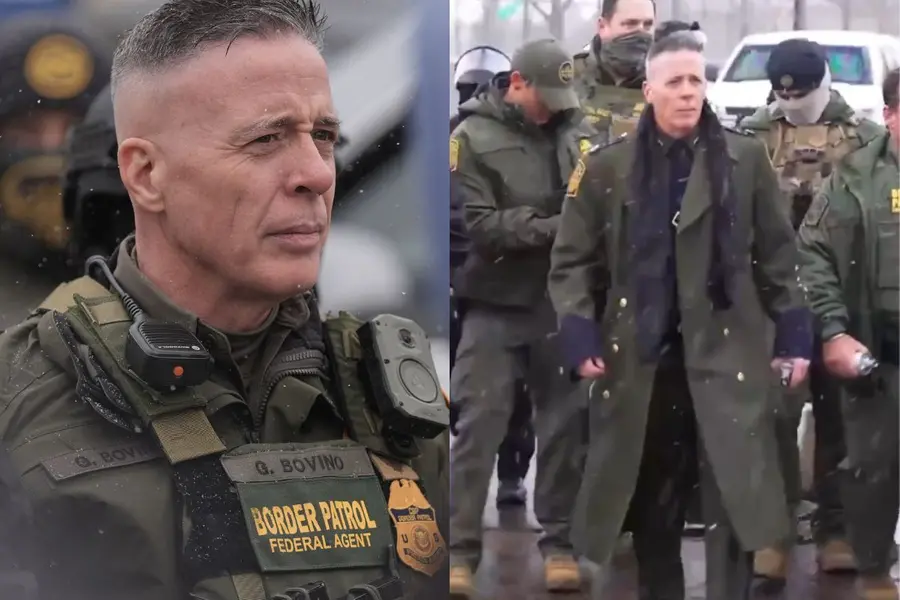
After the removal of US Border Patrol Chief Greg Bovino and the appointment of Border Czar Tom Homan by president Trump, images of Bovino circulating widely online have reignited debate over the symbolism of his attire and the increasingly militarised posture of federal immigration enforcement. Photographs of Bovino moving through snowy Minneapolis streets – flanked by helmeted federal agents and shouting orders at demonstrators – pushed the long olive-green overcoat he sometimes wears into the spotlight.
Critics on social media disparaged the garment as a “Nazi cosplay coat,” while a press account for California Governor Gavin Newsom described it as “Nazi-coded.” The comparison has gained traction amid heightened scrutiny of federal operations in Minneapolis, where officers have faced accusations of excessive force, including the fatal shooting of Renée Nicole Good and Alex Pretti.
Gregory Bovino has pushed back forcefully on the criticism, insisting the coat is a decades-old Border Patrol item he purchased long before his rise to national prominence. “I bought that as a young agent, approximately 1999,” he told News Nation, adding that he had worn it previously, including during a ceremony under the Biden administration.
A military garment with a long global history
While observers have linked the coat’s silhouette to German military attire, fashion historians and military scholars note that the garment belongs to a much broader tradition. The coat’s double-breasted construction, metal buttons and wide Ulster collar evoke the 19th-century “greatcoat,” a style used across European and American armies. Although similar coats were worn by officers in the Nazi-era Kriegsmarine, comparable versions were also part of Allied uniforms during the Second World War. Joseph Stalin famously donned one during the 1945 Yalta Conference.
The greatcoat’s design—like the trench coat, field shirt and combat boot—forms part of a shared military visual language that predates fascism and appears today in civilian cultural references. In the BBC series Doctor Who, for example, the Doctor is often styled in a greatcoat paired with a persona overtly opposed to authoritarianism.
Why the coat struck a nerve
Even if critics seized on the wrong historical precedent, experts argue the unease reflects broader concerns about the militarisation of U.S. immigration enforcement. Clothing, psychologists note, shapes behaviour and self-perception—an idea known as “enclothed cognition.” Studies have shown that wearers of certain garments adopt the attitudes or behavioural tendencies associated with them, from medical coats increasing empathy to police uniforms heightening threat perception.
Viewed through this lens, the evolution of immigration enforcement uniforms over the past century mirrors the transformation of the agencies themselves. In the 1950s, Border Patrol officers appeared in pressed, tailored attire—cropped jackets, ties, campaign hats—that signalled civil authority. Over subsequent decades, and particularly following the security-focused restructuring after 2001, the visual language shifted towards militarised gear: ballistic helmets with cameras, heavy tactical vests, cargo trousers and camouflage patterns incongruous with urban settings.
By visually equipping agents for combat, critics suggest, agencies risk encouraging a mindset in which officers see themselves as soldiers operating in hostile territory rather than civil servants enforcing administrative law. In Minneapolis, where officers have deployed chemical agents, fired gas canisters and engaged aggressively with peaceful demonstrators, this concern has intensified.
Bovino’s rise and the controversy at its centre
Bovino, known online for posting cinematic videos showcasing Border Patrol operations, has emerged as the public face of the administration’s large-scale deportation drive. He has been filmed directing officers, engaging verbally with protesters and standing unmasked among masked tactical units. His statements following the fatal shooting of Renée Good prompted further backlash.
At a press conference hours after the incident, Bovino said officers had acted in line with their training when confronting an armed man intent on harm, telling reporters the suspect “wanted to do maximum damage and massacre law enforcement.” Critics argued video evidence did not support that claim. Bovino later reinforced his defence of the officers on CNN, stating: “The fact that they’re highly trained prevented any specific shootings of law enforcement, so good job for our law enforcement in taking him down before he was able to do that,” adding, “It’s too bad the consequences had to be paid because he injected himself into that crime scene. I can’t say that enough. He made the decision to go there.”
Supporters of the administration’s hard-line approach hail him as a decisive and unflinching leader. Detractors, however, view him as the embodiment of an increasingly militarised enforcement strategy.
A decades-old coat in a modern-day political storm
Bovino insists the coat is simply a standard piece of Border Patrol outerwear dating back more than two decades. “That interview,” he wrote on social media following his News Nation appearance, “cleared up any misconceptions and highlighted the double standard phenomenon.”
Yet the debate around the garment reflects something larger than its appearance: the trajectory of U.S. immigration enforcement and the tension between public perceptions of militarisation and official claims of operational necessity. Whatever unfolds in Minneapolis in the coming days, one outcome seems certain—Bovino, and the coat at the centre of a national argument, are likely to remain highly visible.
Published: 27 Jan 2026, 11:50 am IST
Related Topics
Disclaimer: Kindly avoid objectionable, derogatory, unlawful and lewd comments, while responding to reports. Such comments are punishable under cyber laws. Please keep away from personal attacks. The opinions expressed here are the personal opinions of readers and not that of Mathrubhumi.
