
China's J-16 fighter jet has been spotted carrying its heaviest publicly seen missile load. Here's why the 'Beast Mode' configuration is drawing attention from defence analysts worldwide.
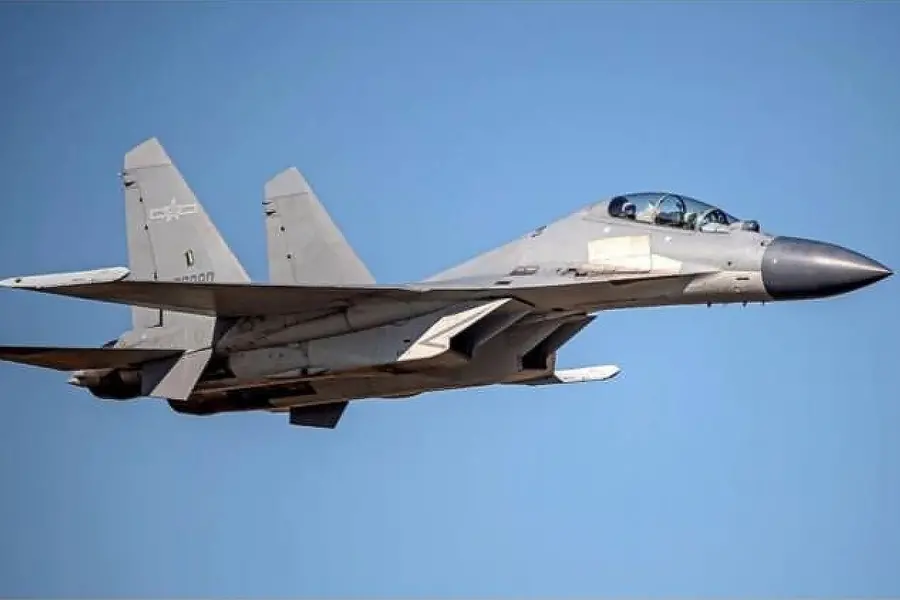
Beijing: A recently circulated image showing China's J-16 multirole fighter jet carrying an unusually heavy air-to-air missile load has attracted widespread attention among defence analysts worldwide.
The configuration, described by Chinese military commentators as "Beast Mode", features eight PL-15 beyond-visual-range (BVR) air-to-air missiles and two PL-10 within-visual-range (WVR) missiles. It is the heaviest publicly observed air-to-air weapons load carried by the aircraft to date and is being viewed as a demonstration of China's expanding air combat capabilities.
Also Read

The image has fuelled renewed debate over the rapid modernisation of the People's Liberation Army Air Force (PLAAF) and its ability to conduct long-range air superiority operations.
Why is the loadout being called 'Beast Mode'?
The term "Beast Mode" is commonly used in military aviation to describe fighter aircraft carrying their maximum or near-maximum weapons load to maximise combat firepower, even if doing so reduces stealth or aerodynamic performance.
According to an analysis published in the Chinese military magazine Ordnance Science and Technology, the latest J-16 configuration effectively transforms the aircraft into a high-capacity "missile truck" capable of carrying a significantly larger number of long-range missiles than many frontline fighters.
Rather than relying solely on stealth, the aircraft is designed to overwhelm enemy formations by carrying enough missiles to engage multiple targets during a single mission.
Military analysts believe such configurations could be used alongside stealth fighters like the J-20, allowing stealth aircraft to identify enemy targets while the J-16 launches large numbers of missiles from safer distances.
What is the J-16 fighter jet?
The Shenyang J-16 is one of China's most advanced non-stealth combat aircraft and serves as a backbone of the PLAAF's frontline fighter fleet.
Developed by the Shenyang Aircraft Corporation, the aircraft is based on Russia's Su-30MKK design but has undergone extensive indigenous upgrades over the years.
Unlike the original Russian aircraft, the J-16 features:
- Active Electronically Scanned Array (AESA) radar
- Advanced digital avionics
- Modern electronic warfare systems
- Chinese-built WS-10 turbofan engines
- Improved targeting and sensor fusion capabilities
- Enhanced communication systems
The aircraft is classified as a 4.5-generation multirole fighter, placing it between older fourth-generation aircraft and fifth-generation stealth fighters.
Its missions include:
- Air superiority
- Long-range interception
- Ground attack
- Maritime strike
- Suppression of Enemy Air Defences (SEAD)
- Escort missions
- Precision strike operations
- Size, speed and performance
The J-16 measures approximately 21 metres in length and has a maximum take-off weight of around 35 tonnes.
Powered by two Chinese-made WS-10B afterburning turbofan engines, it can exceed Mach 2, or more than twice the speed of sound.
According to defence assessments, the aircraft has:
- A combat radius of roughly 1,500 kilometres
- Twelve external hardpoints for carrying weapons
- A maximum payload capacity of around eight tonnes
Its large size allows it to carry more weapons than many lighter fighter aircraft while maintaining long operational range.
The PL-15: China's long-range missile
The most significant weapon in the new configuration is the PL-15, widely regarded as China's most advanced operational beyond-visual-range air-to-air missile.
According to the International Institute for Strategic Studies (IISS), the PL-15 has an estimated engagement range of around 200 kilometres, although exact specifications remain classified.
- The missile is believed to include:
- An active radar seeker
- Two-way data link
- Dual-pulse solid-fuel rocket motor
- High-speed terminal guidance
The dual-pulse propulsion system allows the missile to regain energy during the final phase of flight, improving its ability to intercept fast-moving or manoeuvring aircraft at long distances.
Many defence experts consider the PL-15 to be one of the key weapons challenging the long-range air combat dominance traditionally enjoyed by Western air forces.
The PL-10: Close-range dogfighting weapon
Complementing the PL-15 is the PL-10, China's latest short-range air-to-air missile.
Unlike the PL-15, which targets aircraft from long distances, the PL-10 is designed for close-range aerial combat.
The missile features:
- Imaging infrared seeker
- High off-boresight targeting
- Thrust-vector control
- Helmet-mounted sight compatibility
These technologies allow pilots to lock onto enemy aircraft even at sharp angles without pointing the aircraft directly at the target.
Why analysts call the J-16 a 'missile truck'
Military analysts increasingly describe the J-16 as a "missile truck" because of its exceptional ability to carry large numbers of missiles.
Instead of relying purely on stealth, the aircraft can provide fire support for stealth fighters by launching multiple long-range missiles while remaining farther from enemy air defences.
This concept has become increasingly important as modern aerial warfare shifts toward networked operations where different aircraft perform specialised roles within the same mission.
China's rapidly modernising air force
The J-16 is only one part of a much broader transformation underway inside the People's Liberation Army Air Force.
Over the past decade, China has accelerated production of advanced combat aircraft while gradually retiring older Soviet-era platforms.
According to the IISS and the China Aerospace Studies Institute (CASI), the PLAAF has invested heavily in:
- Modern fighter aircraft
- Airborne early warning systems
- Electronic warfare aircraft
- Aerial refuelling tankers
- Heavy transport aircraft
Integrated command-and-control systems
These improvements are intended to allow China to conduct longer-range operations beyond its immediate borders.
Indigenous engine development marks a major milestone
For years, one of China's biggest military aviation challenges was dependence on imported Russian aircraft engines.
The successful development and deployment of the WS-10 engine family is widely regarded as a major breakthrough.
Domestic engine production gives China greater control over fighter production, maintenance and future aircraft development while reducing reliance on foreign suppliers.
Supporting aircraft extend operational reach
China is also expanding fleets of aircraft that support frontline fighters.
The Y-20 heavy transport aircraft has strengthened strategic airlift capability, while the YY-20 aerial refuelling tanker enables fighters like the J-16 to remain airborne for longer periods and operate much farther from mainland bases.
These support aircraft are considered essential for sustained long-range military operations.
What does this mean?
Although there is no indication that the "Beast Mode" configuration represents the J-16's standard operational loadout, the image demonstrates the aircraft's ability to carry a significantly larger missile payload when required.
For defence observers, the loadout highlights China's continuing investment in long-range aerial warfare, indigenous weapons development and integrated air combat capabilities.
It also reflects the PLAAF's broader strategy of combining advanced sensors, long-range missiles, electronic warfare and support aircraft to strengthen its ability to operate in increasingly complex regional security environments.
Published: 13 Jul 2026, 10:51 am IST
Disclaimer: Kindly avoid objectionable, derogatory, unlawful and lewd comments, while responding to reports. Such comments are punishable under cyber laws. Please keep away from personal attacks. The opinions expressed here are the personal opinions of readers and not that of Mathrubhumi.