
The United States has expressed concern after China carried out a rare submarine-launched intercontinental-range ballistic missile test in the Pacific, renewing focus on Beijing's growing nuclear capabilities and regional security implications.
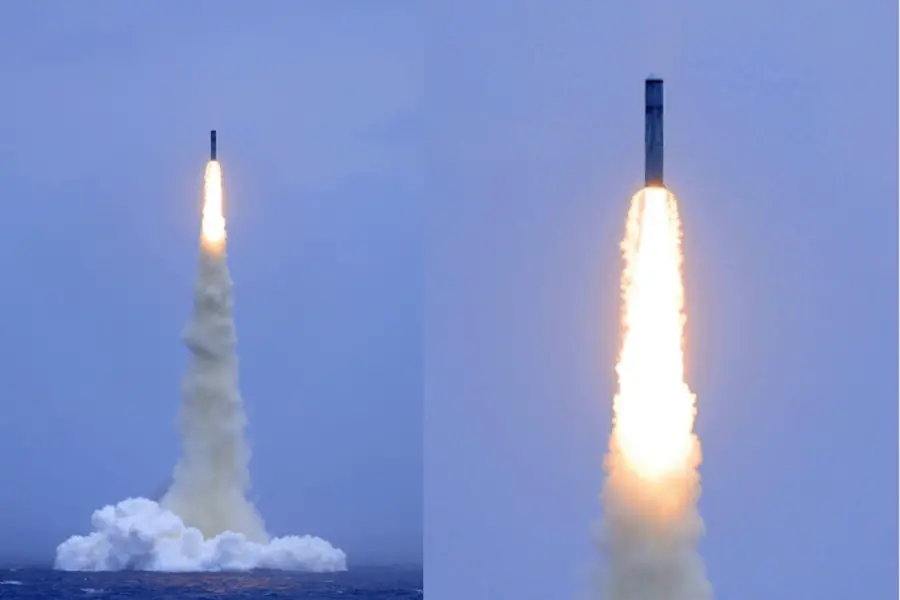
Washington: China's rare public disclosure of a submarine-launched intercontinental-range ballistic missile test has triggered fresh concern in Washington, with the United States warning that Beijing's expanding nuclear capabilities could undermine global non-proliferation efforts.
The test, which involved an unarmed long-range ballistic missile launched from a Chinese submarine into the South Pacific Ocean, has renewed international scrutiny of China's military modernisation and growing strategic arsenal. The missile reportedly carried a dummy warhead and landed in a designated area of the Pacific after authorities said advance notifications had been issued to relevant countries.
The United States confirmed that it tracked the launch and described the development as another sign of China's rapidly advancing nuclear programme. Speaking on the issue, US State Department spokesperson Tommy Pigott said Washington remains concerned about what it views as a lack of transparency surrounding Beijing's strategic weapons expansion.
"At a time when the United States is working harder than ever to prevent nuclear proliferation, China is doing the opposite," Pigott said.
He said Beijing's "rapid and opaque nuclear weapons buildup is of great concern to the region and the world."
American officials argued that greater openness regarding missile tests and military activities is necessary to reduce the risk of miscalculation and maintain regional stability.
Washington also renewed its call for China to participate in formal arms-control negotiations and adopt more predictable notification procedures for long-range missile launches. US officials said such measures would align China with practices followed by other permanent members of the United Nations Security Council and help build confidence among nations monitoring strategic military developments.
The missile launch has drawn attention beyond the United States. Several countries in the Indo-Pacific region expressed unease over the test, highlighting broader concerns about the security implications of intensifying military competition in the region.
New Zealand described the launch as a worrying development, while Australia said the test had the potential to contribute to regional instability. Japan also voiced concern, citing what it sees as an increase in China's military activities and strategic operations across the region.
China's public acknowledgement of the launch is notable because it rarely discloses details of its strategic missile tests, particularly those involving submarine-based systems. Military analysts view sea-based nuclear deterrence as a critical component of a country's strategic defence posture because submarines provide a survivable second-strike capability during potential conflicts.
With IANS inputs
Published: 07 Jul 2026, 10:05 am IST
Related Topics
Disclaimer: Kindly avoid objectionable, derogatory, unlawful and lewd comments, while responding to reports. Such comments are punishable under cyber laws. Please keep away from personal attacks. The opinions expressed here are the personal opinions of readers and not that of Mathrubhumi.
