
Exhumation begins at Tuam mother and baby home, uncovering a mass grave of 800 infants.
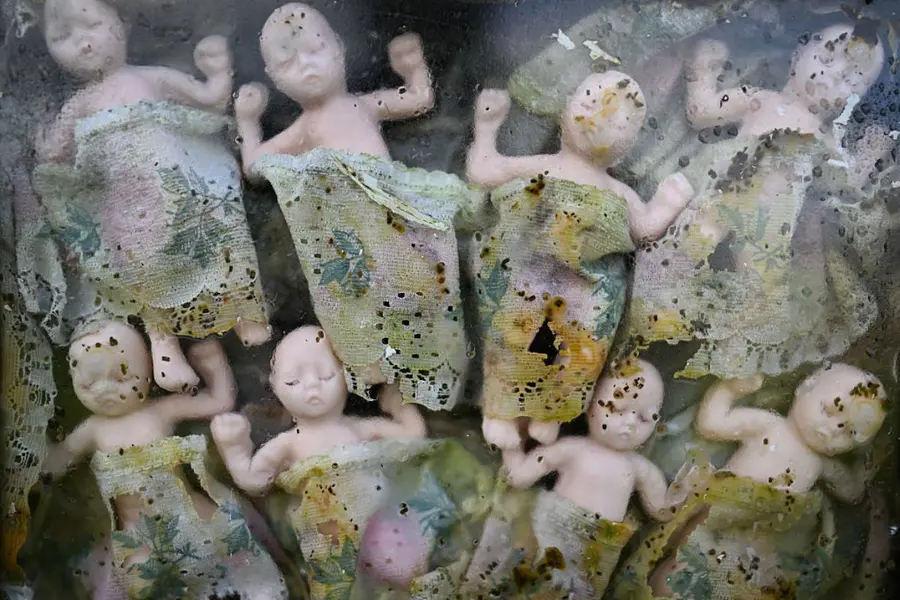
Tuam, Ireland: What began as a childhood scramble for stolen apples in 1970s rural Ireland led to one of the country’s most harrowing revelations — the existence of a mass grave beneath a former Catholic mother and baby home in Tuam, County Galway.
Authorities have commenced the exhumation of a suspected mass grave in Tuam, Ireland, located on the grounds of a former mother and baby home. The site is believed to contain the remains of up to 800 infants and children, once placed in the care of religious institutions that operated across the country for decades.
This burial ground has become a potent symbol of Ireland’s troubled past, where unmarried mothers were routinely isolated and separated from their children. Over time, details of severe mistreatment and neglect have emerged, pointing to systemic abuse that contributed to thousands of child deaths.
A forgotten history unearthed
Two young boys, Franny Hopkins and Barry Sweeney, were being chased off an orchard when they clambered over the wall of the long-abandoned Bon Secours Mother and Baby Home. As they pushed through dense briars and landed in the overgrown grounds, their feet hit a slab that sounded hollow.
“There was just a jumble of bones,” Hopkins recalled. “We didn’t know if we’d found a treasure or a nightmare.”
The children had stumbled upon human remains buried in what was later discovered to be a disused septic tank. It would take more than 40 years — and the relentless efforts of a local amateur historian — before the truth fully emerged.
The turning point came in the early 2010s, when Tuam native Catherine Corless began researching the home for an article she intended to write for the local historical society. She remembered how children from the institution were treated at school — isolated, shamed, and set apart.
“I thought I was doing a nice story about orphans and all that, and the more I dug, the worse it was getting,” she said.
As Corless pored through archives, she encountered a disturbing lack of burial records for nearly 800 children known to have died at the home between 1925 and 1961. Her search for a burial plot in local cemeteries yielded nothing. The growing suspicion: the children had never been properly buried.
The Bon Secours home had operated in repurposed famine-era buildings, taken over after the Irish Civil War. Though the facilities were spartan and harsh, they became one of many institutions that housed unmarried mothers and their babies — women often banished by their families and sent away in secret. The nuns who ran the homes, under contract from the state, imposed strict rules. Many women worked for a year or longer, only to be permanently separated from their children.
Corless’ research uncovered harrowing inspection records. A 1947 report noted that 12 of the 31 babies in the nursery were emaciated, and others were described as “delicate” or “wasted.” Some children died within months of birth. Yet official records at the time stated the care and diet provided were “excellent.”
From silence to outrage
Around the same time Corless was investigating in Tuam, Anna Corrigan in Dublin was digging into her own family history. She’d grown up as an only child, but had vague memories of an uncle accusing her mother of having given birth to sons before her. Unsure whether it was fact or fantasy, she began searching for records.
Corrigan was devastated to discover that her mother had borne two sons — John and William — at the Tuam home. One, she learned, died during a measles outbreak just months after birth. The second’s death was listed in the home’s ledger, but with an altered birthdate and no official death certificate. Corrigan suspected he might have been secretly adopted.
“I cried for brothers I didn’t know, because now I had siblings, but I never knew them,” Corrigan said.
Eventually, Corrigan found Corless, who had compiled a list of 796 children who died at the home and whose burial sites were unknown. Corrigan connected her with journalist Alison O’Reilly, who brought the story to national attention with a 2014 front-page article in the Irish Mail on Sunday titled, “A Mass Grave of 800 Babies.”
The headline caused international uproar. Some media and officials initially questioned whether a septic tank had truly been used as a burial ground. The Bon Secours sisters hired a PR firm to deflect the growing scrutiny. In one email, consultant Terry Prone claimed there was “no evidence that children were ever so buried.”
But the local community and survivors had lived with these stories for decades. Survivors like Peter Mulryan, who spent his early years in the home, began to speak publicly about the abuse and deprivation they endured.
“We were afraid to open our mouths, you know, we were told to mind our own business,” Mulryan said. “It’s a disgrace. This church and the state had so much power, they could do what they liked and there was nobody to question them.”
National apology, international attention
As pressure mounted, then-Prime Minister Enda Kenny ordered an official investigation. He described the treatment of children as that of “an inferior subspecies.” The state inquiry, which concluded in 2021, acknowledged that nearly 9,000 infants — 15% of all births in the institutions — died in 18 mother and baby homes over the decades.
Tuam had the highest death rate. In some years during the 1930s and 1940s, more than 40% of children born in the home died before reaching their first birthday.
Despite these revelations, many survivors criticised the report for shifting the bulk of blame onto women’s families and the children's fathers, with institutions seen as only a secondary force. Still, Prime Minister Micheál Martin issued a full apology: “The shame was not theirs — it was ours.”
The Bon Secours order later admitted that children were buried improperly. “We failed to respect the inherent dignity of the women and children,” said Sister Eileen O’Connor. “We failed to offer them the compassion that they so badly needed.”
A dig for the truth
In 2017, test excavations confirmed what Corless had long believed: the septic tank contained the commingled remains of infants and young children. The site was finally earmarked for a full forensic excavation, which began in July 2025.
Dig director Daniel MacSweeney, who previously worked with the Red Cross identifying victims in conflict zones, said the work ahead is daunting.
“We cannot underestimate the complexity of the task before us,” he said. “The age of the remains, the location of the burials, the dearth of information about these children and their lives.”
Roughly 100 people from around the world have already provided DNA samples, hoping to identify long-lost siblings or children.
But not everyone in Tuam supports the effort. Some residents argue the site should be left undisturbed, citing years of prayers and memorial services already held there.
Still, for those like Corrigan, the excavation marks the beginning of long overdue recognition.
“They were denied dignity in life, and they were denied dignity and respect in death,” she said. “So we’re hoping that today maybe will be the start of hearing them because I think they’ve been crying for an awful long time to be heard.”
Timeline: Tracing the tragedy at Tuam
- 1846 – The Tuam workhouse is established on six acres of land to house up to 800 destitute people.
- 1921 – A mother and baby home is opened in a former workhouse in Glenamaddy, County Galway. It is operated by the Bon Secours Sisters, a Catholic religious order.
- 1922–23 – British soldiers occupy the home during the Irish Civil War. In 1923, six anti-Treaty IRA members are executed there.
- 1925 – The Glenamaddy facility is shut down and relocated to the repurposed Tuam workhouse, which becomes the Tuam Mother and Baby Home.
- 1961 – The Tuam institution is closed.
- 1970s – Two boys discover bones in an underground chamber at the derelict site. Locals, believing the remains were from the famine era, create a small memorial.
- 2012 – Historian Catherine Corless publishes findings in the Journal of the Old Tuam Society, revealing hundreds of children died at the home. She later uncovers 796 death records without any burial entries, linking the earlier bone discovery to a disused septic tank.
- May 2014 – The Irish Mail reports nearly 800 missing infant deaths at Tuam, suggesting many may be buried in the old sewage system. The report sparks global outrage.
- June 2014 – The Irish government announces a broad inquiry into mother and baby homes, including Tuam.
- February 2015 – A formal Commission of Investigation into Mother and Baby Homes is launched.
- March 2017 – Excavations confirm large numbers of infant remains in underground chambers. DNA testing shows the children ranged in age from 35 weeks gestation to three years old.
- 2018 – The government pledges a full forensic excavation and plans new legislation to recover and potentially identify remains.
- October 2018 – Official approval is given for a complete excavation. Estimated costs range from €6 million to €13 million.
- January 2021 – The commission’s final report finds that around 9,000 children died in 18 institutions, including Tuam, between 1922 and 1998. Taoiseach Micheál Martin issues a formal apology.
- 2022 – The Institutional Burials Act is passed, allowing legal excavation and identification of remains at sites like Tuam.
- 2023 – A special directorate is established to manage the Tuam exhumation process.
- June 11, 2025 – The site is secured, and preparatory work for excavation begins.
- July 14, 2025 – The official exhumation begins, with teams working to recover and identify the remains of the children buried at Tuam.
(With inputs from AP)
Published: 31 Jul 2025, 02:26 pm IST
Related Topics
Disclaimer: Kindly avoid objectionable, derogatory, unlawful and lewd comments, while responding to reports. Such comments are punishable under cyber laws. Please keep away from personal attacks. The opinions expressed here are the personal opinions of readers and not that of Mathrubhumi.
