
Pope Leo XIV canonised seven new saints Sunday, including Bartolo Longo, a former Satanic priest who rediscovered his Christian faith.
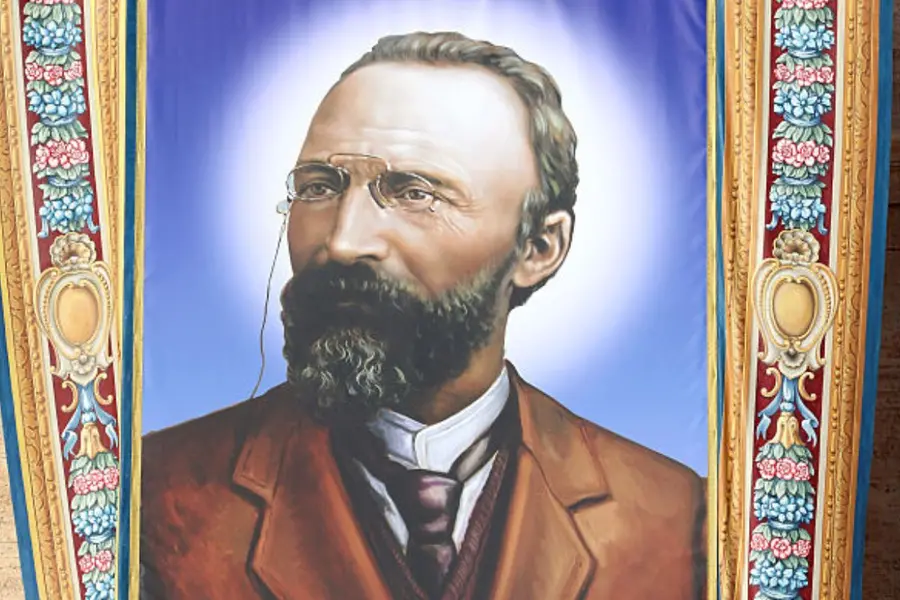
Vatican City: The Vatican witnessed an extraordinary canonisation ceremony on Sunday as Pope Leo XIV declared seven new saints, including Bartolo Longo — a former Satanic priest who underwent a radical conversion to Catholicism and became known as the “Apostle of the Rosary.” The canonisation took place on October 19, World Mission Sunday, in front of an estimated 55,000 faithful gathered in St Peter’s Square.
From the dark arts to divine faith
Born in 1841 in Latiano, Italy, Bartolo Longo’s early life was marked by intellectual rebellion and spiritual turmoil. While studying law at the University of Naples, he was drawn to the 19th-century currents of positivism, rationalism, and spiritualism. Those influences led him into the occult, and he eventually became a self-proclaimed Satanic priest. He led séances, experimented with drugs, and engaged in immoral rituals, spiralling into despair and darkness.
According to accounts, one night Longo heard the haunting voice of his deceased father calling out to him: “Return to God!” That moment ignited a deep personal transformation. Guided by devout Catholic friends and Dominican friars, Longo renounced spiritualism and returned to the Church. As Meg Hunter-Kilmer wrote in Aleteia, “cleansed and consecrated, Bartolo visited one last séance. He walked in, held up a rosary and called out, ‘I renounce spiritualism because it is nothing but a maze of error and falsehood.’”
A mission of redemption and the rosary
After his conversion, Longo joined the Dominican Order as a tertiary and took the name Brother Rosario – “Brother Rosary.” His devotion to the Blessed Virgin Mary became the cornerstone of his renewed life. Longo viewed the Rosary not as mere repetition, but as a heartfelt dialogue with Mary.
According to National Catholic Reporter, in 1872, he experienced what he described as a divine whisper: “If you are looking for salvation, propagate the rosary. It is Mary’s promise: Whoever propagates the rosary will be saved.” From that moment, Longo dedicated himself to spreading Marian devotion, especially through the Rosary.
Rebuilding Pompeii: A city of faith and charity
Longo’s most enduring legacy lies in the transformation of Pompeii – a city once buried under volcanic ash – into a centre of faith and renewal. In 1875, he obtained a neglected image of Our Lady of the Rosary and placed it in a small church. Reported miracles around the image soon attracted pilgrims, leading to the establishment of the Pontifical Shrine of the Blessed Virgin of the Rosary of Pompeii, which remains one of the most visited Marian sanctuaries in the world.
Longo’s work extended beyond the spiritual. With the support of Countess Marianna di Fusco, whom he later married in a chaste union, he founded orphanages, schools, and homes for the children of prisoners. He also established infrastructure in Pompeii – including postal and telegraph services, running water, and an observatory – effectively giving the ruined city a new life.
Pompeii Archbishop Tommaso Caputo described him as “the founder of a new city – a city born of faith.”
The journey to sainthood
Bartolo Longo died on October 5, 1926, at the age of 85, after a life devoted to faith, service, and charity. Pope John Paul II beatified him in 1980, calling him the “Apostle of the Rosary.” His writings later received full theological approval, paving the way for canonisation.
Earlier this year, on February 25, Pope Francis signed the decree authorising Longo’s canonisation – a move affirmed and formalised by Pope Leo XIV following Francis’s death months later.
A moment of global celebration
During Sunday’s ceremony, Pope Leo XIV said, “Today we have before us seven witnesses, the new Saints, who, with God’s grace, kept the lamp of faith burning. May their intercession assist us in our trials and their example inspire us in our shared vocation to holiness.”
Among those canonised alongside Longo were Peter To Rot of Papua New Guinea, Armenian bishop Ignazio Choukrallah Maloyan, Venezuelan physician José Gregorio Hernández Cisneros, and three nuns – Maria Carmen Elena Rendiles Martínez, Vincenza Maria Poloni, and Maria Troncatti – all celebrated for their missionary and humanitarian work.
(With inputs from AFP)
Published: 19 Oct 2025, 05:45 pm IST
Related Topics
Disclaimer: Kindly avoid objectionable, derogatory, unlawful and lewd comments, while responding to reports. Such comments are punishable under cyber laws. Please keep away from personal attacks. The opinions expressed here are the personal opinions of readers and not that of Mathrubhumi.
