
Aid agencies warn that millions remain at risk of famine and extreme malnutrition as economic collapse and restrictions under Taliban rule deepen the crisis
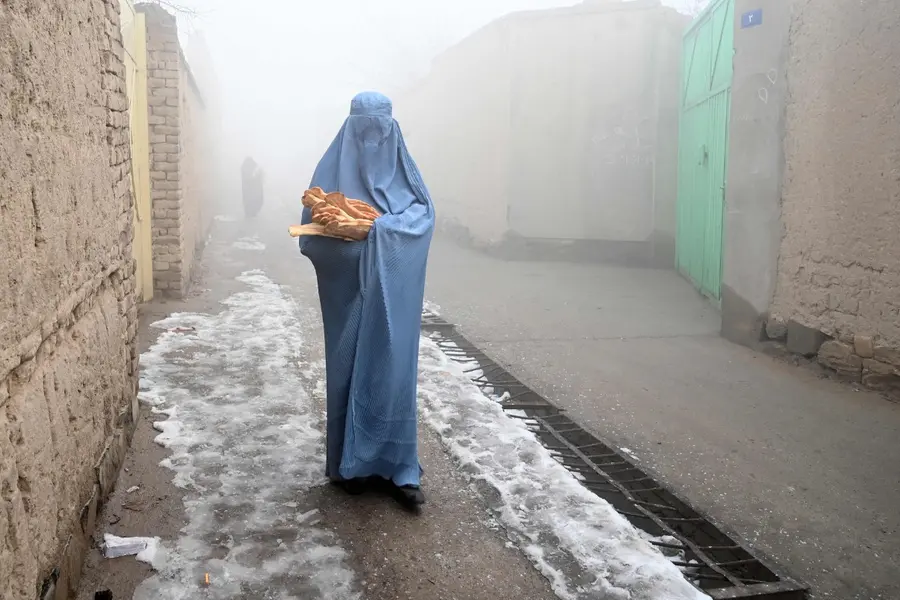
Afghanistan is facing one of its worst humanitarian crises in recent years, with extreme poverty, hunger and unemployment pushing thousands of families towards unimaginable decisions. In several parts of the country, parents are reportedly selling their young daughters in desperate attempts to secure food, pay for medical treatment, or keep the rest of their family alive.
Reports emerging from provinces such as Ghor have exposed the devastating human cost of Afghanistan’s economic collapse, worsening food shortages and strict restrictions imposed under Taliban rule. Aid agencies and international organisations warn that millions of Afghans are now living on the edge of survival.
According to a report by the BBC, Afghanistan is currently witnessing severe poverty and widespread hunger, with soaring unemployment and food shortages leaving families unable to meet even basic daily needs.
The World Food Programme has stated that nearly five million mothers and children across Afghanistan are suffering from extreme malnutrition.
Figures released by the United Nations show that three out of every four people in the country are unable to meet their everyday necessities. Around 4.7 million people, which accounts for more than 10 per cent of Afghanistan’s population, are currently at risk of famine.
The crisis has left many families struggling simply to survive.
A 45-year-old man named Juma Khan told the BBC that his children had gone to bed hungry for three consecutive nights. “My children went to bed hungry three nights in a row. My wife was crying, so were my children. So I begged a neighbour for some money to buy flour,” he said.
Another Afghan man, Khwaja Ahmad, described the desperation facing elderly labourers who can no longer find work. “We are starving. My older children died, so I need to work to feed my family. But I’m old, so no one wants to give me work,” he said while speaking emotionally about his condition.
Several families have reportedly already lost relatives due to malnutrition and poverty-related illnesses.
Why Afghan families are selling their daughters
The worsening humanitarian emergency has forced some families in Afghanistan’s Ghor province into making deeply distressing choices.
The BBC report highlighted cases where fathers are choosing to sell their daughters for money rather than watch them die from hunger and starvation.
One father, Abdul Rashid Azimi, spoke about the unbearable pressure of trying to provide for his children. Holding his seven-year-old daughters, Roqia and Rohila, he explained how poverty had left him considering selling them.
“I come home from work with parched lips, hungry, thirsty, distressed and confused. My children come to me saying, ‘Baba, give us some bread’. But what can I give? Where is the work?” he said.
Azimi added that selling one daughter could allow him to feed the rest of his family for several years. “If I sell one daughter, I could feed the rest of my children for at least four years,” he explained.
Another Afghan man, Saeed Ahmad, revealed that he had already agreed to give away his five-year-old daughter, Shaiqa, to a relative in exchange for 200,000 Afghanis, equivalent to around $3,200 or Rs. 309,451.
Ahmad said the arrangement came after his daughter was diagnosed with appendicitis and a liver cyst, conditions he could not afford to treat.
Also Read: Taliban’s new law says silence of ‘virgin girl’ can be treated as consent to marriage in Afghanistan
“If I had taken the whole sum at that time, he would have taken her away. So I told him, just give me enough for her treatment now, and in the next five years, you can give me the rest, after which you can take her. She will become his daughter-in-law,” he said.
He also admitted the emotional burden of the decision. “Giving away your child at such a young age carries a lot of anxiety. Underage marriages have their problems; however, because I couldn’t pay for her treatment, I was thinking, at least she will be alive.”
Why girls are more vulnerable in Afghanistan
Experts and local residents say daughters are often targeted in such arrangements because boys are traditionally viewed as future earners who may financially support the family later in life.
At the same time, restrictions imposed on women and girls under Taliban rule have further weakened the social position of females in Afghan society.
The Taliban government recently introduced a decree approved by supreme leader Hibatullah Akhundzada titled “Principles of Separation Between Spouses”, which contains 31 articles.
One provision states that the silence of a virgin girl may be treated as consent for marriage. The rule does not apply to boys.
Critics argue that such policies increase the vulnerability of young girls, particularly in families already struggling under severe economic hardship.
Restrictions on women and their wider impact
Analysts and rights groups say Afghanistan’s humanitarian collapse cannot be separated from the Taliban government’s treatment of women.
According to the Afghanistan Socioeconomic Review published by the United Nations Development Programme, nearly 56 per cent of Afghan women are largely confined to their homes, with movement often restricted to less than once a day.
Also Read: What is ‘manufactured malnutrition crisis’ in Gaza?
These restrictions frequently limit women’s access to food, employment and essential services. Combined with barriers to education and healthcare training for women, the policies have significantly affected Afghanistan’s social and economic progress.
Political commentator Fahima Mahomed criticised the Taliban’s position on child marriage while speaking to The New York Post.
“Child marriage is not marriage in any meaningful sense. A child cannot properly consent, and treating silence as consent is dangerous because it removes a girl’s voice completely,” she said.
Mahomed also rejected attempts to broadly frame such policies as representative of Islam. “As a Muslim, I would also strongly reject the idea that this reflects Islam as a whole. The Qur’an itself speaks against compulsion and mistreatment of women, so the Taliban’s position should not be presented as ‘Islamic law’ in a broad sense,” she added.
International aid cuts and Afghanistan’s economic collapse
Afghanistan’s worsening humanitarian conditions have also been linked to a sharp decline in international aid.
The United States, once one of the country’s largest humanitarian donors, has drastically reduced assistance to Afghanistan. According to UN data, aid received from the US in 2026 is approximately 70 per cent lower than in 2025.
At the same time, severe drought conditions have added further pressure on already struggling communities. Villagers told the BBC that neither non-governmental organisations nor government authorities had done enough to address the worsening situation.
The World Food Programme has estimated that it requires around $350 million to continue carrying out assistance programmes in Afghanistan. Aid officials warn that conditions may deteriorate even further without urgent funding.
Although several donor countries have reduced involvement due to concerns over Taliban governance, Taliban officials have argued that humanitarian assistance should not be politicised.
Hamdullah Fitrat defended the administration by blaming previous governments and the aftermath of foreign intervention.
“During the 20 years of invasion, an artificial economy was created due to the influx of US dollars. After the end of the invasion, we inherited poverty, hardship, unemployment and other problems,” he said.
With agency inputs
Published: 22 May 2026, 07:07 pm IST
Related Topics
Disclaimer: Kindly avoid objectionable, derogatory, unlawful and lewd comments, while responding to reports. Such comments are punishable under cyber laws. Please keep away from personal attacks. The opinions expressed here are the personal opinions of readers and not that of Mathrubhumi.
