
Higher operating costs, supply chain disruptions, engine availability issues, rising lease obligations and legal disputes have all combined to create a difficult environment for financially weaker carriers
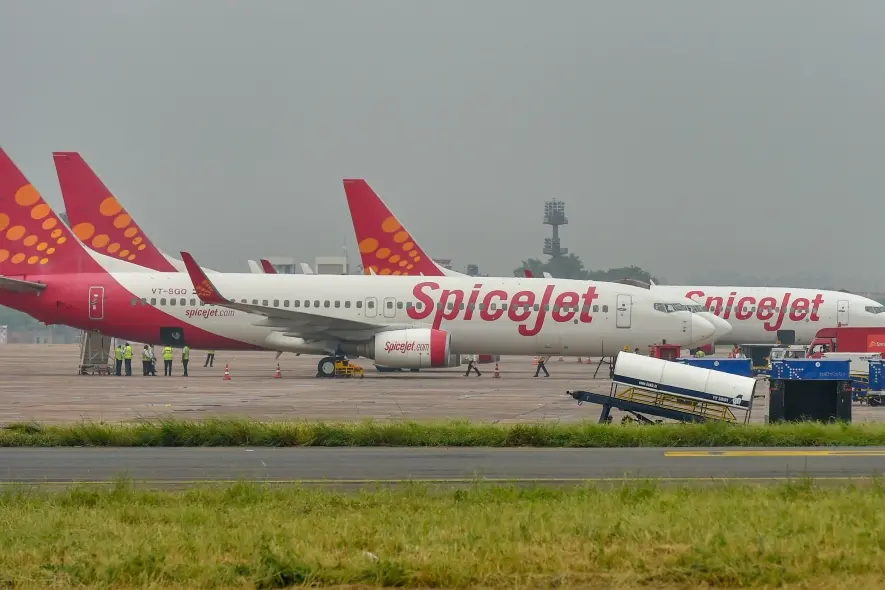
SpiceJet is once again facing a difficult phase, with fresh legal troubles, renewed pressure from aircraft lessors and continuing financial challenges raising questions about the airline's road to recovery.
While the airline has managed to secure some financial relief under the Central government's emergency credit support programme for airlines, it is simultaneously battling a long-running arbitration dispute, mounting liabilities and efforts by foreign lessors to repossess aircraft. The latest developments underline the fragile position of one of India's oldest low-cost carriers.
Delhi HC gives SpiceJet more time
In a significant development, the Delhi High Court has allowed SpiceJet additional time to deposit ₹144.5 crore in its long-running arbitration dispute with KAL Airways and its promoter, Kalanithi Maran.
The airline informed the court that it had already received part of the financial assistance announced by the Centre for airlines affected by operational disruptions linked to the recent West Asia conflict. It also told the court that the remaining funds are expected soon, which would help it clear the outstanding amount.
Based on this assurance, the High Court directed SpiceJet to deposit ₹50 crore within 45 days, while the balance amount must be deposited over the following 90 days. In total, the airline has been given around four-and-a-half months to make the complete payment.
The court also decided that it would hear SpiceJet's challenge against the arbitration award only after the airline complies with these payment directions.
A dispute lasting over a decade
The legal battle dates back to 2015, when KAL Airways transferred its 58.46 per cent stake in SpiceJet to the airline's current promoter and Managing Director, Ajay Singh. At that time, SpiceJet was facing a severe financial crisis and was struggling to continue operations.
As part of the ownership transfer, Kalanithi Maran invested around ₹679 crore through convertible warrants and preference shares. However, Maran later alleged that the promised securities were never issued by the new management, leading to arbitration proceedings. In 2018, the arbitration tribunal ordered SpiceJet to refund ₹579 crore, along with interest. Since then, the matter has travelled repeatedly between the Delhi High Court and the Supreme Court.
Earlier this year, the Delhi High Court calculated that ₹194.51 crore still remained unpaid under its previous directions. After adjusting an earlier payment of ₹50 crore, the outstanding amount was fixed at ₹144.5 crore.
SpiceJet had requested permission to offer a commercial property in Gurugram as security instead of making an immediate cash payment, arguing that such a payment would further strain its finances. The court, however, rejected this request.
The Supreme Court later declined to interfere with the High Court's order but allowed the airline to seek more time considering the extraordinary operational challenges arising from the West Asia crisis.
Lessors move to repossess Aircraft
Even as the legal dispute continues, SpiceJet is facing another challenge. Two Irish leasing companies owned by ICBC Financial Leasing, the aircraft leasing arm of the Industrial and Commercial Bank of China (ICBC), have approached the Directorate General of Civil Aviation (DGCA) seeking deregistration of four Boeing 737 MAX aircraft leased to the airline.
Deregistration is an important legal step that allows aircraft lessors to repossess their aircraft when lease agreements run into problems.
The applications did not specify the reasons for seeking deregistration. However, the move comes at a time when SpiceJet has been under increasing financial pressure and several aircraft remain grounded.
The case is also expected to test India's aircraft repossession framework, which was strengthened through legal changes introduced last year to improve confidence among global aircraft leasing companies.
Responding to the deregistration notices, SpiceJet said the four Boeing 737 MAX aircraft have remained grounded for a long period because of manufacturing-related issues involving their engines. According to the airline, these aircraft have not been contributing to operations, and removing them from the fleet would actually reduce lease rental expenses.
The airline maintained that deregistration of these aircraft would have no impact on its flight operations.
Temporary relief
SpiceJet has also received financial assistance under the Centre's emergency credit support programme introduced for airlines affected by disruptions caused by the recent geopolitical tensions in West Asia. According to reports, the airline has already received around ₹150 crore, with additional financial support expected in the coming days.
The funding is expected to provide some immediate liquidity and help the airline meet critical financial obligations, including payments ordered by the court.
However, industry observers point out that while emergency funding may ease short-term cash flow pressures, it does not address the airline's longer-term structural challenges.
SpiceJet's operational challenges have become increasingly visible over the past year. The airline has reduced its flight schedule, several aircraft remain grounded, and it has faced multiple disputes with aircraft lessors over lease payments.
Reports have also indicated delays in salary payments to sections of its workforce as the airline continues efforts to stabilise its finances. Data from aircraft tracking platform Planespotters shows that only a small portion of the airline's fleet is currently active, reflecting the operational constraints under which it is functioning.
Conclusion
The developments highlight the multiple pressures facing airlines in today's operating environment. Higher operating costs, supply chain disruptions, engine availability issues, rising lease obligations and legal disputes have all combined to create a difficult environment for financially weaker carriers.
For SpiceJet, the challenge is no longer limited to winning back passengers or expanding its network. The airline must also restore confidence among aircraft lessors, financial institutions and investors while meeting regulatory and legal obligations.
The government's emergency credit support may provide valuable breathing space, but rebuilding financial stability will require sustained improvements in fleet availability, operational performance and balance sheet strength.
As India's aviation market continues to grow rapidly, competition is becoming increasingly intense. Stronger airlines are investing in fleet expansion and network growth, while financially stressed carriers must focus on restoring operational credibility before they can fully participate in the next phase of growth.
For SpiceJet, the coming months could prove decisive. Successfully resolving legal disputes, strengthening relationships with lessors and improving fleet utilisation will be critical if the airline hopes to move beyond another chapter of uncertainty.
ALSO READ | More aircraft, but unpaid pilots: Is SpiceJet buying time or staging a comeback
Published: 14 Jul 2026, 02:01 pm IST
Related Topics
Disclaimer: Kindly avoid objectionable, derogatory, unlawful and lewd comments, while responding to reports. Such comments are punishable under cyber laws. Please keep away from personal attacks. The opinions expressed here are the personal opinions of readers and not that of Mathrubhumi.
