
As Kerala welcomes another monsoon season, one of its strangest weather mysteries returns to public memory. In 2001, red-coloured rain fell across several districts, fuelling theories of meteors and atmospheric anomalies
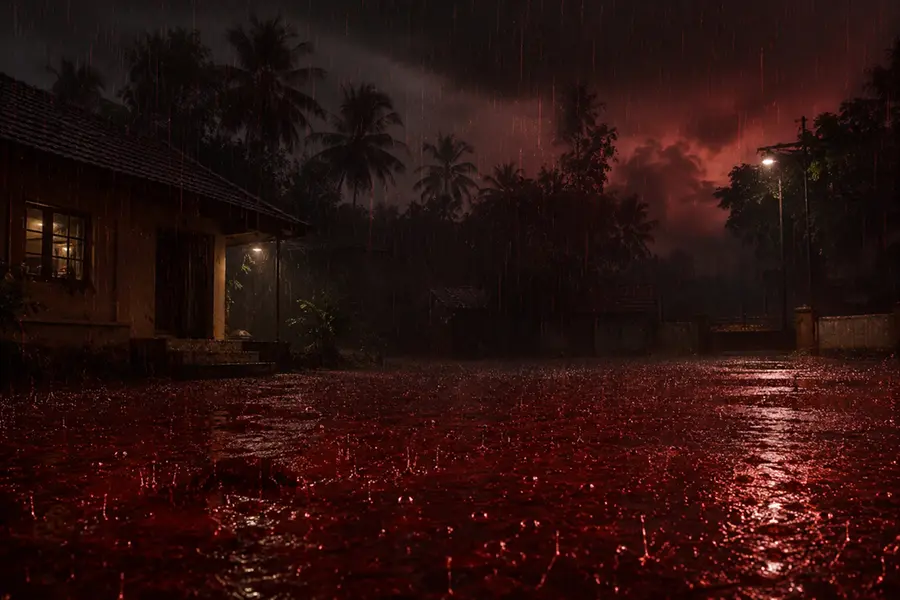
As the southwest monsoon sweeps across Kerala once again, bringing its familiar rhythm of dark clouds, overflowing rivers and rain-soaked landscapes, memories of one of the state’s strangest weather mysteries continue to resurface, the phenomenon of “red rain.”
For many Keralites, the sight of rainwater tinged red, pink, yellow or even black sounds like folklore. Yet it is a documented scientific phenomenon that has puzzled residents, sparked wild theories and prompted extensive research over several decades.
When rain fell red
The most famous episode happened between July and September 2001, when reports of red-coloured rain poured in from several parts of Kerala. The first widely reported incidents happened on July 25, 2001, in Kottayam and Idukki districts. Over the following weeks, similar reports emerged from Ernakulam, Palakkad and Pathanamthitta.
Residents described rainwater turning red or pink soon after rainfall. In some places, the coloured rain was so localised that ordinary rain was falling just a few metres away. Most events lasted less than 20 minutes but left a lasting impression on those who witnessed them.
Areas including Kadanad, Thrikkothamangalam, Chenappady, Vadanamkurussi, Aluva and Muvattupuzha reported unusual rainfall. Yellow-coloured rain was also observed near Chittar in Pathanamthitta district.
The phenomenon generated enormous curiosity. Some feared pollution. Others wondered whether it was linked to a meteor, volcanic dust or an unknown atmospheric event.
Not the first time
While the 2001 event attracted global attention, coloured rain was not entirely new to Kerala.
Scientific investigations later noted reports of similar occurrences in Changanassery during the 1950s. Media reports also referred to coloured rain events as far back as 1896. Residents interviewed during the 2001 probe by the Centre for Earth Science Studies recalled witnessing red rain during their childhood.
“It therefore appears that coloured rainfall might have been taking place occasionally in the state, but might have gone largely unnoticed,” scientists observed in their report.
One notable earlier incident happened at Morkulangara near Changanassery. According to media reports, residents witnessed a brief spell of reddish rain that lasted only a few minutes and was confined to a small area.
Locals reportedly found “red-coloured water lying in the yard” before realising that the rainwater itself had acquired a reddish tint. The scientific investigation began almost immediately after reports surfaced in 2001.
Meteor theory
Early observations led some researchers to speculate that the coloured particles might have originated from an exploding meteor. The Centre for Earth Science Studies briefly suggested that atmospheric fallout from a meteor could explain the phenomenon.
The idea gained public attention because several residents reported hearing loud thunderclaps and seeing flashes of light before the coloured rain began.
However, the meteor hypothesis soon ran into problems. Scientists realised that meteor debris could not continue falling over the same locations for weeks while remaining largely unaffected by wind patterns. Microscopic examination also revealed that the particles resembled biological material rather than space dust. The meteor explanation was eventually abandoned.
Mystery solved?
The mystery was finally solved through a joint investigation by the Centre for Earth Science Studies (CESS) and the Tropical Botanical Garden and Research Institute (TBGRI), commissioned by the Government of India’s Department of Science and Technology.
Researchers cultured the particles found in the rainwater and compared them with samples collected from the local environment.
Their conclusion was strikingly simple. The coloured particles were spores from Trentepohlia, a common lichen-forming green alga found abundantly across Kerala.
The joint report concluded that “the colour was found to be due to the presence of a large amount of spores of a lichen-forming alga belonging to the genus Trentepohlia.” Scientists found the same algae growing extensively on trees and surfaces around Changanassery.
The report further noted, “Both samples (from rainwater and from trees) produced the same kind of algae, indicating that the spores seen in the rainwater most probably came from local sources.”
When researchers revisited the area in August 2001, they found almost every suitable surface coated with the organism.
“The site was again visited on 16 August 2001, and it was found that almost all the trees, rocks and even lamp posts in the region were covered with Trentepohlia estimated to be in sufficient amounts to generate the quantity of spores seen in the rainwater.”
Why is the Alga red?
One of the most fascinating aspects of the story is that Trentepohlia is actually a green alga.
The organism belongs to the group of green algae known as chlorophytes. However, large quantities of orange and red carotenoid pigments mask the green chlorophyll, giving the spores their distinctive reddish-orange appearance.
When millions of these microscopic spores become airborne and mix with rain clouds, they can colour rainwater red, orange or pink.
Researchers estimated that each millilitre of rainwater contained around nine million red particles. Across all reported events, as much as 50,000 kilograms of coloured particles may have fallen over Kerala.
After months of investigation, scientists arrived at a clear conclusion.
The study stated, “Thus, the study has determined that the coloured rain in many parts of the state is due to the presence in rainwater of significant quantities of coloured lichen-forming algal spores of local origin; no dust of meteoric, volcanic or desert origin is present in the rainwater; the colour of the rainwater is not due to any dissolved gases or pollutants.”
Published: 04 Jun 2026, 06:56 pm IST
Related Topics
Disclaimer: Kindly avoid objectionable, derogatory, unlawful and lewd comments, while responding to reports. Such comments are punishable under cyber laws. Please keep away from personal attacks. The opinions expressed here are the personal opinions of readers and not that of Mathrubhumi.
