
T.K. Radha met Oppenheimer at Princeton.
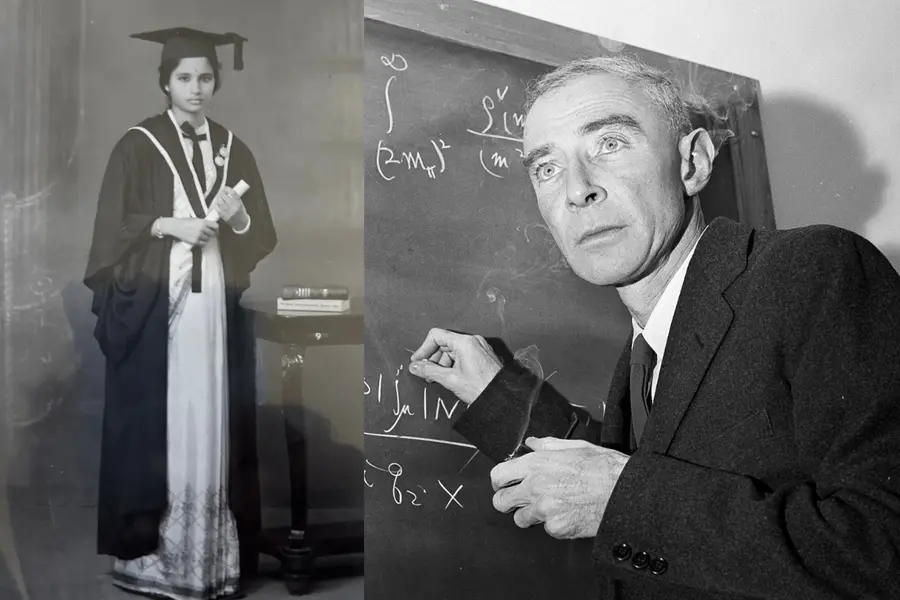
J. Robert Oppenheimer may not be as familiar a name in Kerala as APJ Abdul Kalam. But Christopher Nolan’s multiple Oscar-winning film Oppenheimer has changed that, bringing the American physicist—who led the creation of the world’s first atomic bomb—into popular conversation across the state.
Yet, few know that a young Malayali woman once walked the halls of Princeton’s Institute for Advanced Study under Oppenheimer’s directorship. Even fewer know she was personally invited by Oppenheimer and discussed research with him.
This is the lesser-known story of T.K. Radha—from reading under kerosene lamps in Thrissur village to standing at the forefront of global physics, shoulder to shoulder with some of the greatest scientific minds of the 20th century.
Childhood under kerosene lamps
Born in 1938 in Thayyur, a small village near Erumapetty, Radha came into the world during a time when girls were not expected to attend college. Her birth was met with disappointment—she was the third daughter in a society that favoured sons. But an early prophecy gave hope. “The family astrologer assured my father that this child will come out with flying colours in school and college,” Radha told Mathrubhumi English.
Raised between Madras and Ernakulam, Radha learned Malayalam and Sanskrit at school. Her home in Thayyur, which was surrounded by jackfruit, tamarind, and coconut trees, had no electricity. "We had to read under kerosene lamps and draw water from the well," Radha recalled.
Her family moved often due to her father’s government job, but education remained central to her journey. “My sisters both finished their SSLC and were waiting to get married… But my sisters requested my father to send me to do at least an Intermediate,” she said.
Radha went on to study at Stella Maris College, Chennai. Radha’s academic performance spoke for itself. At Stella Maris, she scored 100% in Mathematics and 98% in Physics. She continued with Physics Honours at Presidency College, Madras—the same college her father had attended. Despite concerns about co-education, her parents allowed her to apply.
She topped the university and received a gold medal. Her father wanted her to write the Indian Administrative Service exam. But being not 21, she joined a new M.Sc. course in Nuclear Physics at Madras University, under the guidance of Prof. Aladi Ramakrishnan. Foreign physicists such as Robert Marshak, Niels Bohr, and Leonard Schiff regularly visited, inspiring a generation of Indian researchers. “We all were soon able to do research on Particle Physics, which was a hot topic then,” she recalled.
She completed her Ph.D. under Ramakrishnan and began publishing research in prestigious journals.
In 1962, Radha was selected to attend a summer school on Elementary Particle Physics in Trieste, Italy — an academic gathering of some of the world’s brightest minds.
“There, many Nobel Prize winners gave lectures,” she said.
It was during this phase that she caught the attention of not just one, but two prominent physicists abroad: Prof. Schiff at Stanford and Prof. Marshak at the University of Rochester. Both offered her post-doctoral fellowships.
Around this time, Prof. Ramakrishnan was also advocating for an Indian equivalent to the IAS at Princeton — a space for unfettered scientific exploration. He took Radha and her colleagues to meet Prime Minister Nehru and Education Minister C. Subramaniam to argue for such an institution.
The result was the birth of the Institute of Mathematical Sciences (Matscience) in Madras, where Radha joined as a staff scientist. “It was a place where we could do pure research,” she said.
Her international profile continued to rise. She briefly worked at Stanford and Rochester, co-publishing papers with both Schiff and Marshak. Her work was presented at conferences in Moscow and Brookhaven.
A rare invitation: Meeting Oppenheimer
In 1965, the turning point came. After a brief stint lecturing in Australia, Radha received a letter from none other than J. Robert Oppenheimer. The invitation was to spend an academic year at the Institute for Advanced Study (IAS) in Princeton—an elite sanctuary for free scientific thought, once home to Albert Einstein.
She arrived at IAS in September. “I met Prof. Oppenheimer one-on-one within a few days of my arrival,” she recalled. “He was a very kind man. When he heard from his secretary that I had paid my air fare to New York out of my pocket, he asked me to meet him and immediately issued a cheque for the amount.”
The two had several conversations during her stay. “He told me that he had read the complete Bhagavad Gita in Sanskrit and believed in it and quoted verses from it when the atom bomb went off,” Radha noted. Although he had not visited India due to a revoked security clearance, he remained intellectually connected to Indian philosophy. “We discussed my research work whenever I had the opportunity to see him.”
It was a brief but major association with a man who had changed the course of history. Interestingly, Radha was one of the earliest women of colour—and perhaps the first Malayali woman—at the IAS.
Return, reinvention, and recognition
Radha returned to Matscience in Madras by mid-1966, enriched by the Princeton experience and ready to contribute further. But fate had one more twist.
On her return route, she was invited to give a seminar in Edmonton, Canada. There, she met Dr. Vembu Gourishankar, a professor of Electrical Engineering. They married later that year and settled in Canada (after marriage, she got the name Radha Gourishankar).
She continued to teach graduate-level physics and publish papers. But a difficult pregnancy — during a time with no maternity support or childcare — forced her to step back from active research.
She later re-trained in computer science and worked as a Programmer Analyst in the University of Alberta’s Physics Department for 15 years. She even co-authored research papers during that time.
She later became a well-respected volunteer in Edmonton’s health services and was honoured with the YMCA Woman of the Year award in 2014 for volunteering.
Present life
Now in her late 80s, Radha lives in Edmonton with her daughter. She fondly remembers her visits to Thayyur and Kerala. “We went on a boat around the backwaters of Kerala and she [her daughter] got to see a Kathakali performance and the artists doing their elaborate make-up before the performance,” she said.
She watched the movie Oppenheimer three times—once for each friend who insisted on seeing it with her. “It was very realistic, but for the scene where he talks about the Bhagavad Gita book,” she added.
Published: 15 May 2025, 03:13 pm IST
Related Topics
Disclaimer: Kindly avoid objectionable, derogatory, unlawful and lewd comments, while responding to reports. Such comments are punishable under cyber laws. Please keep away from personal attacks. The opinions expressed here are the personal opinions of readers and not that of Mathrubhumi.
