
The Supreme Court's latest move puts the 2023 law governing Election Commission appointments under fresh constitutional scrutiny as the ECI faces a separate row over SIR and electoral-roll decisions.
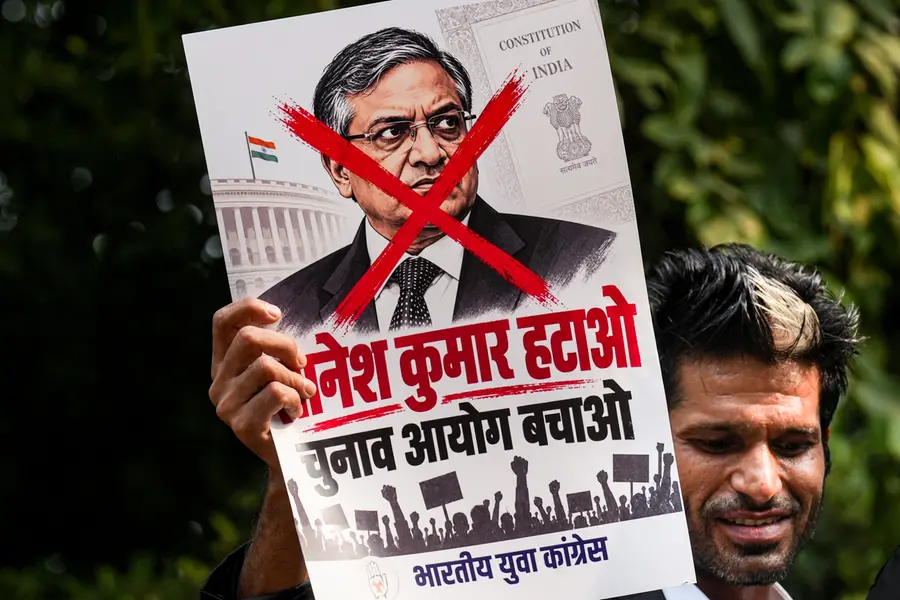
New Delhi: The Supreme Court has moved the challenge to the 2023 law governing the appointment of the Chief Election Commissioner and Election Commissioners towards a larger Constitution Bench, bringing the ECI’s appointment process into sharper focus at a time when the poll panel is facing a separate controversy over the Special Intensive Revision of electoral rolls.
The Supreme Court on Wednesday directed that petitions challenging the 2023 law governing the appointment of the Chief Election Commissioner and Election Commissioners be placed before the Chief Justice of India for constitution of a larger bench.
Also Read

The development came after a two-judge bench comprising Justices Dipankar Datta and Satish Chandra Sharma differed over whether the challenge required consideration by a Constitution Bench. The judges ultimately agreed that sending the matter through another preliminary reference could cause further delay.
The case concerns the Chief Election Commissioner and Other Election Commissioners (Appointment, Conditions of Service and Term of Office) Act, 2023. Under the law, the three-member selection committee consists of the Prime Minister, a Union Cabinet minister nominated by the Prime Minister and the Leader of Opposition in the Lok Sabha.
The law replaced the arrangement laid down by the Supreme Court in its 2023 Anoop Baranwal judgment, under which the Prime Minister, Leader of Opposition and Chief Justice of India were to select the Election Commissioners until Parliament enacted legislation on the subject.
Why the appointment law is back in focus
Justice Dipankar Datta questioned whether the present selection mechanism provides sufficient independence from the executive. He observed that the Election Commission must not only be independent but must also appear independent.
Justice Satish Chandra Sharma took the view that the constitutional questions raised by the challenge should be considered authoritatively by a Constitution Bench. The disagreement resulted in the matter being sent to the CJI for appropriate bench formation.
The petitioners have argued that giving the government two members on the three-member selection committee could allow the executive to dominate the appointment process. The Union government, however, has defended the 2023 law and argued that Parliament has the power to prescribe the appointment mechanism under Article 324 of the Constitution.
How this connects to the current ECI controversy
The court development comes just a day after an Indian Express investigation reported that Election Commissioners Sukhbir Singh Sandhu and Vivek Joshi had recorded objections at least 14 times over 10 months concerning decisions linked to electoral rolls, the SIR exercise, Form 6 and access to voter data.
The Election Commission has disputed the interpretation of those internal notes. It has said that written suggestions and differing views are part of its normal internal process and that official decisions were ultimately taken unanimously. The ECI also said its digital systems operate under security protocols and that statutory powers continue to rest with Electoral Registration Officers and District Election Officers.
The reported disagreements have nevertheless intensified political scrutiny of the poll panel, particularly over how decisions concerning voter rolls are made.
SIR remains a separate legal issue
The Special Intensive Revision of electoral rolls is already before the Supreme Court. On September 22, the court raised concerns about notices issued to voters during the Delhi SIR process and suggested that voters could be allowed to respond through channels such as WhatsApp and email.
The appointment-law case is different from the SIR proceedings. The former concerns the constitutional validity of the mechanism for selecting Election Commissioners, while the latter involves questions surrounding the revision of electoral rolls and procedures affecting voters.
However, the two developments have emerged at the same time, putting the structure and functioning of the Election Commission under increased judicial and public scrutiny.
What happens next
The immediate next step is for the Chief Justice of India to constitute a larger bench of the appropriate strength. That bench will eventually consider the constitutional questions surrounding the 2023 appointment law.
The case could therefore have implications beyond the present controversy, particularly for the balance between Parliament's power to legislate on Election Commission appointments and the constitutional requirement that the poll body function independently.
The key news angle today is the convergence of two developments: the Supreme Court's decision to move the ECI appointment-law challenge towards a larger bench and the continuing controversy over internal objections concerning the SIR and electoral-roll processes.
The appointment case goes to the institutional structure of the ECI: who selects its top officials and whether that mechanism provides sufficient independence.
The SIR controversy focuses on the exercise of the ECI's electoral-roll powers: how voters are included, excluded or asked to establish their eligibility.
The Supreme Court's latest order does not decide whether the 2023 appointment law is constitutional. It moves that question towards consideration by a larger bench. The ECI, meanwhile, maintains that its decisions have followed statutory procedures and that internal differences are part of its deliberative process.
Published: 24 Sept 2026, 06:47 am IST
ABOUT THE AUTHOR
Related Topics
Disclaimer: Kindly avoid objectionable, derogatory, unlawful and lewd comments, while responding to reports. Such comments are punishable under cyber laws. Please keep away from personal attacks. The opinions expressed here are the personal opinions of readers and not that of Mathrubhumi.