
Kerala received widespread rainfall before the official monsoon onset, as weak winds, a Pacific typhoon and disrupted weather patterns delayed the southwest monsoon's arrival.
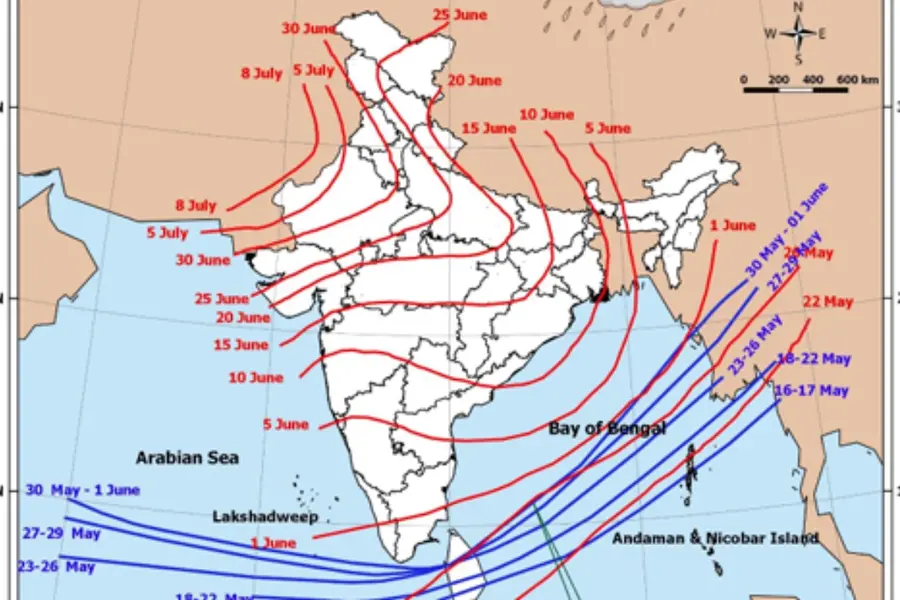
As clouds gathered and rain lashed parts of Kerala in late May and early June, many expected the India Meteorological Department (IMD) to declare the onset of the southwest monsoon.
However, despite receiving significant rainfall, Kerala was still waiting for the official monsoon announcement.
Also Read

The unusual situation has highlighted an important scientific fact: Rain alone does not mean the monsoon has arrived.
Why rain does not automatically mean monsoon
The IMD follows a strict set of criteria before declaring the onset of the southwest monsoon over Kerala.
Meteorologists assess three major factors:
- Widespread rainfall across designated monitoring stations
- Strong and sustained low-level and upper-level wind patterns
- Persistent cloud activity and atmospheric organisation
While rainfall was present in Kerala, the supporting wind and cloud structures needed for a full-fledged monsoon system were not sufficiently developed. As a result, the weather department refrained from declaring the official onset despite wet conditions across parts of the state.
The missing ingredient: Weak cross-equatorial winds
One of the biggest reasons behind the delay was the weakness of cross-equatorial winds.
These winds originate in the southern hemisphere and cross the equator before moving into the Arabian Sea and Bay of Bengal. They carry enormous amounts of moisture and act as the engine that drives the southwest monsoon towards India.
This year, meteorologists observed that these winds remained weaker than normal. Without strong moisture transport and atmospheric circulation, the monsoon system struggled to organise itself even though rainfall had already begun in some areas.
The weaker winds prevented the monsoon from gaining the strength required for a decisive advance over Kerala.
The surprising role of a typhoon thousands of kilometres away
One of the most unusual aspects of the 2026 monsoon delay was the influence of a developing typhoon in the western Pacific Ocean.
Although located far from India, large tropical weather systems can affect atmospheric circulation across vast regions. Weather experts believe the typhoon altered wind patterns over the Indo-Pacific region, effectively drawing moisture and atmospheric energy away from the Indian Ocean.
The diversion reduced the strength of monsoon currents over the Arabian Sea, slowing the development of favourable conditions near the Kerala coast.
The event serves as a reminder that the Indian monsoon is part of a much larger global weather system. Weather disturbances occurring thousands of kilometres away can sometimes influence rainfall patterns across the Indian subcontinent.
Bay of Bengal weather systems added to the disruption
The Pacific typhoon was not the only challenge facing the monsoon.
Meteorologists also identified a cyclonic circulation over the Bay of Bengal and adjoining ocean regions. Instead of helping the monsoon strengthen, this circulation disrupted the large-scale atmospheric flow needed for the monsoon's smooth advance.
The competing weather system interfered with the organisation of winds and moisture transport, further delaying the establishment of monsoon conditions over Kerala.
The El Niño factor
Another development being closely monitored is the gradual emergence of El Niño conditions in the Pacific Ocean.
El Niño is a climate phenomenon associated with warming ocean temperatures in the central and eastern Pacific. Historically, many El Niño years have been linked to weaker monsoons and below-normal rainfall over India.
While El Niño was not the direct cause of the delayed onset, meteorologists say it contributed to a broader atmospheric environment that was less favourable for rapid monsoon development.
The IMD has already projected below-normal rainfall for the 2026 monsoon season, making the delayed onset particularly significant for agriculture, water management and economic planning.
The monsoon was almost at Kerala's doorstep
Perhaps the most remarkable aspect of the delay was how close the monsoon actually was.
Weather assessments indicated that the monsoon system had at times reached areas just off the Kerala coast. However, without adequate wind strength and organised cloud activity, it could not make the final push inland.
This led to repeated revisions of onset expectations, with forecasts shifting from May 26 to May 28, then June 1 and eventually into the first week of June.
When is the monsoon expected to arrive?
Meteorologists expect conditions to improve between June 4 and June 6 as stronger winds develop over the Arabian Sea and cloud formations become more organised.
These developments are expected to satisfy the IMD's criteria for officially declaring the onset of the southwest monsoon over Kerala.
Although the delay may amount to only a few days, the combination of weak cross-equatorial winds, a distant Pacific typhoon, Bay of Bengal disturbances and emerging El Niño conditions has made the 2026 monsoon onset one of the most unusual and closely watched in recent years.
The episode also highlights the growing complexity of weather forecasting in an interconnected climate system, where events occurring thousands of kilometres away can influence the timing of India's most important rainy season.
Published: 03 Jun 2026, 03:17 pm IST
Related Topics
Disclaimer: Kindly avoid objectionable, derogatory, unlawful and lewd comments, while responding to reports. Such comments are punishable under cyber laws. Please keep away from personal attacks. The opinions expressed here are the personal opinions of readers and not that of Mathrubhumi.