
The women’s reservation bill has been defeated in the Lok Sabha after failing to secure the required two-thirds majority in a division vote.
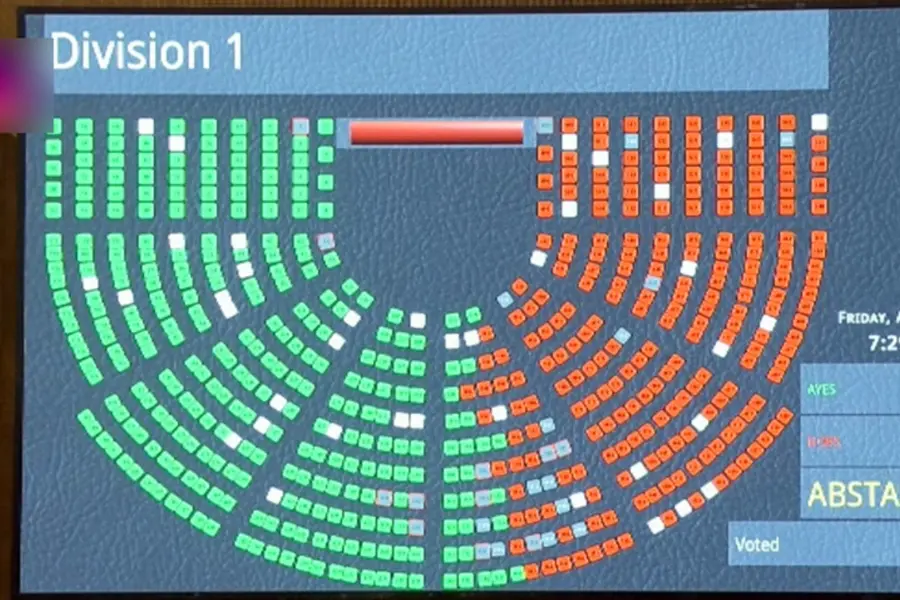
The constitution amendment bill proposing changes linked to women’s reservation in legislatures by 2029 and an expansion of the lok sabha strength to around 850 seats was defeated in the lok sabha on Friday, April 17, 2026, after failing to secure the required two-thirds majority.
Voting outcome in lok sabha
Also Read

The division of votes showed numerical support for the bill but not the required constitutional threshold. Out of 528 members present and voting, 298 MPs voted in favour of the bill, while 230 MPs voted against it.
For a constitution amendment to be passed in the lok sabha, it requires a two-thirds majority of members present and voting. In this case, the required mark was 352 votes, meaning the bill fell short despite a clear simple majority in favour.
Following the result, the bill was declared defeated in the house. The government later indicated that it would not proceed with two related bills, stating that the proposals could not be viewed in isolation.
Government response
Parliamentary affairs minister Kiren Rijiju expressed disappointment over the outcome, calling it a missed opportunity to build consensus on a major constitutional reform.
He added that such significant legislative changes require broader agreement across political parties, especially when dealing with representation and electoral structure.
Key arguments during debate
During the debate in the lok sabha, home minister Amit Shah defended the government’s position, stating that the imbalance in representation between voters and members of parliament could be addressed through delimitation.
He argued that delimitation would help correct disparities in representation across states and constituencies and ensure a more balanced electoral structure.
Leader of opposition Rahul Gandhi strongly opposed the bill. He said the proposal was not genuinely aimed at women’s reservation, but was instead an attempt to change the electoral map of the country.
He further argued that the changes could reduce representation for southern states, northeastern states, and smaller states, raising concerns over federal balance and fair representation.
Constitutional procedure and implications
Under article 368 of the constitution of india, a constitution amendment bill must be passed separately by both the lok sabha and the rajya sabha with a two-thirds majority of members present and voting.
If either house rejects the bill, it lapses immediately and cannot be moved forward in its existing form. Unlike ordinary legislation, constitutional amendment bills cannot be resolved through a joint sitting of parliament.
This means the defeat in the lok sabha effectively ends the bill’s legislative journey unless a fresh proposal is introduced.
Political and parliamentary impact
The defeat marks a significant setback for the government, as constitutional amendments generally require broad political consensus due to the high voting threshold.
However, constitutional conventions indicate that the defeat of a bill does not automatically require the resignation of the government. In the absence of a loss of majority or a failed confidence motion, the council of ministers continues to function.
The lok sabha was adjourned after the proceedings and is scheduled to reconvene on April 18, 2026, Saturday at 11am.
Published: 17 Apr 2026, 07:44 pm IST
Related Topics
Disclaimer: Kindly avoid objectionable, derogatory, unlawful and lewd comments, while responding to reports. Such comments are punishable under cyber laws. Please keep away from personal attacks. The opinions expressed here are the personal opinions of readers and not that of Mathrubhumi.