
Congress chief Mallikarjun Kharge has asserted that the opposition will defeat the Delimitation Bill in the Lok Sabha, banking on numbers, unity, and a strong political pitch.
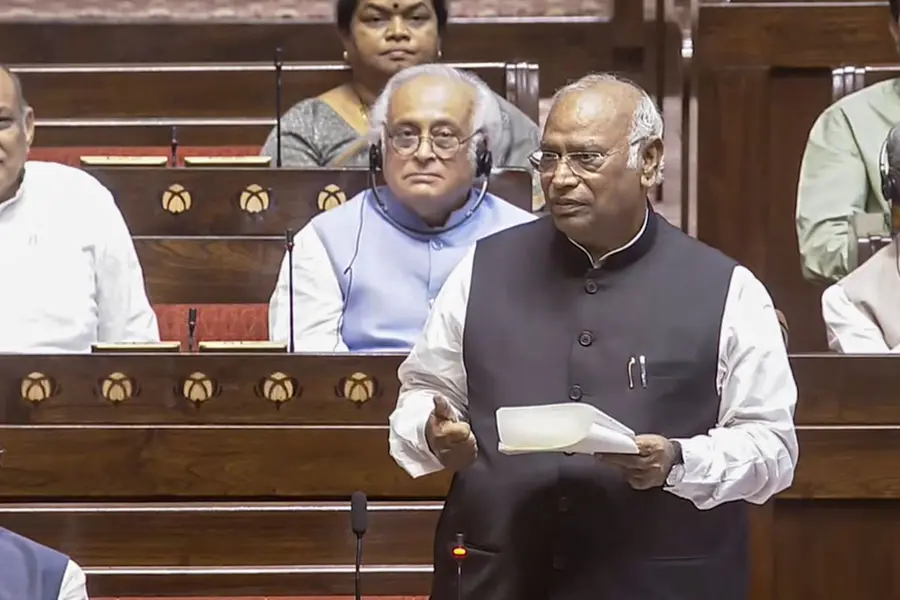
A political flashpoint is brewing in Parliament as Congress president Mallikarjun Kharge signalled an aggressive push by the opposition to block the proposed Delimitation Bill in the Lok Sabha.
With discussions underway on the Constitution (131st Amendment) Bill, 2026, and related legislations, the INDIA bloc is now shifting focus from protest to strategy.
Kharge made it clear that opposition MPs will not just oppose but attempt to defeat the legislation outright.
“Our people are fighting and will defeat it in the Lok Sabha,” he said, underlining a coordinated approach among alliance partners.
Numbers game and whip strategy
At the heart of the opposition’s plan lies arithmetic. The Centre requires a two-thirds majority, 362 votes, to pass the constitutional amendment.
The INDIA bloc is betting that if it can ensure full attendance of its MPs and prevent cross-voting, it can make it difficult for the government to reach that mark.
The Congress has already issued a three-line whip to ensure the presence of all its Lok Sabha MPs during the crucial April 16–18 sitting.
Other opposition parties are expected to follow suit, turning the vote into a tight headcount battle.
Framing the political narrative
Beyond numbers, the opposition is also attempting to shape public perception.
Several leaders have raised concerns that delimitation based on the 2011 Census could disproportionately impact southern states by reducing their representation.
Congress MP K Suresh termed the bill “dangerous,” alleging it could politically weaken opposition parties.
Meanwhile, CPI MP P Sandosh questioned the government’s decision to link delimitation with census and women’s reservation, calling it a move that could affect the federal structure.
By separating their support for the Women’s Reservation law from their opposition to delimitation, INDIA bloc parties are trying to avoid being seen as anti-reform while sharpening their critique of the government’s intent.
Unity test for INDIA bloc
The vote is also shaping up as a test of opposition unity. With multiple parties involved, coordination on messaging, attendance, and voting discipline will be crucial.
Any cracks, abstentions, or cross-voting could tilt the balance in favour of the government.
On the other side, NDA leaders have dismissed the opposition’s concerns. JD(U) MP Sanjay Kumar Jha questioned the protests, pointing out that the Women’s Reservation law was passed unanimously in 2023 and arguing that no changes have been made to delimitation provisions.
As the debate intensifies, the Lok Sabha is set for a high-stakes political contest where numbers, narrative, and unity will determine whether the opposition can translate Kharge’s assertion into a legislative roadblock.
Published: 17 Apr 2026, 02:25 pm IST
Disclaimer: Kindly avoid objectionable, derogatory, unlawful and lewd comments, while responding to reports. Such comments are punishable under cyber laws. Please keep away from personal attacks. The opinions expressed here are the personal opinions of readers and not that of Mathrubhumi.
