
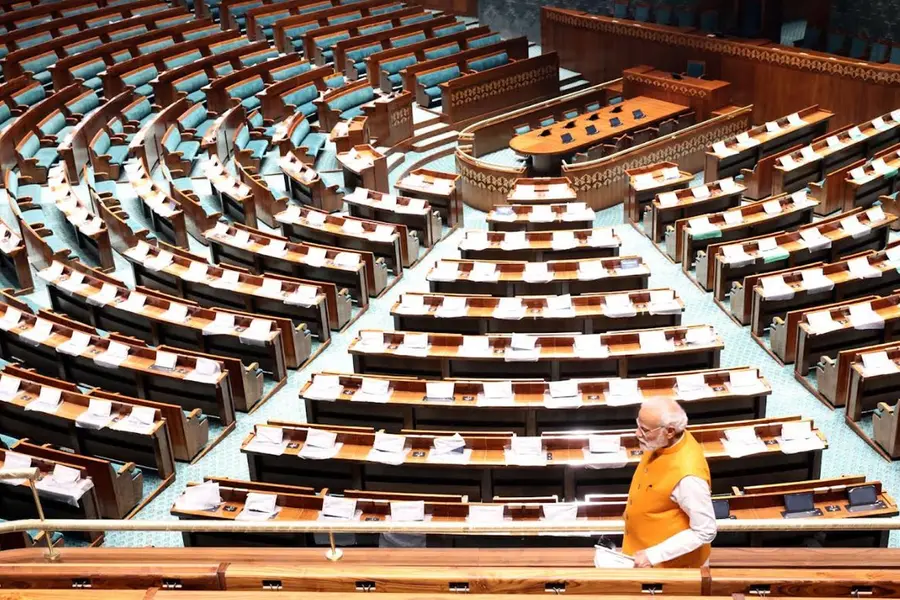
The Narendra Modi government has found itself falling short a number of times during the ongoing parliamentary session over the lack of centralized data on several critical issues.
These include examination paper leaks, discrimination against SC/ST students, suicides among medical interns in government hospitals, and losses caused by natural calamities. These revelations were made in response to questions raised by parliamentarians in both the Rajya Sabha and Lok Sabha.
No data on ration card exclusions from e-KYC
The Union government informed Parliament on December 4 that it has no data on whether the mandatory e-KYC verification process has led to the exclusion of ration cardholders, particularly affecting migrant populations. Minister of State for Consumer Affairs, Food and Public Distribution Nimuben Jayantibhai Bambhaniya clarified that the e-KYC process is conducted by state governments, making them responsible for ensuring inclusivity.
"The e-KYC process is carried out by states/Union Territories. No data of ration cards canceled due to the implementation of e-KYC is available with the Department of Food and Public Distribution," Bambhaniya said in response to Congress MP Sasikanth Senthil’s query. The e-KYC process requires each family member to physically authenticate their identity through Aadhaar at the ration shop, a move criticized by the Right to Food Campaign for disproportionately impacting genuine beneficiaries, especially migrants.
No records on examination paper leaks
On December 2, Minister of State for Education Sukanta Majumdar told the Lok Sabha that data on examination paper leaks is not centrally maintained. He explained that competitive exams are conducted by various bodies, and incidents specific to individual exams are not recorded at the central level.
Addressing concerns over the alleged mismanagement of the National Eligibility-cum-Entrance Test (NEET), Majumdar stated that reports of cheating and malpractice had emerged, prompting the Ministry of Education to direct the Central Bureau of Investigation (CBI) to investigate.
No central data on losses from natural calamities
On December 4, Minister of State for Home Affairs, Nityanand Rai, informed the Rajya Sabha that the central government does not maintain data on losses caused by natural calamities. Responding to a query by MP Randeep Singh Surjewala about the Wayanad landslide, Rai stated that data on casualties, injuries, and disabilities from natural disasters is not centrally recorded.
However, he cited a memorandum from the Kerala government dated August 17, 2024, which reported 359 deaths or missing persons, 95 individuals with disabilities exceeding 40%, and 378 injured persons hospitalized due to the Wayanad landslide. The central government formed an Inter-Ministerial Central Team (IMCT) in August 2024 to assess the damage without waiting for the state’s memorandum.
No records on medical intern suicides
The Ministry of Health and Family Welfare revealed on December 3 that it does not maintain data on suicides among medical interns in government hospitals. Minister of State Prataprao Jadhav, in response to MP Sukhendu Sekhar Ray, stated that such data is not centrally-compiled.
The minister highlighted that the National Medical Commission's Anti-Ragging Committee established a 15-member National Task Force (NTF) in February 2024 to address the mental health and well-being of medical students. The NTF has recommended centralized reporting systems to monitor suicides and address systemic issues.
Discrimination against SC/ST students
The Union government also admitted to the lack of centralized data on discrimination faced by SC/ST students in educational institutions. Minister of Social Justice and Empowerment Virendra Kumar, in reply to MP Alok Kumar Suman, stated that discrimination cases are not centrally recorded.
Citing National Crime Records Bureau (NCRB) data, Kumar noted a rise in crimes and atrocities against SC/STs, with over 5.24 lakh cases registered between 2013 and 2022. To curb discrimination, steps such as establishing SC/ST cells, Equal Opportunity Cells, and grievance redressal mechanisms in higher educational institutions have been implemented.
Agencies
Published: 05 Dec 2024, 04:43 pm IST
Related Topics
Disclaimer: Kindly avoid objectionable, derogatory, unlawful and lewd comments, while responding to reports. Such comments are punishable under cyber laws. Please keep away from personal attacks. The opinions expressed here are the personal opinions of readers and not that of Mathrubhumi.
