
The Supreme Court has sought responses from the Centre, states and the Election Commission on a plea challenging the use of Aadhaar as proof of citizenship, residence and age in voter registration, arguing it should be strictly limited to identity verification.
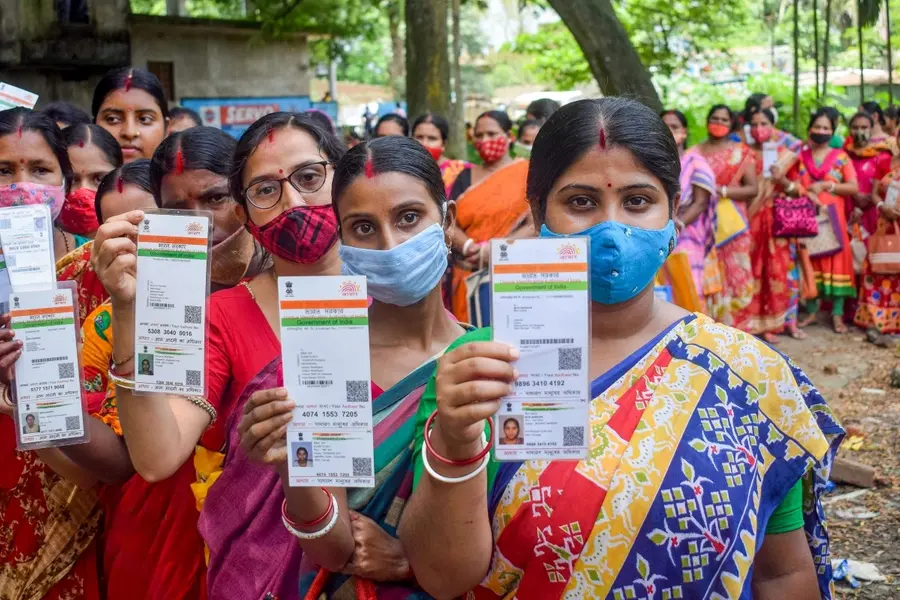
New Delhi: Can an Aadhaar card be used to establish citizenship and help secure a place on India's electoral rolls? The Supreme Court on Tuesday agreed to examine that contentious question, issuing notices to the Centre, state governments and the Election Commission of India on a plea alleging that Aadhaar is being used far beyond what the law actually permits.
The petition argues that while Aadhaar has become India's most widely accepted identification document, the Aadhaar Act explicitly states that it cannot be treated as proof of citizenship, domicile, address or date of birth. Yet, according to the plea, it is routinely accepted in situations where those very credentials are required — including voter registration.
A Bench comprising Chief Justice of India Surya Kant and Justice V Mohana sought responses from the Union government, states and the Election Commission on the Public Interest Litigation (PIL) filed by advocate Ashwini Kumar Upadhyay.
The PIL challenges the use of Aadhaar in Form 6, the application submitted by eligible citizens seeking inclusion in electoral rolls. The petitioner contends that permitting Aadhaar to be furnished as proof of age and residence for voter enrolment runs contrary to the legal framework governing the identity document.
Filed under Article 32 of the Constitution, the plea seeks a declaration that the acceptance of Aadhaar as proof of date of birth and residence in Form 6 is inconsistent with Section 9 of the Aadhaar Act, 2016, Section 23(4) of the Representation of the People Act, 1950, and violates Article 14, which guarantees equality before the law.
Section 9 of the Aadhaar Act makes it clear that an Aadhaar number does not, by itself, confer any right of citizenship or domicile. The petition also cites a clarification issued by the Unique Identification Authority of India (UIDAI) on August 22, 2023, reiterating that Aadhaar serves only as proof of identity and cannot be used as conclusive evidence of citizenship, address or date of birth.
Despite these legal safeguards, the petitioner claimed that Aadhaar is increasingly being relied upon for purposes extending well beyond identity verification. According to the plea, the document is frequently accepted during school admissions, applications for ration cards and driving licences, property transactions and electoral enrollment processes that require proof of residence, age or nationality.
The petition further alleged that weak verification mechanisms allow illegal immigrants and infiltrators to obtain Aadhaar cards and subsequently use them as foundational documents to secure additional identity records, including voter identity cards. Such practices, it argued, could compromise both the integrity of welfare delivery systems and the credibility of electoral rolls.
Raising concerns over the broader implications of illegal infiltration, the plea invoked Articles 14, 19, 21, 29, 326, 327 and 355 of the Constitution. It argued that unauthorised migration has consequences that extend beyond documentation, potentially affecting electoral integrity, demographic balance, public resources and national security.
The petitioner also relied on the Supreme Court's observations in the Sarbananda Sonowal versus Union of India case, where large-scale illegal migration was described as amounting to "external aggression and internal disturbance".
Among the directions sought, the plea has urged the apex court to ensure that Aadhaar is accepted strictly as proof of identity and only in the manner envisaged under Section 9 of the Aadhaar Act and the UIDAI's 2023 clarification.
With ANI inputs
Published: 16 Jun 2026, 08:10 pm IST
Related Topics
Disclaimer: Kindly avoid objectionable, derogatory, unlawful and lewd comments, while responding to reports. Such comments are punishable under cyber laws. Please keep away from personal attacks. The opinions expressed here are the personal opinions of readers and not that of Mathrubhumi.
