
The latest National Family Health Survey (NFHS-6) has identified Madhya Pradesh as the state with the highest child malnutrition levels in India, with key indicators showing a significant deterioration over the past five years.
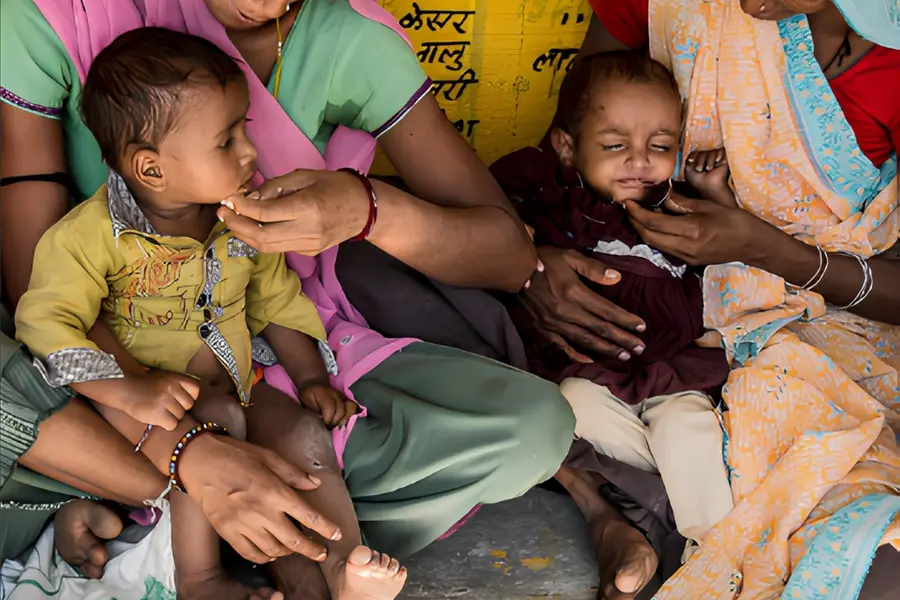
Madhya Pradesh has emerged as the worst-performing state in India on child malnutrition indicators, according to the latest findings of the National Family Health Survey (NFHS-6). The report shows a concerning rise in the number of undernourished children despite years of government nutrition programmes and welfare interventions.
The findings have renewed concerns about child health and food security in the state, particularly after several recent cases of severe acute malnutrition were reported from districts such as Satna and Chitrakoot.
Also Read

What does the NFHS-6 data show?
The survey found that Madhya Pradesh now has the highest proportion of children suffering from wasting in the country.
Wasting (low weight for height)
- NFHS-6: 23.8%
- NFHS-5: 18.9%
Increase: Nearly 5 percentage points
Wasting is considered one of the most serious indicators of malnutrition because it reflects acute undernutrition and increases the risk of illness and mortality among children.
The national average for wasting stands at 19%, meaning Madhya Pradesh is significantly above the country's overall rate.
Underweight children
The state also ranked second nationally in the proportion of underweight children.
- Madhya Pradesh: 39.7%
- Jharkhand: 41.1%
- National average: 31.8%
The latest figure represents a sharp increase of 6.7 percentage points compared with the previous survey.
One positive trend: Stunting declines
Despite worsening figures in other indicators, Madhya Pradesh recorded improvement in reducing stunting among children.
Stunting (low height for age)
- NFHS-5: 31.4%
- NFHS-6: 24.5%
Stunting reflects chronic malnutrition over a long period and is associated with poor physical and cognitive development.
The decline suggests that some long-term nutrition interventions may be having an impact, although experts caution that progress remains uneven.
Why are experts concerned?
Health experts note that wasting and underweight rates are often linked to inadequate nutrition during infancy and early childhood.
The survey also found a decline in exclusive breastfeeding rates in Madhya Pradesh, reflecting a trend observed in several states across India. Reduced breastfeeding and poor complementary feeding practices can significantly increase the risk of malnutrition among young children.
The report further highlighted that many children aged six to 23 months were not receiving adequate nourishment during a critical stage of growth and development.
Government schemes under scrutiny
The findings have placed renewed focus on the effectiveness of nutrition programmes in the state.
In 2025-26, the Madhya Pradesh government announced the Yashoda Scheme, which promised the distribution of tetra-pack milk to children through schools and anganwadis.
However, more than a year later, the programme has not yet been implemented.
Officials have stated that logistical challenges, including finalising suppliers and procurement costs, have delayed the rollout. The scheme is expected to cover nearly eight million children every day.
How much is being spent on nutrition?
State spending on nutrition-related programmes has remained broadly stable at around ₹1,500 crore in recent years.
However, budget allocations have shifted:
Poshan Scheme funding reduced from ₹1,300 crore in 2024-25 to ₹1,150 crore in 2026-27.
Poshan Abhiyan funding increased from ₹42 crore to ₹250 crore.
Officials argue that increased investment in targeted nutrition interventions will help improve outcomes, while critics say implementation remains the biggest challenge.
Political reactions
The findings have sparked political debate in the state.
Opposition leaders have accused the government of failing to adequately address child malnutrition despite years of welfare schemes and budget allocations.
The state government, however, maintains that it is actively working to tackle the problem through region-specific initiatives and community-based programmes aimed at improving child nutrition and health outcomes.
Why the report matters
The NFHS is India's most comprehensive health and demographic survey and is widely used by policymakers to assess public health challenges.
The latest findings underscore that child malnutrition remains one of Madhya Pradesh's most pressing social and health concerns. While improvements in stunting offer some encouragement, rising levels of wasting and underweight children suggest that significant gaps remain in nutrition delivery, healthcare access and early childhood support systems.
Published: 02 Jun 2026, 03:20 pm IST
Related Topics
Disclaimer: Kindly avoid objectionable, derogatory, unlawful and lewd comments, while responding to reports. Such comments are punishable under cyber laws. Please keep away from personal attacks. The opinions expressed here are the personal opinions of readers and not that of Mathrubhumi.