
With the proposed service documents ordered to be compiled by the end of November, the legal spotlight shifts back to how Indian courts will react.
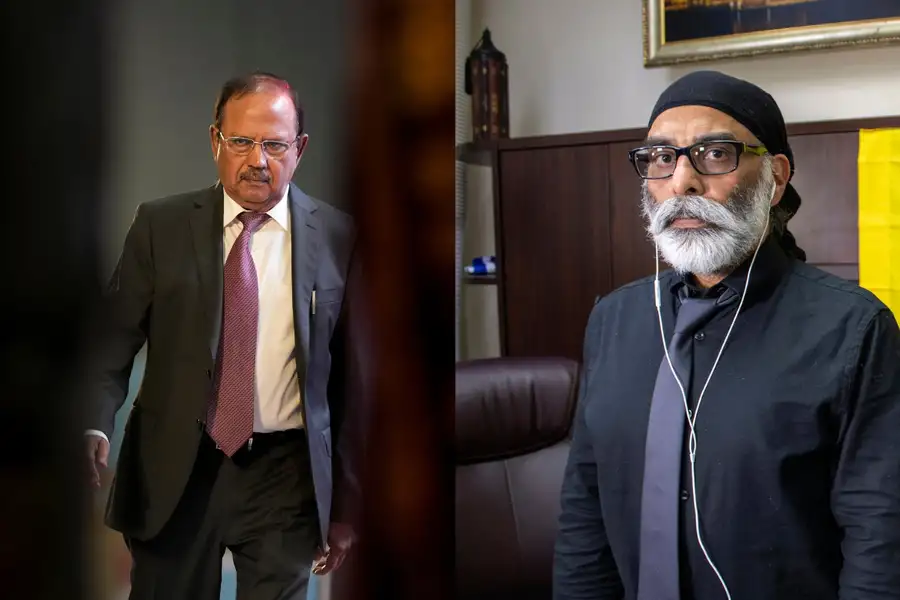
A federal court in the United States has initiated a fresh attempt to deliver legal papers to India's National Security Advisor, Ajit Doval, and former head of the Research and Analysis Wing, Samant Goel. US District Judge Katherine Polk Failla, presiding in the Southern District of New York, issued an order instructing the court clerk to dispatch summonses and accompanying judicial documents directly to district courts in Delhi. Under this arrangement, paperwork intended for Ajit Doval is to be forwarded to the Patiala House District Court, whilst documents concerning Samant Goel are directed to the Tis Hazari and Dwarka district courts. The order stems from a civil lawsuit filed in September 2024 by Gurpatwant Singh Pannun, an American-Canadian legal counsel representing the banned organisation Sikhs for Justice. Pannun, who is listed as a designated terrorist by Indian authorities, has alleged that Indian officials conspired to target him in New York during 2023.
India rejects lawsuit as baseless while legal questions remain
The Ministry of External Affairs in New Delhi has firmly pushed back against the legal proceedings. Official spokesperson Randhir Jaiswal stated publicly that India completely rejects these frivolous court actions and characterises the allegations against top security figures as fabricated and malicious. The Indian government maintains that foreign legal papers cannot simply bypass established official protocols. Under Indian law, any request from a foreign jurisdiction to serve judicial documents on individuals residing within India must strictly pass through the country's designated central authority, which is the Department of Legal Affairs inside the Ministry of Law and Justice. Despite New Delhi's stance, Judge Failla accepted an argument presented by Pannun's legal team. They contended that Article 19 of the Hague Convention allows litigants to use domestic civil procedure laws, specifically referencing Section 29(c) of India's Code of Civil Procedure along with Order V Rules 21 and 23, to transmit foreign summonses directly to local Indian courts.
How diplomatic and central channels hit a roadblock
This unusual legal manoeuvre follows multiple failed attempts to hand over court papers. According to American court records, process servers previously tried three times to personally deliver summonses to Ajit Doval during his official visits to the United States, but security teams intervened on every occasion. Later, Pannun's legal team attempted to process the paperwork through India's Ministry of Law and Justice under standard Hague Convention rules, but Indian authorities returned the documents, noting that the civil lawsuit fell outside the treaty's coverage. US court officials also turned down several alternative suggestions, such as emailing documents to India's Attorney General, serving lawyers involved in connected criminal matters, or publishing public notices in newspapers. Separately, the United States State Department delivered lawsuit documents regarding the Government of India itself directly to the Indian Embassy in Washington via a formal diplomatic note, a process governed under the Foreign Sovereign Immunities Act rather than standard individual rules.
New York court prepares to sentence Indian businessman Nikhil Gupta
As the civil summons issue unfolds, attention in New York turns to a separate but closely linked criminal proceeding. Today, Friday November 20, fifty-five-year-old Delhi businessman Nikhil Gupta is scheduled to appear before US District Judge Victor Marrero for sentencing in Manhattan at around 10 am local time. Gupta was arrested by authorities in the Czech Republic in June 2023 and subsequently extradited to the United States a year later, remaining in federal custody ever since. Earlier this year, he entered a guilty plea to three federal charges: murder-for-hire, conspiracy to commit murder-for-hire, and money laundering conspiracy. American prosecutors contend that Gupta acted as a primary intermediary in a plot to eliminate Pannun on American soil. Their investigation revealed that a person Gupta contacted to recruit an assassin was actually an informant working with the Drug Enforcement Administration, while the supposed hitman introduced to him was an undercover federal agent.
Prosecution demands heavy prison term citing gravity of offence
Federal prosecutors have submitted a detailed twenty-page filing requesting a severe sentence of nearly twenty-four and a half years in prison, representing the top end of federal sentencing guidelines. US Attorney James McDonald argued that Gupta's participation in an attempted political assassination of an American citizen was exceptionally brazen and ruthless. The prosecution highlighted recorded communications showing that Gupta instructed the undercover agent to eliminate anyone present alongside the primary target during the planned operation. Furthermore, prosecutors presented a three-page statement from Pannun describing how he has been forced to live under continuous armed security protection for over twelve hundred days, severely restricting his daily movement and professional activities. The government argued that imposing a top-tier prison term is essential to send an unmistakable deterrent message against state-sponsored violence targeting individuals for their political expression.
Defence pleads for leniency citing pressure and personal hardship
In contrast, Gupta's defence lawyers have urged the judge to follow a recommendation by the court's Probation Office for a reduced twelve-year sentence. They argued that Gupta has no prior criminal background and was suffering from unmanaged alcohol dependence when the events occurred. Defence filings emphasized that Gupta felt overwhelmed and coerced by co-conspirator Vikash Yadav, believing that a request from a government official carried the full weight of state authority that an ordinary citizen could not refuse. In a handwritten letter to Judge Marrero, Gupta expressed deep regret for his actions, sharing that time in solitary confinement led him toward yoga, daily prayer, and meditation, earning him the nickname Indian Yoga among fellow inmates. His legal team also submitted over forty character letters from family, neighbours, and local tradespeople in Delhi, including carpenters, electricians, welders, and taxi workers, appealing for mercy.
Explosive allegations reveal drug aircraft and weapons deal offers
Recent court submissions filed ahead of sentencing brought to light extraordinary details regarding co-defendant Vikash Yadav, a former officer in India's external intelligence agency. Prosecutors disclosed that Yadav offered lucrative side deals to Gupta's criminal contact to ensure the assassination was carried out smoothly. According to court records, Yadav allegedly offered to arrange official clearance at Imphal Airport in Manipur for a private aircraft carrying up to two thousand kilograms of illicit drugs. Additionally, he reportedly offered to supply military-grade firearms, including specialized AK-series assault rifles and Tokarev handguns. Recorded calls revealed that Yadav made these extraordinary favours strictly conditional on the successful execution of the New York plot. Following public disclosures of his involvement, Indian authorities confirmed that Yadav was no longer employed by the government, whilst Delhi Police separately arrested him in late 2023 on unrelated kidnapping charges before he was released on bail.
Canadian murder mystery linked to local gang rivalries
The prosecution filing also revisited the June 2023 killing of Hardeep Singh Nijjar, a Canadian Sikh activist shot dead outside a temple in British Columbia. Court documents revealed that Yadav sent Gupta a video showing Nijjar's body inside his vehicle shortly after the shooting, which Gupta immediately forwarded to his contact while claiming that multiple targets existed. However, a separate American federal indictment unsealed in July 2026 formally charged members of the Lawrence Bishnoi criminal syndicate with Nijjar's murder, attributing the killing to ongoing organized gang rivalries. Indian officials welcomed those charges, noting they align with New Delhi's long-standing position that Canadian incidents stemmed from underworld conflicts rather than state operations. Gupta's defence attorneys have argued that because he was never charged in connection with Nijjar's death, that incident should not be used to inflate his sentence in New York.
What happens next as Delhi courts receive foreign papers
With the proposed service documents ordered to be compiled by the end of November, the legal spotlight shifts back to how Indian courts will react. Legal experts in New Delhi clarify that receiving courts such as Patiala House, Tis Hazari, or Dwarka are not automatically bound to carry out the US court's request. When the papers arrive, an Indian judge possesses the discretion to either reject the transmission outright on the grounds that foreign summonses must arrive via the Ministry of Law and Justice, or formally accept the packet and solicit an official legal opinion from the ministry. Furthermore, Judge Failla in New York indicated she remains open to re-evaluating the transmission route if formal objections arrive from Indian government authorities. For now, the complex interplay between foreign civil suits, criminal trials, and domestic sovereign procedure leaves the final outcome in a state of delicate legal suspense.
Published: 20 Nov 2026, 08:19 am IST


Disclaimer: Kindly avoid objectionable, derogatory, unlawful and lewd comments, while responding to reports. Such comments are punishable under cyber laws. Please keep away from personal attacks. The opinions expressed here are the personal opinions of readers and not that of Mathrubhumi.
