
A LocalCircles survey finds 80% of consumers want front-of-pack warnings when packaged food is high in even one of sugar, salt or saturated fat, ahead of the Supreme Court hearing on September 10.
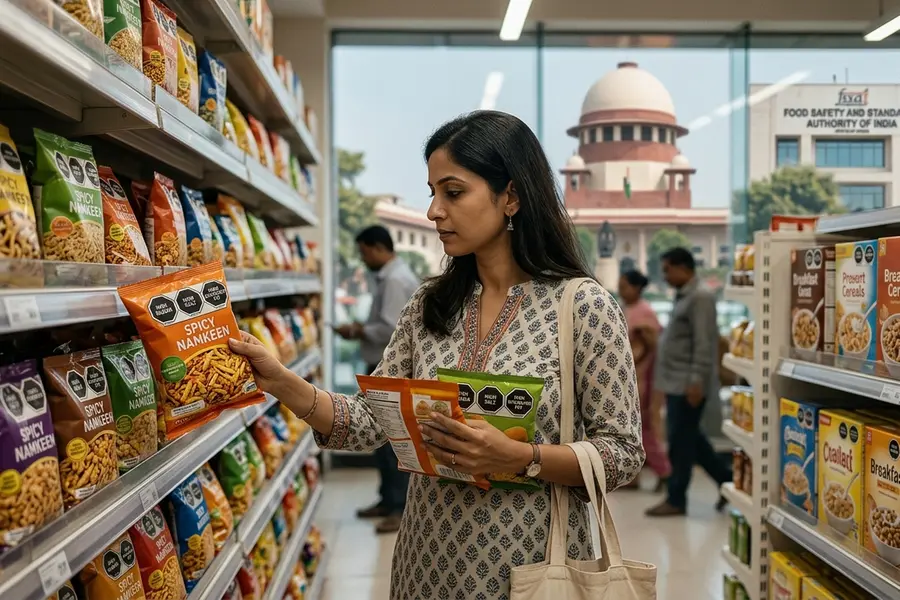
A survey of more than 108,000 household consumers across 328 districts has found strong support for stricter front-of-pack warning labels on packaged foods, with 80% saying a warning should be issued when a product is high in even one of sugar, salt or saturated fat.
The LocalCircles survey found that 80% of respondents want front-of-pack warnings to apply from the beginning when packaged food is high in any one of the three nutrients. Only 12% supported the proposed two-phase approach, under which products high in two or more nutrients would initially receive warnings.
Also Read

Consumers also overwhelmingly favoured prominent labels. About 88% said warnings should be large, clearly visible and immediately noticeable on the front of a package. Only 10% considered the proposed size adequate.
Demand for total nutrient information
The survey also found that consumers want labels to account for the total amount of sugar, salt and saturated fat in a product.
About 53% wanted warnings based on the total amount of these nutrients, while another 37% wanted both added and total amounts displayed prominently. Only 6% supported using added amounts alone.
This means 90% of respondents wanted total nutrient quantities reflected in some form.
Consumers want faster implementation
The survey showed strong support for a shorter implementation timeline. Around 88% said food companies should be required to introduce the warnings within six months after the rules are finalised.
The first draft of India's front-of-pack labelling rules was notified in September 2022, meaning the proposed system has remained under discussion for several years.
Online food sales also in focus
Consumers also want warning labels to appear when packaged food is sold online.
Around 89% said warnings should be displayed on both the product listing and product page before an item is added to a cart. Another 2% wanted the warning on the detailed product page.
The issue is increasingly relevant as consumers buy packaged food through e-commerce and quick-commerce platforms, where purchasing decisions can be made from small product images without seeing the physical packaging.
FSSAI proposal and Supreme Court hearing
The survey comes amid scrutiny of the Food Safety and Standards Authority of India (FSSAI)'s proposed front-of-pack warning system.
FSSAI told the Supreme Court on August 28 that it proposes red hexagonal warnings carrying declarations such as "High Sugar", "High Salt", "High Fat" or "Highly Sweetened Beverage". The matter is scheduled to come before the Supreme Court on September 10.
Under the proposed first phase, warnings would apply when a product is high in two or more of added sugar, salt and added saturated fat, along with certain sweetened beverages. Products high in only one nutrient could be covered in a later phase, although no date has been fixed for that phase.
Industry and policy debate
The proposed system has faced criticism from nutrition advocates, while packaged food companies have also raised concerns about how thresholds should be calculated.
The debate includes whether warnings should be based on added or total nutrients and whether thresholds should be calculated per 100 grams or according to serving size.
A Parliamentary Standing Committee on Consumer Affairs, Food and Public Distribution had also called on FSSAI to notify front-of-pack labelling rules without further delay and sought stronger monitoring of packaged foods sold online.
What the survey indicates
The LocalCircles findings show a consistent consumer preference for stricter and more visible warnings. Across the major questions, respondents largely favoured:
- warnings when even one key nutrient is high;
- large and clearly visible front-of-pack labels;
- disclosure of total nutrient quantities;
- implementation within six months; and
- warnings on online product listings and pages.
The survey was based on more than 108,000 responses from household consumers across 328 districts. LocalCircles said its polls had a margin of error below 4% and a confidence level above 96%.
The survey adds a consumer perspective to the regulatory debate ahead of the Supreme Court hearing. The central issue is whether India's proposed warning system should prioritise a narrower initial rollout based on multiple nutrients or provide consumers with an immediate warning whenever a packaged product is high in any one of the specified nutrients.
The findings also highlight a broader shift in how food labelling is being viewed. Consumers are not only seeking more information but also want that information to be visible at the point of purchase, including on digital shopping platforms.
The outcome of the regulatory and legal process could therefore influence how packaged food companies communicate nutritional risks on both physical packaging and online marketplaces.
Published: 08 Sept 2026, 03:13 pm IST
ABOUT THE AUTHOR
Disclaimer: Kindly avoid objectionable, derogatory, unlawful and lewd comments, while responding to reports. Such comments are punishable under cyber laws. Please keep away from personal attacks. The opinions expressed here are the personal opinions of readers and not that of Mathrubhumi.