
If you own a smart refrigerator or internet-connected home device, you might wonder if hackers can target your kitchen.
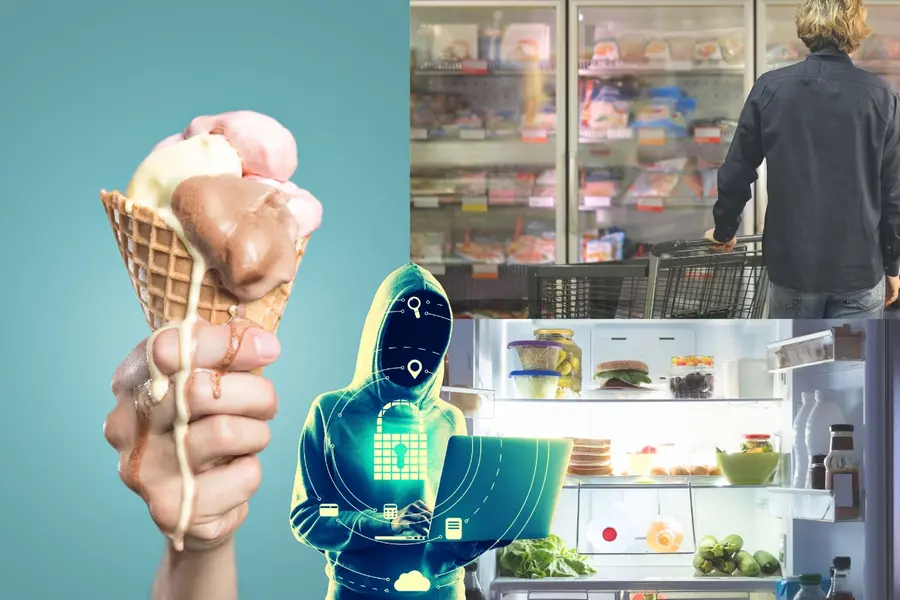
Supermarkets across six European countries have been hit by mysterious fridge and freezer disruptions. In Belgium, Luxembourg, Sweden, Ireland, the Netherlands, and Estonia, store cooling systems were unexpectedly manipulated overnight. Instead of keeping food frozen, the equipment switched into defrost mode, sending temperatures soaring to as high as 50 degrees Celsius.
This sudden heat melted ice cream, ruined fresh produce, and forced shop managers to dump millions of euros worth of spoiled food. In Belgium and Luxembourg, around 40 Delhaize supermarkets were affected, with one branch in Hoeilaart losing 100,000 euros (£83,500) in stock alone. Other Belgian chains, including Carrefour, Colruyt, and Intermarche, alongside an Ikea superstore in Mons, reported similar technical outages.
Across Sweden, several ICA and Coop stores saw their freezers hacked, forcing temporary store closures. Meanwhile, 13 SuperValu supermarkets in Ireland, a Selver store in Estonia, and at least 17 small businesses and butcher shops in the Netherlands faced identical disruptions. Refrigeration technicians worked through the night to disconnect affected equipment from networks. The UK National Cyber Security Centre confirmed it is monitoring the situation, though no British stores have been hit.
Where else has freezer sabotage been reported globally?
This is not an isolated incident. Just last month in France, over 350 to 500 supermarkets suffered identical cyberattacks, where extreme heat even caused some cooling units to catch fire and generated tens of millions of euros in damage.
Farther across the globe, the US Pentagon is investigating similar freezer failures that occurred in late August across six military base commissaries, including Fort Huachuca in Arizona. US Army criminal investigators and Cyber Command are now coordinating with French law enforcement to understand these outages. First flagged by a blog called Signal and Silence, the investigations were subsequently reported by Stars and Stripes and The Daily Telegraph.
Sabotaging cold storage over the internet has occurred before. In 2022, hackers targeted supermarkets in Russia and Israel using obsolete controllers. Last year, US prosecutors in Los Angeles accused a Ukrainian hacker group member of knocking out cooling systems at a meatpacking plant, ruining over 2,000 pounds of meat.
Why are cooling systems vulnerable and who is behind it?
It remains unclear who is responsible for these European attacks. However, cybersecurity experts explain that the core problem lies in how modern cooling equipment operates. Controllers manufactured by Danish firm Danfoss ran many of the affected systems. These devices were originally designed as standalone mechanical units for in-person maintenance, but store operators gradually connected them to the internet for remote control.
Many units were running obsolete software or outdated firmware, making them easy targets. System technicians noted that fixing this vulnerability requires physical hardware modifications, not just simple software updates.
Industry bodies like the Global Food Safety Initiative warn that a hacked cooling system is as dangerous as a broken one because it directly threatens the food supply chain. Cybersecurity analysts point out that attackers usually seek to steal data, disrupt essential services, or use connected appliances as digital gateways into larger corporate networks.
Are your home smart appliances at risk?
If you own a smart refrigerator or internet-connected home device, you might wonder if hackers can target your kitchen. In theory, any appliance connected to Wi-Fi can be breached. Researchers demonstrated this as early as 2015 by intercepting internet traffic from a smart refrigerator. Beyond fridges, connected security cameras, smart locks, video doorbells, thermostats, ovens, washing machines, and even smart toothbrushes carry vulnerabilities.
However, ordinary household devices are rarely primary targets. Routers account for more than 75 per cent of all cyberattacks on connected home electronics. Connected vehicles have also shown flaws, such as a 2015 remote hack of a moving Jeep that led to 1.4 million vehicle recalls, and a Kia vulnerability that allowed remote unlocking. Critical public utilities like power and water supplies remain much harder targets because they use multiple layers of specialised security.
To protect your smart appliances, experts advise changing factory default passwords, enabling two-factor authentication, updating software regularly, keeping devices on a local network, and disconnecting non-essential electronics from the internet.
Published: 02 Nov 2026, 08:48 pm IST


Related Topics
Disclaimer: Kindly avoid objectionable, derogatory, unlawful and lewd comments, while responding to reports. Such comments are punishable under cyber laws. Please keep away from personal attacks. The opinions expressed here are the personal opinions of readers and not that of Mathrubhumi.
