
Reports and ground investigations have revealed that Delhi’s air quality monitoring network may be showing misleading results
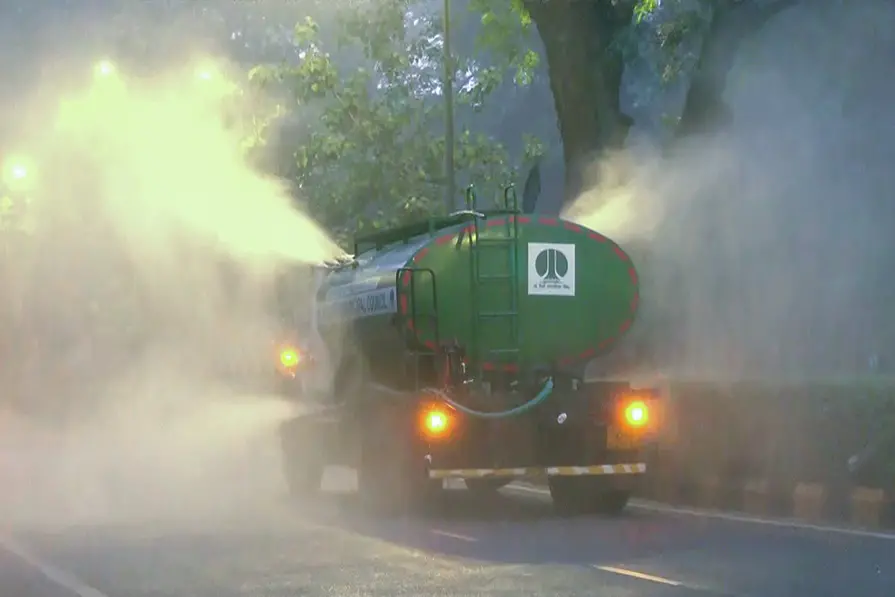
As Delhi once again battles hazardous air this season, allegations have surfaced that government agencies are manipulating air quality readings by spraying water around monitoring stations to make pollution levels appear lower.
Delhi ‘AQI fraud’: water sprinklers clean the data, not the air
Also Read

Reports and ground investigations have revealed that Delhi’s air quality monitoring network may be showing misleading results — not because the air is cleaner, but because the monitors themselves are being artificially “cleaned” with water.
At Jahangirpuri, one of Delhi’s officially designated pollution “hotspots,” a Newslaundry report found Public Works Department (PWD) tankers spraying water around a monitoring station inside the Industrial Training Institute (ITI) campus, while nearby debris and dust remained untouched. Drivers confirmed they were assigned by the PWD to spray twice daily between 11 am and 5 pm.
The Delhi government’s nine-point plan for pollution hotspots promised regular road cleaning, debris clearance, and waste removal. Instead, the only well-maintained patch appeared to be the one surrounding the pollution monitor.
Local residents told reporters that they have never seen tankers near their shops or homes, despite the choking dust and burning sensations in their eyes and throats.
Environmentalists have warned that such water spraying near air quality sensors can drastically distort pollution readings. “If water is sprayed near an air quality monitor, the recorded pollution levels will appear lower,” said environmentalist Vimlendu Jha. “It suppresses dust particles and makes the data artificially cleaner, hiding the true state of Delhi’s air.”
BJP government accused of ‘fake clean-ups’ and data manipulation
In a broader investigation, Media India Group reported that the BJP-led Delhi administration allegedly engaged in similar “clean image” tactics — from staging fake ghats with filtered water for Chhath Puja to installing new air monitoring stations in less polluted areas.
Environmental groups accused the government of creating the illusion of progress while avoiding genuine clean-up measures. AAP and independent activists claimed that spraying near sensors, selective data presentation, and temporary anti-foam chemicals in the Yamuna were all part of an image-management campaign.
Verhaen Khanna of the New Delhi Nature Society described it as “scientific fraud,” warning that suppressing particulate data misleads the public and policymakers. “This isn’t just data tampering — it’s gaslighting citizens already losing years of life expectancy due to polluted air,” he said.
Cloud seeding failure adds to criticism
The government’s much-publicised cloud-seeding experiment, costing over ₹32 million, also failed to produce measurable rainfall, with experts calling it “scientifically unviable” during dry winter conditions. Critics argued it was another publicity stunt aimed at deflecting criticism rather than improving air quality.
A crisis of trust, not just of air
Despite switching political roles, both AAP and BJP have been accused of prioritising optics over outcomes. While air quality remains among the world’s worst, Delhi continues to witness the same patterns — unfulfilled promises, manipulated data, and short-term measures.
Experts argue that Delhi’s environment crisis now reflects a deeper governance failure. “Each manipulated AQI reading and artificial pond fractures public trust,” said Khanna. “Citizens deserve transparency and enforcement, not press conferences and fake clean-ups.”
The controversy over Delhi’s air quality management deepened following reports from Newslaundry and Media India Group that alleged deliberate manipulation of pollution readings by state agencies. Evidence from Jahangirpuri and Anand Vihar showed PWD tankers repeatedly spraying water around monitoring stations — a practice environmentalists said can suppress PM2.5 and PM10 readings.
Critics also pointed to the creation of a “fake clean Yamuna” for Chhath Puja, with potable water brought from treatment plants for photo opportunities. Meanwhile, the real river remained polluted, with high levels of faecal contamination.
Data from CPCB indicated that 44% of Delhi’s sewage still flows untreated into the Yamuna, while several sewage treatment plants remain non-functional.
Despite these figures, the government’s public statements continue to highlight “improved” AQI scores and “successful” pollution control drives — data that experts now question.
Environmental analysts stress that long-term solutions must focus on stricter enforcement of emission norms, functional sewage treatment, industrial regulation, and urban planning — not superficial clean-ups.
Delhi’s pollution crisis, they warn, is no longer just an environmental issue but a test of governance integrity — a city cleansing its data while its citizens struggle to breathe.
Published: 03 Nov 2025, 09:30 am IST
Related Topics
Disclaimer: Kindly avoid objectionable, derogatory, unlawful and lewd comments, while responding to reports. Such comments are punishable under cyber laws. Please keep away from personal attacks. The opinions expressed here are the personal opinions of readers and not that of Mathrubhumi.