
Hundreds of teachers and sanitation workers were detained by police in Chennai on December 27, 2025, as protests demanding pay parity and job reinstatement escalated.
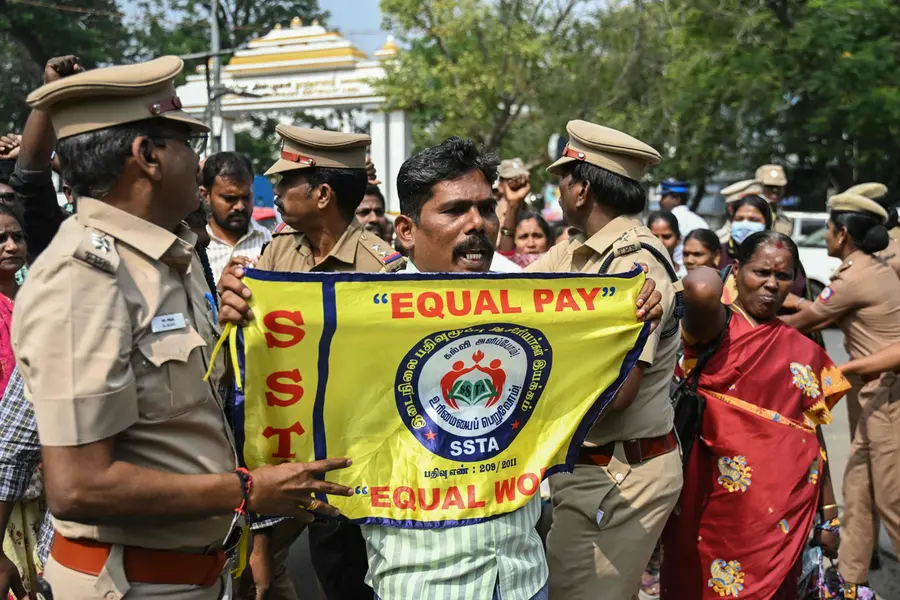
Chennai: Chennai saw widespread unrest on Saturday as over 1,500 secondary grade teachers and sanitation workers staged separate protests highlighting long-standing grievances.
Sanitation workers, mostly women, attempted to march from Parry’s Corner to the Secretariat to petition the Chief Minister regarding job losses linked to the Greater Chennai Corporation’s move to privatise solid waste management in two city zones. Despite staging the protest for over 150 days, authorities detained more than 500 workers after they attempted a sudden road roko, transporting them in 34 buses before releasing them later.
Also Read

Meanwhile, the Secondary Grade Seniority Teachers Association (SSTA) continued its protest for the second day outside the Chief Education Officer’s office in Egmore. Teachers demanded rectification of pay anomalies for those joining service after June 1, 2009. The discrepancy in basic pay stood at ₹3,170 lower than their predecessors, rising to over ₹9,000 due to subsequent pay commission revisions. Over 1,000 teachers were forcibly removed and detained by police, with several fainting and many suffering torn clothing during the removal process.
The protests have drawn attention to broader systemic issues: the implications of privatization on sanitation workers, gendered vulnerability of female employees, long-term pay inequities in the education sector, and administrative responses to public sector unrest. The police assured that legal procedures were followed and that detainees were released after initial processing.
Sanitation workers’ protests stem from the privatization of waste management in two Greater Chennai Corporation zones. They allege irregular termination and demand reinstatement with regularised pay and service benefits. The protest coincided with teachers’ demand for “same pay for same work,” highlighting disparities in service rules and pay commission adjustments for employees joining after June 2009.
The authorities deployed significant manpower to manage both protests, citing public safety concerns amid dense traffic and urban congestion. Social media videos of the incidents, showing police removing teachers and detaining sanitation workers, went viral, drawing national attention and criticism from labour unions and civic organisations.
The protests underline persistent gaps in policy implementation for public sector employees and municipal workers, raising questions about labour rights, transparency in privatization, and administrative measures to ensure safety and fairness during public demonstrations. Observers note that timely engagement with unions, equitable pay revisions, and structured dispute resolution mechanisms could mitigate such recurring unrest.
(With PTI inputs)
Published: 27 Dec 2025, 08:16 pm IST
Related Topics
Disclaimer: Kindly avoid objectionable, derogatory, unlawful and lewd comments, while responding to reports. Such comments are punishable under cyber laws. Please keep away from personal attacks. The opinions expressed here are the personal opinions of readers and not that of Mathrubhumi.