
Thiruvananthapuram: Historians warp much about the railways, democracy and rule of law on every possible occasion when it comes to the contributions of the British to India. Against this, the British historian William Dalrymple preferred to dissertate about maladies caused by the East India Company, the first multi-national company in India. The history of corporatisation of India starts from the East India Company, he says.
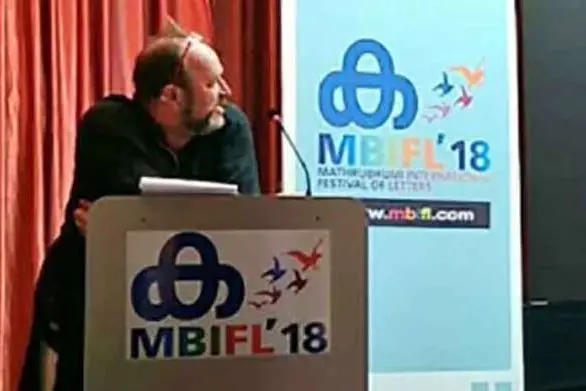
At Mathrubhumi International Festival of Letters at Kanakakkunnu Palace, Thiruvananthapuram on Saturday, he spoke about his latest book on the East India Company and delved deep into the past and present of corporatisation in India.
Actually, the merciless raids the English managed to conduct in a financially well-off India and the ill-gotten gains from it led Britain to progress and prosperity, he stated. Dalrymple also pointed out that the very first Indian word which found its place in the Oxford dictionary was loot, the Hindi word which means plunder. It was not just an accident. In 1765, Robert Clive, the then Bengal Governor and director of The East India Company had managed to muster the governance rights of Bengal, Bihar and Odisha through a treaty he had reached between the Mughal Emperor Shah Alam II, that was exactly the moment when the corporate rule had started in India. The British came upon the abundant mass of treasure and nobody knew for certain how much wealth they managed to squeeze out of its holders in Bengal. The British seized all the richness of the Bengal public treasury and stocked it up in 100 boats and sailed it to the headquarters of East India Company in Kolkata.
By the time Clive returned from India, his wealth was 2,34,000 pounds.He instantly rose to the position of the richest man in the whole of Europe simply on the strength of the lousy money he amassed from India. Clive and his men added 250 million pounds to the coffers of East India company. This burgeoning wealth gave the leverage to the East India company to purchase the British parliament members and topple democracy in there, Dalrymple pointed out.
After two and half a century, the world and India face the shocks of an indomitable corporatisation and its roots are going very deep back to the days of East India company. Actually, East India company was the empire within the British empire, the writer said.
Dalrymple also felt that the Adani, Ambani and Tata groups now show the same traits of the erstwhile East India Company. The ever-expanding powers of multinational corporations and the challenges they pose to the world still elude all efforts of solutions or answers. The nations are left with no clue on how to safeguard their polity from the power manipulations of the multinationals.
Trump reminds me of Clive
Dalrymple left the audience at the Kanakakkunnu Palace in splits when he said American President Donald Trump reminds him of Robert Clive. The statement also raised some serious concerns over the state of the world affairs.
Dalrymple drew interesting parallels between the two to prove how. Trump is a businessman to reach the White House. And he made it to the top of the world’s most powerful nation with the help of the corporates. Not just that, he resembles Clive even in his gestures and the way he carries himself, the writer said by pointing at the picture of the US president flashed on the screen behind.
Published: 04 Feb 2018, 09:54 am IST
Related Topics
Disclaimer: Kindly avoid objectionable, derogatory, unlawful and lewd comments, while responding to reports. Such comments are punishable under cyber laws. Please keep away from personal attacks. The opinions expressed here are the personal opinions of readers and not that of Mathrubhumi.
