
Santa Claus, long believed to move unseen, was spotted this Christmas on a live flight-tracking platform, where his sleigh appeared as a high-altitude “aircraft” cruising at 60,000 feet
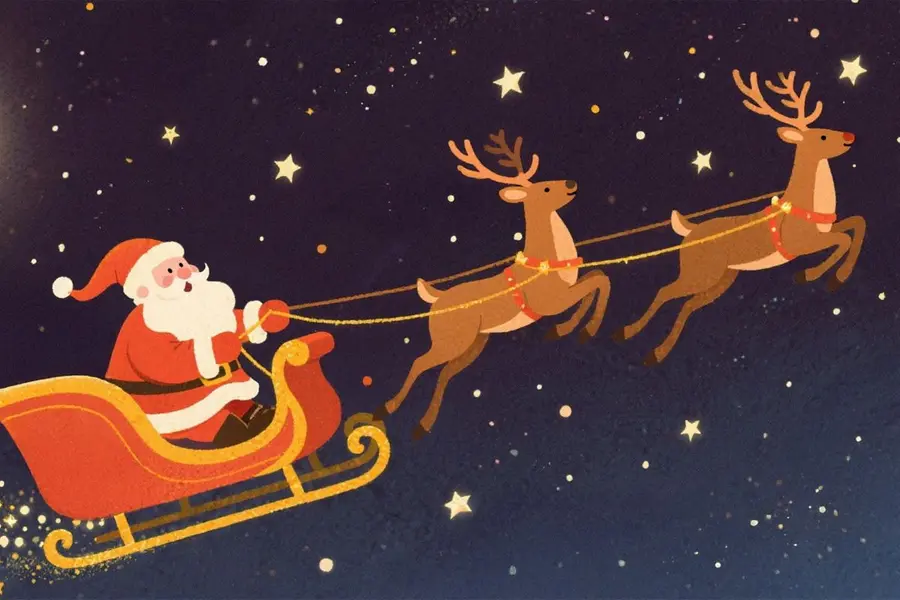
The magic of Christmas has always been built on belief, not proof. Santa Claus, known for staying unseen, was never supposed to leave any trace behind.
But as technology now tracks almost everything around us, even the most mythical journeys are harder to keep hidden. This December, a familiar Christmas tradition appeared on a global flight-tracking screen, and millions watched with curiosity.
Also Read

On December 23, aviation enthusiasts spotted an unusual ‘aircraft’ climbing to a staggering 60,000 feet on Flightradar24. The call sign read R3DN053. The aircraft type was listed as SLEI, sleigh. Its registration was HOHOHO.
The route showed XMS to XMS, North Pole to North Pole. Within minutes, Santa Claus’s sleigh became the most tracked flight globally, with thousands following his progress in real time.
Why did the Internet react so quickly?
In an era where even a takeaway order can be tracked to the doorstep, Santa’s legendary journey finally entered the digital age, and the internet was thoroughly entertained.
Flightradar24’s festive update confirmed that Santa had done his homework.
Air traffic controllers at the NUUK FIR even “confirmed” radar contact with Santa as he carried out slow-flight checks over the North Pole, gearing up for what is widely regarded as the busiest night in global airspace.
What did the live map reveal?
The live map became a festive spectacle. Santa’s red sleigh icon glided above Northern Europe, while commercial aircraft cruised far below, seemingly unaware that Christmas had officially entered controlled airspace.
The sleigh’s listed altitude sparked instant reactions online. “Even the North Pole doesn’t get privacy anymore,” joked one user, while another wrote, “Santa’s being intercepted over Norway.” A particularly popular comment summed up the mood neatly: “60,000 feet? Those reindeers are built different.”
According to the image data, the sleigh was ranked number one worldwide, tracked live by over 16,000 users and maintaining a steady course with zero vertical speed.
Why was Santa heading towards Finland?
Santa’s plotted course towards Rovaniemi, Finland, came as no surprise. Modern Christmas tradition increasingly places Santa’s official departure point in Lapland, right on the Arctic Circle. Rovaniemi, home to the famous Santa Claus Village, hosts a Grand Departure Celebration every December 23.
In contemporary folklore, Santa’s travels officially begin on December 23, often around 00:00 UTC.
Christmas began as a Christian festival celebrating the birth of Jesus Christ, with early records dating back to around 336 AD in Rome. These celebrations coincided with the winter solstice and drew influence from Roman festivals such as Saturnalia, which focused on feasting, light and renewal.
Over time, Christmas absorbed elements from pagan Yule traditions, including evergreen decorations and seasonal gatherings. As Christianity spread across Europe during the Middle Ages, the festival evolved into a blend of religious observance and cultural custom.
Santa Claus himself emerged from this layered history of belief and storytelling, inspired by figures such as Saint Nicholas and later shaped by literature and popular culture.
A legend reimagined for the digital age
This year’s appearance on a flight-tracking platform may have been playful, but it reflected something deeper. Even the most magical traditions now find a place within the digital world, where stories unfold not just through folklore, but through screens, maps and shared moments online.
Published: 26 Dec 2025, 08:01 am IST
Related Topics
Disclaimer: Kindly avoid objectionable, derogatory, unlawful and lewd comments, while responding to reports. Such comments are punishable under cyber laws. Please keep away from personal attacks. The opinions expressed here are the personal opinions of readers and not that of Mathrubhumi.