
Despite reforms and new policies, education system continues to focus on rote learning and grades—leaving students unequipped with the life skills they actually need to survive in the real world.
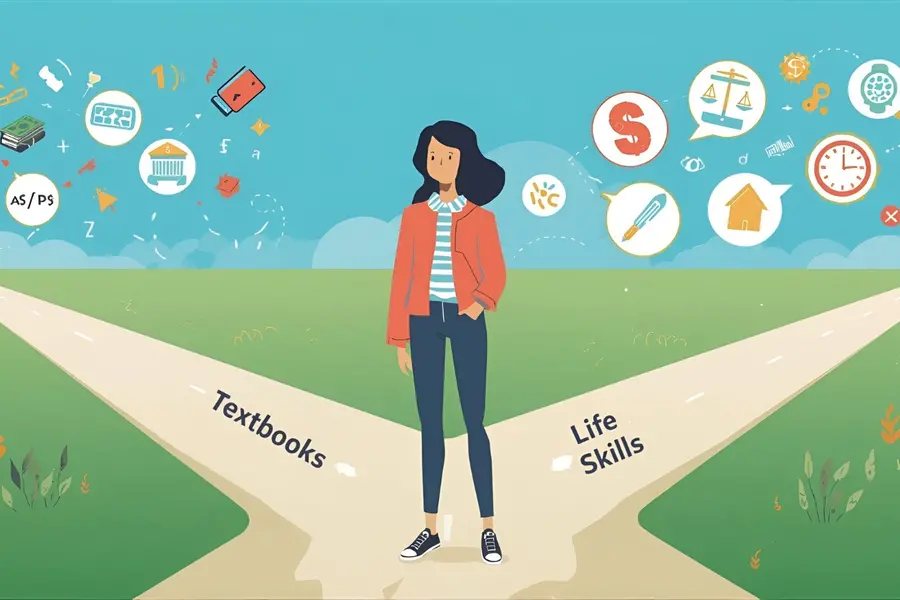
Although schools provide students with academic knowledge and grades, they often fail to equip them with the life skills needed to survive in the real world. India’s education system—rooted in colonial-era rote learning—continues to focus on marks, memorisation, and theoretical knowledge, leaving millions of students unprepared for financial, emotional, and professional realities.
While students can solve complex equations and memorise historical dates, few are taught how to manage money, navigate relationships, deal with failure, or adapt to a changing world driven by technology and mental health challenges.
The Problem with India’s Education System
India’s curriculum still mirrors a 19th-century model designed to produce clerks, not creators. Despite the introduction of the National Education Policy (NEP) 2020, implementation at the grassroots remains limited. Schools continue to prioritise exams over experience, ranks over reasoning, and conformity over creativity.
Practical subjects like financial literacy, emotional intelligence, or digital responsibility are rarely prioritised. As a result, many students graduate with degrees but lack the skills to manage basic life decisions—from handling stress to understanding taxes or building meaningful relationships.
10 Essential Life Skills Schools Forgot to Teach You
1. Communication Skills
Being able to express ideas clearly—both in writing and speech—is essential in every field. Strong communication builds confidence, teamwork, and leadership.
2. Critical Thinking
Students should be encouraged to question, analyse, and make independent decisions. Real-world success depends more on reasoning than rote memorisation.
3. Emotional Intelligence
Understanding emotions, practising empathy, and managing stress are crucial for building healthy relationships and professional stability.
4. Financial Literacy
Few schools teach students how to save, invest, or budget. Learning these skills early can prevent poor financial decisions and debt traps later in life.
5. Digital Literacy
In a tech-driven world, knowing how to navigate digital platforms safely and responsibly is vital. Cyber safety, online etiquette, and digital awareness should be part of basic education.
6. Adaptability and Flexibility
Today’s world changes faster than textbooks can keep up. The ability to unlearn, relearn, and adapt is key to survival in evolving industries.
7. Time and Stress Management
Balancing work, rest, and recreation is essential for long-term productivity and mental health—a skill often neglected in the rigid school routine.
8. Entrepreneurial Thinking
Schools rarely teach risk-taking, innovation, or problem-solving in real-life contexts. Yet, these skills are at the heart of modern employment and start-up culture.
9. Networking and Social Skills
Building professional and personal networks helps in growth, but schools seldom train students to collaborate or form healthy, supportive connections.
10. Civic and Environmental Awareness
Responsible citizenship—understanding rights, duties, and sustainability—is fundamental. Schools must move beyond token lessons to action-based awareness.
Time to Redefine “Education”
Real education goes beyond grades—it’s about preparing young people for life, not just livelihoods. India’s outdated education system needs urgent transformation to integrate experiential learning, mental health awareness, and real-world problem-solving.
Until then, students will continue to excel in exams yet struggle to survive the test of life.
Published: 03 Nov 2025, 10:06 am IST
Disclaimer: Kindly avoid objectionable, derogatory, unlawful and lewd comments, while responding to reports. Such comments are punishable under cyber laws. Please keep away from personal attacks. The opinions expressed here are the personal opinions of readers and not that of Mathrubhumi.
