
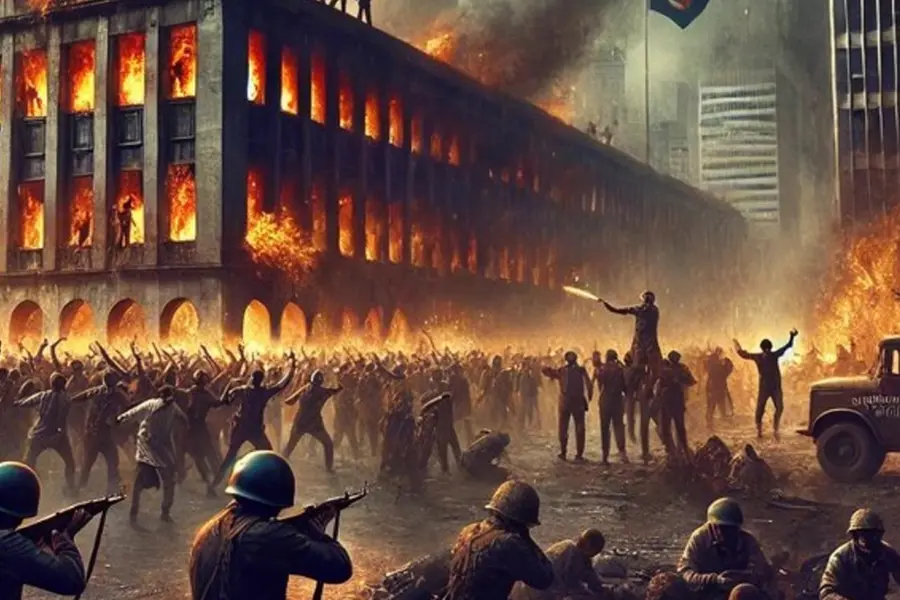
Operation Searchlight, launched on the night of March 25, 1971, was a military operation carried out by the Pakistan Army in East Pakistan (now Bangladesh) to suppress growing calls for autonomy and independence. The operation marked the beginning of the Bangladesh Liberation War and resulted in a mass genocide against the Bengali population.
The roots of discontent
The events leading to Operation Searchlight were rooted in political, economic, and linguistic discrimination against East Pakistan by the ruling West Pakistani establishment.
- Political Marginalisation: Despite making up the majority of Pakistan’s population, Bengalis in East Pakistan had limited political representation. In the 1970 general elections, the Awami League, led by Sheikh Mujibur Rahman, won a landslide victory with 160 out of 162 seats allocated to East Pakistan. This gave them a clear mandate to form the central government. However, the West Pakistani leadership, led by President Yahya Khan and Zulfiqar Ali Bhutto, refused to transfer power, fearing a shift in control.
- Economic Disparities: East Pakistan contributed 59% of Pakistan’s total exports but received only 30% of the earnings. Meanwhile, West Pakistan, which accounted for just 25% of total exports, enjoyed 70% of the revenue. This economic exploitation fueled resentment and demands for greater autonomy.
- Linguistic and Cultural Suppression: The imposition of Urdu as Pakistan’s sole national language in the 1950s, despite Bangla being spoken by the majority in East Pakistan, led to the Language Movement of 1952. This movement laid the foundation for Bengali nationalism, which would later play a crucial role in the push for independence.
The lead-up to Operation Searchlight
As tensions escalated, Sheikh Mujibur Rahman called for a nationwide civil disobedience movement. The situation reached a boiling point when General Yahya Khan, who had been negotiating with Mujib, abruptly left Dhaka on March 25, effectively giving the go-ahead for a military crackdown.
Under the pretext of restoring order, Pakistan's military prepared to launch a brutal offensive. The plan, codenamed Operation Searchlight, aimed to eliminate key political leaders, student activists, intellectuals, and Bengali officers in the army, police, and paramilitary forces. The goal was to crush the non-cooperation movement and reassert West Pakistan’s control over the East.
March 25-26, 1971: The night of genocide
At 11:30 PM on March 25, 1971, the Pakistan Army launched Operation Searchlight. Heavily armed troops moved out of Dhaka Cantonment, targeting multiple key locations simultaneously.
Key targets and attacks
- Rajarbagh Police Lines: Bengali police officers put up fierce resistance but were ultimately overwhelmed. Many were killed, while others fled or were arrested.
- Dhaka University: Troops stormed student dormitories, killing hundreds of students and faculty members. Professors, including Dr. Govinda Chandra Dev and Jyotirmoy Guhathakurta, were executed.
- Pilkhana (East Pakistan Rifles Headquarters): The paramilitary force was attacked, and many personnel were massacred.
- Shankhari Bazaar and Old Dhaka: The military targeted Hindu-majority areas, executing thousands of civilians and burning homes.
- Sheikh Mujibur Rahman’s Residence: Mujib was arrested in the early hours of March 26 and taken to West Pakistan.
By dawn, Dhaka was under siege, with an estimated 7,000 people killed in a single night. The systematic targeting of civilians, intellectuals, and political figures signaled the beginning of a full-scale genocide.
Impact and escalation into the liberation war
- Mass Exodus: The crackdown forced millions of Bengalis to flee to India, where refugee camps swelled with displaced families.
- Proclamation of Independence: Before his arrest, Sheikh Mujibur Rahman had already declared Bangladesh’s independence. On March 26, the official announcement was made via radio by Major Ziaur Rahman on behalf of Mujib.
- Formation of Mukti Bahini: In response to the atrocities, the Mukti Bahini (Liberation Army) was formed, comprising defected Bengali soldiers, students, and civilians who took up arms against the Pakistan Army.
- International Response: While India openly supported the Bengali cause, most Western nations, including the United States and China, backed Pakistan. The brutality of the crackdown, however, led to widespread condemnation, with reports of mass killings emerging in the international press.
Casualties and genocide recognition
- The Bangladesh government estimates that 3 million people were killed during the nine-month war.
- 250,000–400,000 Bengali women were raped, many held in military-run rape camps.
- 10 million refugees fled to India, causing one of the largest humanitarian crises of the 20th century.
- The United Nations has recognized the mass killings in East Pakistan as acts of genocide under Resolution 1430 (1971).
The road to independence
Operation Searchlight was intended to suppress Bengali nationalism but instead became the catalyst for the Bangladesh Liberation War. After nine months of fierce resistance, the Pakistani forces surrendered on December 16, 1971, leading to the birth of an independent Bangladesh.
Even today, March 25 is observed as Genocide Day in Bangladesh, a solemn reminder of the brutal crackdown that ignited the nation’s fight for freedom.
Published: 25 Mar 2025, 12:14 pm IST
Related Topics
Disclaimer: Kindly avoid objectionable, derogatory, unlawful and lewd comments, while responding to reports. Such comments are punishable under cyber laws. Please keep away from personal attacks. The opinions expressed here are the personal opinions of readers and not that of Mathrubhumi.
