
Grilling kebabs looks simple until half the skewer is charred and the other half's still raw. Here's how the pros actually order it.
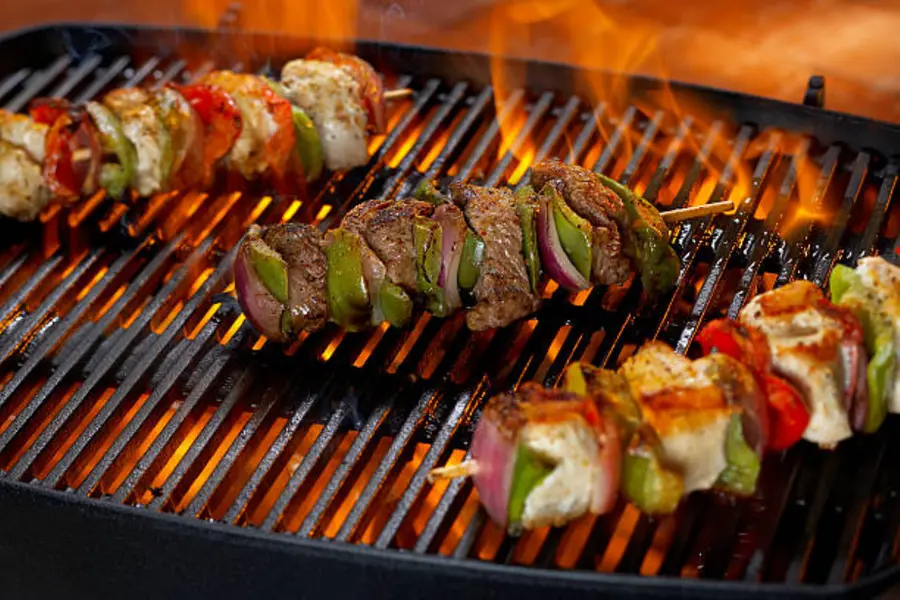
Kebabs are a go-to for feeding a crowd, a whole meal on a single stick. But getting them right isn't just about jamming meat and vegetables together and hoping for the best.
A few simple principles separate dried-out, unevenly cooked skewers from restaurant-quality ones.
Also Read

Start with uniform cuts
Before you even think about order, cut everything to a consistent size. Pieces of the same thickness cook at the same rate, so uneven chunks mean some parts finish while others are still raw or, worse, overcooked.
If one ingredient naturally takes longer to cook, resize it so it can keep pace with everything else on the skewer rather than trying to force it to cook faster.
Build from the center outward
Gas grills tend to run hottest directly over the burners or toward the back, while charcoal grills are usually hottest dead center.
The general rule: place slower-cooking items, like meat and poultry, where the heat is most intense, and put quicker-cooking items, like vegetables or seafood, toward the cooler ends.
In short, skewer order should follow cook-time order. Don't place a two-minute shrimp right next to a 12-minute steak cube unless you've planned for it with grill placement.
Leave space between pieces
Crowding a skewer traps steam and prevents proper browning. Leaving a small gap between pieces lets heat circulate and cook the food more evenly.
This matters more for meat than vegetables. With metal skewers especially, the metal itself conducts and radiates heat into the food, so a little spacing lets that heat reach the inside of the meat.
Vegetables are more forgiving, they cook faster and are fine with a bit of crunch, so they can sit closer together.
Grouping them more tightly, especially near the ends, can even help them hold their shape instead of blistering or falling apart too quickly.
Also Read: Who said kebabs are only for non-vegetarians?
Don't overcrowd the grill
The same spacing principle applies to the grill itself. Leave roughly half an inch to one inch between skewers so heat can move freely around them.
If you're cooking a large batch, work in stages or use indirect heat zones rather than piling everything on at once. Rotating skewers between hotter and cooler areas of the grill as they finish cooking helps manage this too.
Decide on a flipping strategy
How often you flip depends on the result you want. For a hard sear or char, flip only once, similar to cooking a steak, let each side brown fully before turning.
For a more even, all-around cook, flip and rotate frequently, almost like a rotisserie, so the exterior browns evenly while the inside cooks through.
Also Read: Enjoy crunchy chickpea kebab with tea
Consider mono-ingredient skewers
One professional-level shortcut is to skip mixed skewers entirely and cook each ingredient on its own stick. This lets everything cook exactly as long as it needs to, with no compromises.
It also makes timing easier, quicker-cooking vegetables like peppers, onions, and mushrooms can be cooked early, pulled off, and flashed back on the heat briefly before serving, freeing up prime grill time for the proteins.
Guests can then mix and match pieces once everything is off the grill.
Season in stages
Flavor-building shouldn't happen all at once either. Season or marinate meat and vegetables before they go on the skewer so every piece is evenly flavored.
Once assembled, a light brushing of neutral oil helps prevent sticking and burning. Save sweeter, sugar-heavy sauces or glazes for the very end of cooking, sugar burns quickly, so applying it too early risks charring before the food is done.
Think of seasoning in three stages: before skewering, during cooking, and as a finishing touch.
There isn't one single "correct" way to arrange a kebab, but there is a logic to it. Follow these basics and your skewers will come off the grill evenly cooked, well-browned, and full of flavor.
Published: 08 Aug 2026, 06:35 pm IST
ABOUT THE AUTHOR
Related Topics
Disclaimer: Kindly avoid objectionable, derogatory, unlawful and lewd comments, while responding to reports. Such comments are punishable under cyber laws. Please keep away from personal attacks. The opinions expressed here are the personal opinions of readers and not that of Mathrubhumi.