
On Teachers’ Day, meet Biju Asan, a Travancore Devaswom Board artist who has spent nearly 30 years teaching traditional temple arts such as Chenda, Thimila and Sopana Sangeetham to children for free. He believes education and art should go hand in hand.
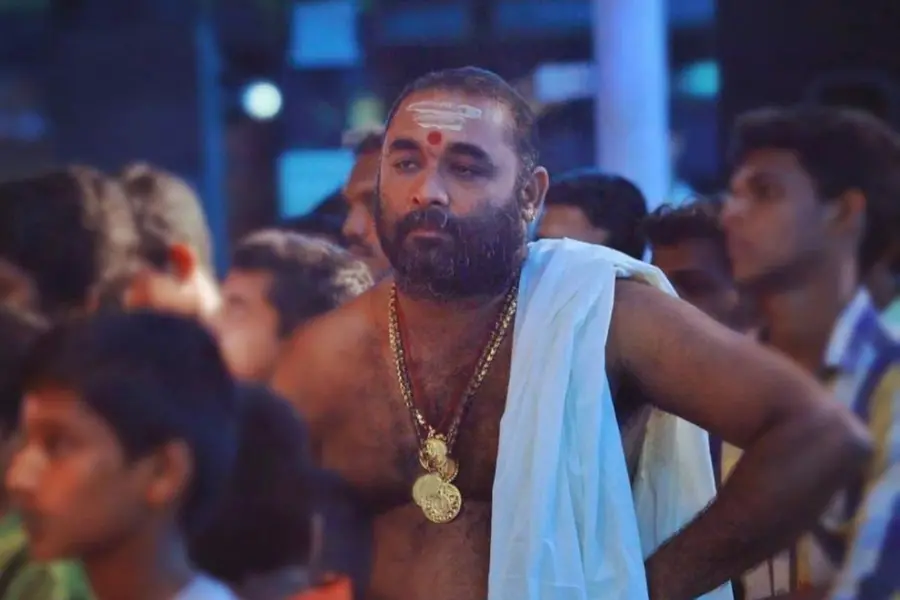
On most Teachers’ Days, the spotlight naturally falls on school classrooms, blackboards and the teachers who spend their days shaping young minds. But there are teachers whose classrooms have no bells, timetables or prescribed syllabi. Their lessons are passed down through practice, performance and a bond that often lasts long after the student has left.
Bijumon, known as Biju Asan, is one such teacher.
For nearly three decades, he has been teaching traditional temple arts to children and he has never charged them a fee.
By day, Biju works in the Panchavadyam department of the Travancore Devaswom Board, under the Thrikkakara Paravur Group at Thrikkakara Devaswom. In the hours left after work, he becomes a teacher of Sopana Sangeetham, Kalampattu, Chenda, Thimila and traditional temple rituals, or Kshethra Adiyanthara (sacred daily or periodic rituals).
His students come from across Ernakulam district. Over the years, he estimates that he has taught between 1,500 and 2,000 children.
And his reason for continuing to teach for free is remarkably simple.
“Everyone will have a desire to learn, but they might not have the financial means,” Biju told Mathrubhumi English. “Children who lack financial backing should not back out of this. They should also learn; they must learn.”
ALSO READ: What if it’s not just a toxic relationship? The narcissistic abuse signs people often miss
For Biju, teaching is not simply about preserving an art form. It is about ensuring that a child does not have to choose between tradition and a future.
‘Education first, art alongside it’
Biju began teaching even before he joined the Travancore Devaswom Board, a job he has held for about 25 years. At the time, he was also performing in stage programmes, Panchavadyam and Melam.
Today, his advice to his students remains consistent: learn the art, love the art, but do not abandon education for it.
“One cannot make a living solely off this art form,” he says. “My intention is that they should pursue education, acquire higher education, get good jobs, and also love this art.”
It is a philosophy that comes from experience rather than theory.
According to Biju, making a sustainable living exclusively through temple arts can be difficult because opportunities to perform are limited, while the number of artists is large. For a young person, he believes, education provides the foundation for a secure future, while art can become something deeper, a source of identity, joy and peace of mind.
“They should get educated, get good jobs, and along with that, in their free time, use this just for peace of mind,” he says. “For their own happiness and well-being.”
His approach to learning is equally demanding. He points out that reaching the highest levels in a traditional art form requires years of intense practice and dedication, something that can be difficult to combine with formal education.
“If one wants to reach that level, one has to practise from 2 AM to 6 AM or 7 AM and learn under a traditional Gurukula system,” he says. “If so, it means they will lose their education.”
ALSO READ: From Bihar to Delhi, they found their own Onam in Kerala
For Biju, the answer is not to choose one over the other.
It is to make room for both.
A teacher who stays after the lesson ends
Perhaps what makes Biju’s relationship with his students different is that, for him, teaching does not end when the lesson does.
He describes the relationship as an “aathmabandham”, a deep bond between teacher and student.
Unlike a conventional classroom where a teacher may teach a syllabus and move on to the next class, Biju believes a teacher must understand the child, their personality, interests and needs — and walk alongside them.
“We understand the child's character correctly, or we know what his desires are. So, we walk alongside him, giving him exactly what he needs,” he says.
That bond, he believes, creates a sense of affection and respect that can influence a child far beyond the art form itself.
His students continue to remain in touch even after completing their studies. Some join different troupes, while others participate in programmes whenever they are called.
The bond is also visible during the annual festivities at Thrikkakara temple. Biju says that much of the festival is now handled by his own students, with outside artists brought in only when required for special occasions.
ALSO READ: From watching Pulikali to becoming a ‘Penpuli’; Nimisha Bijo on breaking into Thrissur’s tiger dance
For a teacher, there may be few things more rewarding than seeing a student eventually take the stage.
The happiness of watching a student perform
Ask Biju what it feels like to see his students perform, and his answer becomes deeply personal.
“It brings a feeling to the heart that cannot be put into words,” he says.
He compares the feeling to something filmmaker Sathyan Anthikad once described after releasing a film, the strange sense of sadness that comes when something that belonged to you for so long finally leaves your hands.
Biju experiences something similar when his students perform.
“Something that was confined only within me all these days, when they perform it, there is a feeling that it has left me,” he says.
But there is happiness in that departure too.
“The greatest happiness I experience in my life is watching my students perform, watching them perform what we do.”
There is another moment that means even more to him: when someone introduces a performer as “Biju's student”.
For a teacher who has spent decades teaching without expecting payment, recognition comes in a different form.
His students, he says, know that he never expected anything from them in return.
“If there is any need, they will help within seconds, or they will always be by my side,” he says. “Because they know their Asan does not expect anything from them.”
Then comes a line that perhaps captures his entire journey as a teacher:
“That indeed is my greatest wealth.”
The first student he can never forget
Among the thousands of children he has taught, Biju still remembers his first student vividly.
The boy was from Vyttila and, according to Biju, was exceptionally bright. He began learning from Biju at a very young age and later went to Bengaluru to study engineering.
He died in a vehicle accident there.
“It is something I can never forget in my life,” Biju says.
The memory is a reminder that teaching is not measured only in the number of students who pass through a teacher's hands. Some students leave behind memories that remain for a lifetime.
Nearly 30 years after he began teaching, Biju continues to open the door for another child to learn.
His classroom may not look like a conventional classroom. There may be a Chenda instead of a textbook, a Melam instead of a school bell, and temple grounds instead of four walls.
But his lesson is remarkably contemporary: education can build a future, while art can give that future meaning.
And perhaps, on Teachers’ Day, that is a lesson worth remembering too.
Published: 05 Sept 2026, 09:35 am IST
ABOUT THE AUTHOR

Related Topics
Disclaimer: Kindly avoid objectionable, derogatory, unlawful and lewd comments, while responding to reports. Such comments are punishable under cyber laws. Please keep away from personal attacks. The opinions expressed here are the personal opinions of readers and not that of Mathrubhumi.