
As he enters his 20th year in the teaching profession, Shameer has taken on perhaps one of his most difficult assignments yet — and one that comes with a greater responsibility.
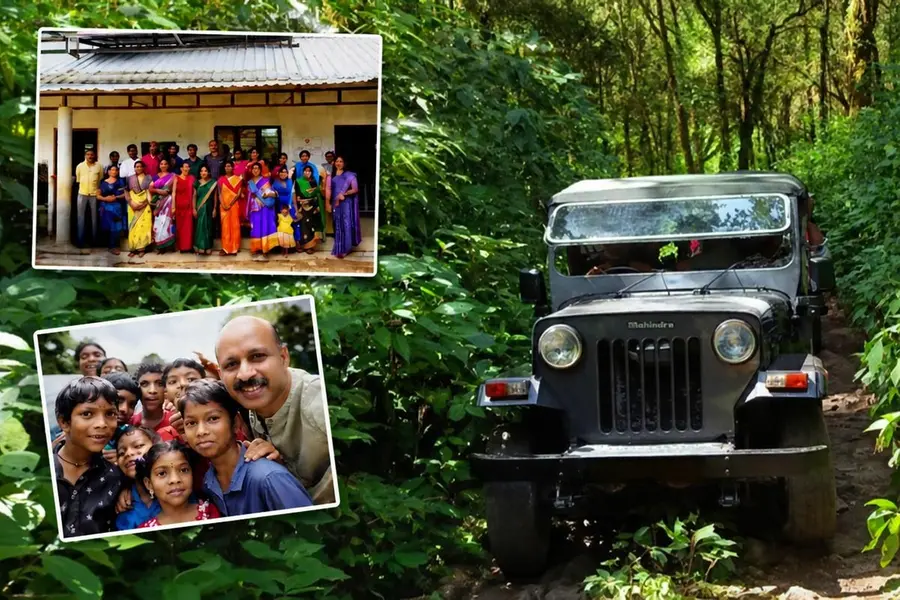
This Teachers’ Day, a government school in Edamalakkudy offers a glimpse of what teaching can actually mean in a place where reaching the classroom is itself a challenge. With no proper roads or bridges, difficult forest terrain, limited transport and settlements spread across the region, teachers posted here cannot follow the routines of a typical school. Newly appointed headmaster Shameer CA knows these realities well. His focus is not on grand promises, but on keeping children in school, improving attendance and making learning relevant to their lives.
Being a headmaster at a government school is a coveted post in Kerala, and many teachers entering the profession see it as a major milestone to achieve before retirement. Yet, there are government schools where teachers find it difficult to take up the role, leaving the post with fewer takers because of the challenges involved.
The government lower primary (LP) school at Edamalakkudy, the state’s first tribal panchayat, is one such school --meant only for those willing to go the extra mile, quite literally, trekking miles through the challenging forest terrain of Idukki district.
Edamalakkudy lacks proper roads and bridges across rivers, while vehicles cannot reach many of its settlements. Just weeks ago, critically ill patients had to be carried on makeshift bamboo stretchers through dense forests and across flowing rivers for several kilometres to reach the nearest healthcare facilities. Such delays in transportation have tragically cost lives in the past.
The difficult terrain is not the only challenge. The region is also home to wild animals, including elephants and bison, posing an additional threat to teachers posted here. Teachers do not have the luxury of travelling home every day, as getting in and out of the terrain is a herculean task, particularly during the rainy season. Instead, they live in the settlements and usually return to their homes only once or twice a month.
Against this backdrop, appointed headmasters failing to report for duty, leaving the post, or teachers seeking transfers is not unusual. Shameer CA, a primary school teacher hailing from Idukki who recently took charge as headmaster, was well aware of these realities from his three-year teaching stint at the school. Yet, he refuses to bow to the challenges posed by the terrain.
Shameer is now among the six teachers handling 60 students at the school in the Societykudy settlement. He has a bigger target in mind --to improve attendance and increase enrolment to more than 100 students.
Now residing near Muvattupuzha in Ernakulam district, his decision to take charge did not come suddenly. His experience with Samagra Shiksha Kerala (SSK), particularly its work with single-teacher schools, prepared him for the realities of teaching in remote settlements. His experience in Marayoor and Adimali, along with his efforts to tackle the challenges posed by geographically isolated terrains during the COVID-19 pandemic, further prepared him for the assignment.
As he enters his 20th year in the teaching profession, Shameer has taken on perhaps one of his most difficult assignments yet --and one that comes with a greater responsibility.
“At present, the school remains accessible to five or six settlements. We can successfully accommodate more students, provided proper travel facilities and accommodation are made available for students from other settlements,” he said.
During his stint with SSK, Shameer successfully implemented Padippurussi (Taste of Learning), a specialised initiative aimed at ensuring that all local students become fully literate in Malayalam. However, he believes that simply imposing a standardised curriculum on children is not the right approach.
“Instead, we have to adapt our curriculum to their realities. Otherwise, these children may lose interest and eventually give up on education altogether because of their aversion to a system that does not reflect their lives,” he said.
The same principle, he argues, should apply to introducing new technologies and approaches. “We are in the AI era, but we cannot facilitate such an orientation for students in the same way it is done in several schools in Kerala. Here, their realities are different. Suddenly introducing things without a consensual approach may backfire,” he said.
Shameer, whose areas of expertise are English and science, believes that inculcating scientific temper is one of the approaches that can broaden students’ horizons.
“For instance, we used to conduct space-related camps and activities in which students could participate and gain new perspectives and ideas,” he said.
“We do not just rely on the prescribed textbooks. We also create tailor-made worksheets that incorporate elements of their culture,” he added.
Published: 05 Sept 2026, 09:28 am IST
ABOUT THE AUTHOR

Related Topics
Disclaimer: Kindly avoid objectionable, derogatory, unlawful and lewd comments, while responding to reports. Such comments are punishable under cyber laws. Please keep away from personal attacks. The opinions expressed here are the personal opinions of readers and not that of Mathrubhumi.