
From Bihar, Tamil Nadu and Delhi to Kerala, meet the people making Onam their own through food, family, friendship and new traditions.
On Onam day, Kerala does not always look like a place where you need to be born to belong.
A man who came to Kerala for work walks down the road in a mundu. Groups of migrant workers sit together over a sadya, many tasting the elaborate feast after being invited by Malayalis around them. Restaurants fill with people enjoying the Onam lunch. Across homes, offices, campuses and streets, those who came to Kerala from elsewhere join the celebrations.
For some, it is their first Onam. For others, it is already a small tradition of their own.
They may not speak Malayalam fluently. They may have grown up celebrating Pongal, Diwali or other festivals. They may have arrived in Kerala for a job, education or marriage. Yet, after years of living here, Onam has found its way into their lives — through a pookalam made in a small room, a saree chosen by friends, a family sadya, a new recipe or even a spontaneous game with children in the hills.
The festival, in their case, is not something they are simply watching from outside.
They are joining in.
It started with not knowing what Onam was
When Neelam came to Kerala from Uttar Pradesh, she knew very little about the festival.
Her husband had already been living here for around 18 years. He eventually asked her to move to Kerala with their children, telling her that the schooling here would be good.
The distance from her village made her hesitant.
Then came her first Onam.
A teacher at her children's school invited her for Onam celebration. Neelam went, watched the festivities and returned home with a completely different feeling.
“I went there, saw it, and liked it very much,” she recalled.
She told her husband about the programme and began trying to recreate what she had seen.
Not in a grand way. In their own room.
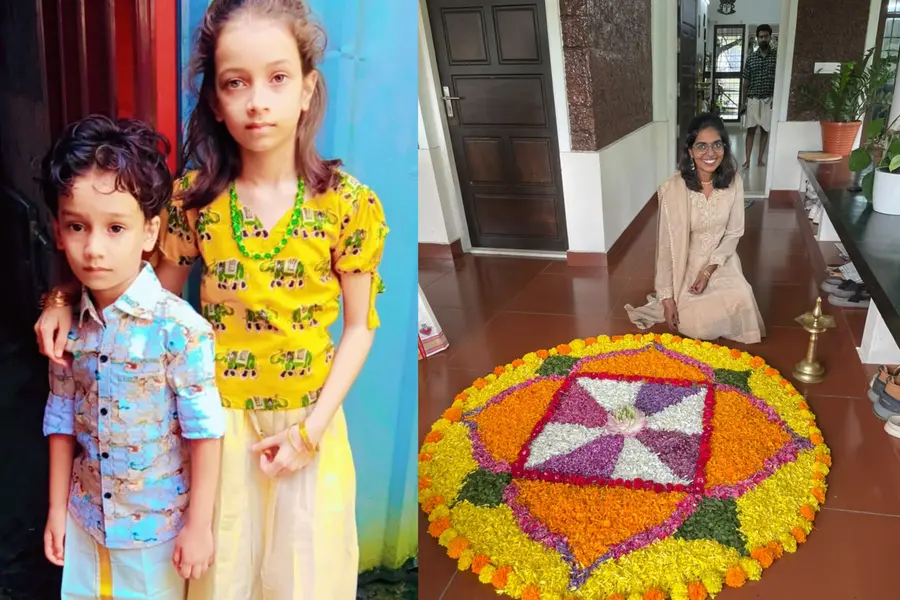
She and her husband started celebrating Onam together, bringing little pieces of the festival into their everyday life. The pookalam she had once seen as something uniquely Kerala is now something she enjoys making herself.
“I like it; this year I made the pookalam at my daughter's school” she said simply when talking about pookalam.
Three years after first encountering Onam, Neelam now knows the story of Mahabali, has celebrated the festival with her family and has started picking up Kerala recipes.
She makes sambar, rasam and dosa. She has tasted sadya and knows her favourite part of it — payasam, followed by sambar, pappadam and rice.
But the more interesting part is what she wants to do with all that she has learnt.
If she returns to her village, she wants to take Kerala's flavours with her.
“I feel within myself that when I go back, I will prepare the dishes from here and feed everyone,” she said.
That is perhaps how a festival slowly becomes yours, you stop merely participating in someone else's celebration and start imagining how you would recreate it for your own people.
For Savita, Onam became a family tradition of her own
Savita Jayakumar came to Kerala from Bihar after marrying a Malayali man in 1999. Decades later, Onam is no longer a festival she experiences as an outsider.
It has become something she actively creates for her own family.
She has celebrated Onam before, but says every celebration still feels special. At home, the festival is kept simple — a small pookalam, a traditional meal and time together as a family.
“Every Onam we try to make a small pookalam at home and enjoy a nice meal together to keep the memory alive,” Savita said.
She has also taken the festival into her kitchen. This year, she made a traditional payasam for her family, with palada payasam remaining her favourite item on the Onam sadya.
And unlike someone experiencing Onam for the first time, Savita now knows the story behind the celebration too.
She knows the story of King Mahabali — another piece of Kerala's cultural memory that has become part of her own after years of living here.
Savita’s story has also travelled into the next generation. Her daughter has grown up with both sides of the family’s culture, enjoying Onam as well as Bihari festivals such as Chhath. In a way, she carries both worlds with her — a Malayali side at home and her mother’s Bihari roots too.
For Abisha, Onam came with a familiar feeling
For Abisha, the journey was different.
She came from Kanyakumari in Tamil Nadu after marrying a Malayali man and now lives in Manjummel. She is still learning Malayalam, but the language barrier did not stop her from finding something familiar in Onam.
Her first Onam was celebrated at home, with her husband's relatives gathering for Uthradam.
Everyone came. There was food, flowers and a house full of family.
“I enjoyed celebrating Onam very much,” Abisha said.
Perhaps the festival did not feel entirely alien to her because of its similarities to the Tamil harvest festival Pongal, which closely resembles Onam.
Back in Tamil Nadu, Pongal is also a harvest celebration that brings families together over several days. So while the customs were different, the feeling of coming together was familiar.
She learnt the story of Mahabali from her husband and family and began understanding why Onam matters to the people around her.
Then came the sadya. Some Kerala flavours took getting used to. She found the food a little different from what she was accustomed to. But she found favourites too.
“Sambar is something we have in Tamil Nadu too, but it has a different taste,” she said.
ALSO READ: From watching Pulikali to becoming a ‘Penpuli’; Nimisha Bijo on breaking into Thrissur’s tiger dance
She also took to aviyal because it was something new for her.
And Abisha is not simply settling into Kerala as a member of her husband's family. Six months ago, she started a food unit in Manjummel, building something of her own in the place that has become her second home.
Now, when she thinks about celebrating Onam every year, she imagines the whole family coming together.
She has heard that her husband's grandparents began the family's Onam tradition.
She wants to keep it going.
Sometimes belonging is a friend helping you wear a saree
Mayuri arrived in Kerala from Delhi in 2024, not for marriage or work, but to study journalism in Kottayam.
Her first Onam came while she was still trying to adjust to Kerala.
Her classmates helped her choose a saree, drape it and get ready for the college celebrations.
Then came sadya. For someone who had been struggling to adjust to the food in Kerala, Onam offered her a completely different introduction to it.
But her most memorable experience happened after her classmates left for home.
Mayuri decided to travel alone to Munnar.
While walking through the hills, she came across people celebrating Onam. Songs were playing and children were playing games.
She started talking to them. Then she joined them.
"There were Onam songs playing and children playing games. I started talking to some of the children and ended up joining their games. Still one of my best moments in Kerala."
There was no long introduction, no need to know all the rules of the festival. She was simply welcomed into the moment.
When she returned to Kottayam, there was another small surprise waiting.
Her friends had brought snacks from their homes for her.
The gesture reminded her of Diwali.
And perhaps that was the point at which Onam stopped feeling like something she was merely observing as an outsider.
She had begun building her own small world in Kerala.
As she looks back, Mayuri puts it down to something bigger than learning the language or memorising traditions.
Sometimes, she realised, belonging comes through small kindnesses.
ALSO READ: What if it’s not just a toxic relationship? The narcissistic abuse signs people often miss
The Onam welcome does not end at the sadya
The same feeling can be seen beyond homes and college campuses.
On Onam, migrant workers who spend much of the year working in Kerala have also found themselves at the centre of celebrations.
Some were invited to share sadya by Malayali families and organisations. Restaurants saw people from different parts of the country sitting down for an Onam meal. On the streets, men who came to Kerala for work could be seen embracing one of the festival's most recognisable traditions — the mundu.
For many of them, Kerala is a workplace.
But on a day when the state celebrates together, the lines between who is from here and who came here become a little less visible.
And this year, when Kerala sat down together to celebrate, they were sitting at the table too.
Published: 27 Aug 2026, 03:21 pm IST
ABOUT THE AUTHOR

Disclaimer: Kindly avoid objectionable, derogatory, unlawful and lewd comments, while responding to reports. Such comments are punishable under cyber laws. Please keep away from personal attacks. The opinions expressed here are the personal opinions of readers and not that of Mathrubhumi.