
Anupama Parameswaran’s “I started to shrink” confession opens a deeper look at narcissistic abuse, how it differs from a toxic relationship and why victims struggle to leave.
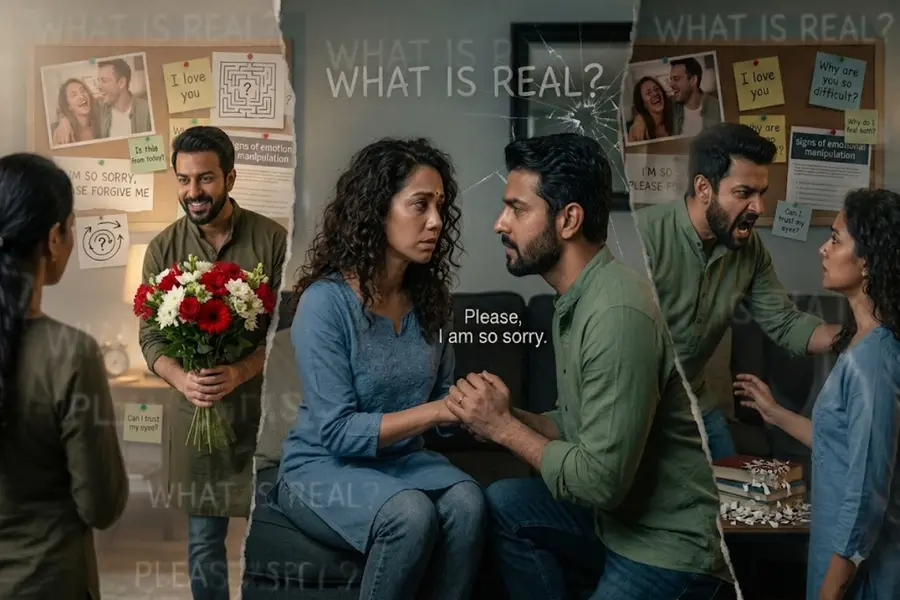
What if you have slowly stopped being yourself in a relationship, but cannot pinpoint when it happened? You think twice before speaking because you know how your partner might react. You stop meeting certain friends. Going to the gym becomes an issue. Your interests begin to disappear. You become careful about what you say, where you go and even how you behave, because keeping the relationship peaceful seems more important than anything else.
And yet, there are good days. There is affection. There are apologies. There are moments when you remember why you fell in love in the first place. That is part of what can make narcissistic abuse so difficult to recognise.
Actor Anupama Parameswaran recently brought the subject into focus when she spoke about what she described as two years of “narcissistic abuse” in an interview with I AM with Dhanya Varma. Without naming the person involved, Anupama spoke about the physical and emotional toll of the experience and explained that there was a long period of pain and self-reflection behind the Instagram post that prompted questions about her relationship.
“There are two years of pain, physical and emotional destruction, behind that one post,” she said.
She also described how the experience affected her sense of self. “I started to shrink,” Anupama said, recalling that she had lost a significant amount of weight during that period.
Her comments, along with actor Madonna Sebastian's discussion of narcissistic abuse, have opened a wider conversation. But beyond the celebrity stories and social media terminology, what does narcissistic abuse actually look like? How is it different from an unhealthy relationship? And why can someone find it so difficult to recognise what is happening while they are still inside it?
According to Renitta Monica Rodrigues, Consultant Psychologist at Feel and Heal Psychological Counselling Centre, Kalamassery, the answer begins with understanding the difference between a toxic relationship and narcissistic abuse.
Not every toxic relationship is narcissistic abuse
Relationships can become unhealthy in many ways. Frequent conflict, jealousy, disrespect, emotional dependency and poor communication can all create a toxic dynamic.
But narcissistic abuse refers to something more specific.
“It usually refers to a repeated pattern of manipulation, control, devaluation, lack of empathy or violation of the other person’s boundaries,” Rodrigues explains.
One bad argument does not automatically make someone abusive. Neither does one episode of anger or selfish behaviour.
“What we need to look at is whether there is a pattern that continues over time and across different situations,” she says.
That distinction is important because the word “narcissist” is often used loosely. Narcissistic abuse is not itself a diagnosis, and having narcissistic traits does not automatically mean that someone has Narcissistic Personality Disorder (NPD).
Rodrigues says she would therefore focus less on trying to label the other person and more on understanding the behaviour and its impact.
“The more important question is not, ‘Does my partner have NPD?’ but ‘Is there a consistent pattern of behaviour that is harming me and affecting my sense of self?’”
When the person you love is also the person hurting you
One reason people struggle to identify narcissistic abuse is that the relationship may not be bad all the time.
There may be affection, intimacy and genuine-looking care before the relationship shifts into criticism, control or emotional harm. Then may come an apology, followed by another period of closeness.
This creates what Rodrigues describes as cognitive dissonance, the confusion of holding two contradictory experiences at the same time.
“This person loves me, but why are they treating me like this?” is the question the person may repeatedly find themselves asking.
The good moments can create hope.
Maybe things will go back to how they were.
Maybe this time it will be different.
And that hope can make leaving far more complicated than simply deciding that the relationship is unhealthy.
Guilt can add another layer.
The person may start thinking, Maybe I should change. Maybe if I behave differently, this won't happen.
“Repeated criticism and devaluation can also affect self-esteem,” Rodrigues says. “They may stop trusting their own judgement.”
So even when someone knows they are unhappy, they may still struggle to understand whether what they are experiencing is actually abuse.
When your world starts getting smaller
Rodrigues recalls working with a client whose relationship initially appeared very different from what it turned out to be.
The female partner had presented the situation in a way that made it seem as though the male partner was responsible for most of the problems. But when the incidents were explored in detail, a pattern emerged.
His independence had gradually been restricted.
Going to the gym became difficult. Spending time outside the relationship became difficult. Maintaining certain relationships and exploring his interests and talents also became difficult.
“Slowly, many parts of his individual life were getting reduced,” Rodrigues says.
The relationship was not negative all the time. There were phases of affection and love, followed by controlling or abusive behaviour and then apologies.
That inconsistency made it harder for him to make sense of what was happening.
“The biggest challenge was not simply telling him, ‘This is abuse.’ It was helping him see the pattern for himself and understand that he was not responsible for everything that was happening,” she says.
Through psychoeducation and cognitive restructuring, therapy focused on the beliefs he had developed about himself and the relationship.
Gradually, he began understanding that having his own interests, relationships, boundaries and needs did not make him the problem.
And that is often where the phrase “I lost myself” begins to make sense.
When you start living around someone else's emotions
A person does not necessarily lose themselves in one dramatic moment.
Sometimes, they simply become increasingly occupied with managing another person's emotions.
Will this make my partner angry?
Should I avoid doing this?
What should I say so there won't be a problem?
Over time, their own needs can become secondary.
Friendships may reduce. Hobbies may disappear. Career interests may be put aside. Personal decisions become difficult because every choice is filtered through the possible reaction of the other person.
Rodrigues says this is one of the strongest patterns she sees among people who come to therapy after experiencing narcissistic abuse.
“Self-doubt” is common, she says. People often ask, “Was I actually the problem?” or “Did I overreact?”
Guilt is another recurring theme.
“They may have become so used to prioritising the other person’s emotions that putting their own needs first feels selfish,” Rodrigues says.
There can also be emotional sensitivity and fear of conflict. After repeatedly experiencing intense reactions from a partner, a person can become extremely cautious about what they say and do.
In some narcissistic patterns, Rodrigues says, narcissistic rage may also become relevant when a person's need for admiration is frustrated or they feel criticised, rejected or humiliated.
It may appear as intense anger, blaming or aggressive behaviour.
Understanding the psychological reason behind such reactions, she stresses, does not justify abusive behaviour.
So how do you know what you're experiencing?
There may not be one incident that gives you the answer.
Instead, Rodrigues suggests looking at the pattern, consistency and duration.
Can you express your opinion freely?
Can you say no?
Are your boundaries respected?
Can you maintain your friendships and interests?
Can you develop your career and explore your talents?
Or do you constantly feel that you have to change yourself to prevent the other person from becoming angry?
It is also worth paying attention to what happens when you try to become more independent.
“If maintaining friendships, going to the gym, developing your career, exploring your talents or simply having personal space repeatedly creates conflict or leads to restrictions, that is something worth looking at carefully,” Rodrigues says.
The goal is not to diagnose your partner.
It is to understand what the relationship is doing to you.
Healing means finding yourself again
Leaving a harmful relationship does not necessarily mean the emotional damage disappears with it.
Someone who has spent a long time being criticised, controlled or invalidated may continue questioning themselves afterwards.
Was I wrong?
Did I overreact?
Was everything actually my fault?
This is where therapy can help.
Rodrigues says psychoeducation and cognitive restructuring can help people examine the beliefs they have developed about themselves and their relationships. Therapy can also focus on rebuilding boundaries and decision-making.
The person needs to slowly experience that they can make decisions without constantly worrying about how somebody else will react.
But healing also means returning to the parts of life that were pushed aside.
Friends.
Interests.
Career.
Talents.
Personal choices.
Identity.
“Therapy is not only about recovering from the relationship,” Rodrigues says. “It is also about getting back in touch with who they are outside that relationship and rebuilding their confidence, independence and self-trust.”
That may be why Anupama's description of “shrinking” feels so powerful.
Because sometimes the clearest sign that something is wrong is not simply that you are unhappy.
It is that you are becoming smaller.
And when someone finally steps away, healing may begin with a very different question.
Not “What is wrong with me?”
But, as Rodrigues puts it: “What happened to me, and how can I rebuild myself?”
For someone still inside such a relationship, recognising that pattern can be the first step. They may not be ready to leave. They may not have the right words for what they are experiencing. They may still love the person.
But they can begin by asking themselves something simple: Am I still allowed to be myself in this relationship?
Published: 14 Aug 2026, 11:01 am IST
ABOUT THE AUTHOR

Disclaimer: Kindly avoid objectionable, derogatory, unlawful and lewd comments, while responding to reports. Such comments are punishable under cyber laws. Please keep away from personal attacks. The opinions expressed here are the personal opinions of readers and not that of Mathrubhumi.