
As the sun’s rays touched the page, the magic happened—dull fruit turned golden yellow, and readers gasped
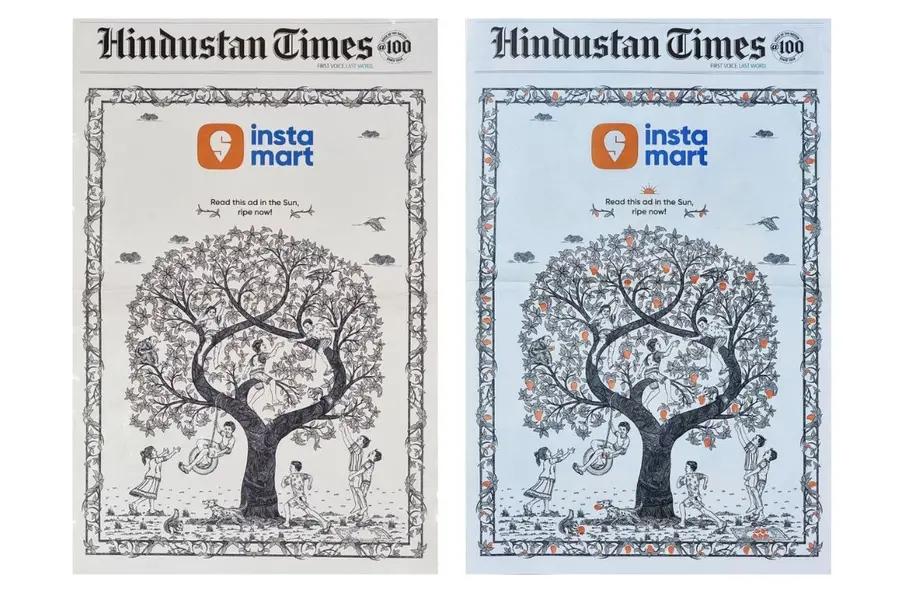
Mumbai: When readers of the Hindustan Times recently turned to the front page, they were in for more than just the morning headlines. Instead of the usual rush of newsprint and routine ads, a burst of nostalgia, science, and seasonal joy unfolded—quite literally—under the sun. Swiggy Instamart’s latest print advertisement didn’t just announce the arrival of mango season; it staged a summer spectacle, proving that interactive newspaper ads have finally ripened in India.
The ad in question featured a charming illustration of a mango tree, complete with children clambering on its branches and the laid-back mood of a pre-digital Indian summer. At first glance, the tree bore no mangoes. However, the twist came with a simple prompt: Read this ad in the Sun, ripe now! As the sun’s rays touched the page, the magic happened—dull fruit turned golden yellow, and readers gasped. Using photochromatic ink, a rare and expensive printing technique that reacts to UV light, Instamart had effectively created India’s first sun-sensitive newspaper ad. A nostalgic scene was transformed into a vibrant homage to the country’s favorite summer fruit, powered purely by natural light.
“Just like real mangoes ripen in the sun, this ad transforms with sunlight, making the magic unfold right before your eyes,” said Mayur Hola, Instamart’s head of brand. The campaign, he noted, was a tribute to both the season and the brand’s core promise: freshness, speed, and the delight found in the little things. It was a statement not just about mangoes, but about Instamart’s identity as more than just a grocery delivery service—it is a curator of everyday magic.
This playful gesture wasn’t a one-off. It follows Instamart’s scented mango ad last year, where pages carried the aroma of fresh fruit, engaging readers’ noses before they even placed an order. That olfactory hit brought with it a wave of childhood memories, conjuring up bazaars, fruit baskets, and sticky fingers from roadside mango feasts. With the photochromatic follow-up, Instamart turned up the sensory dial once more, now appealing to sight, nostalgia, and interactivity. In doing so, the company is proving that even something as ordinary as a grocery delivery app can flirt with the extraordinary through inventive storytelling.
The idea was conceptualised by Instamart’s in-house team and executed in partnership with media agency Havas. The creative arc focused on transforming a fleeting print impression into a lasting emotional memory. The cost, unsurprisingly, was high—photochromatic ink isn’t your average CMYK (a subtractive color model used in color printing). It required special production processes and precise alignment with environmental variables like ultraviolet (UV) exposure. However, the payoff, at least in brand buzz and consumer engagement, has been exceptional.
More importantly, the ad signals a broader shift in how print advertising can reinvent itself in the digital age. Newspapers, long struggling to retain reader attention and attract premium advertisers, are now exploring ways to turn the static into the spectacular. Interactivity, once the domain of digital platforms, is now stepping boldly into print.
With audiences becoming increasingly resistant to traditional ad formats and with brands vying for mindshare in crowded markets, innovations like this offer a rare and potent blend of novelty and intimacy.
Of course, not every brand has the budget or appetite for such grand experiments. The cost of deploying photochromatic ink at scale is steep, and only a handful of publications may be able to offer the logistics and reach needed to justify the expense, but the door has been opened. Instamart’s gambit shows that the newspaper is not a dying medium—it is a sleeping giant, waiting for a creative nudge.
Already, marketing circles are abuzz with speculation about what’s next. Will tea brands print heat-sensitive cups that reveal messages when you place your mug on them? Will fashion ads carry textures you can feel? Will comics unfold into AR stories with a QR code? The possibilities are tantalizing, and for a print medium often declared passé, such reinventions are a shot of much-needed adrenaline.
For Instamart, the mango campaign has done more than push seasonal produce—it’s redefined what a brand interaction can feel like. From a simple act of flipping through the newspaper, the reader is suddenly part of a small experiment, a sunny game, a sensory moment. In a world oversaturated with digital screens and swipeable ads, this back-to-basics innovation—newspaper plus sunlight—feels revolutionary in its simplicity.
It also reinforces the emotional power of mangoes, India’s most beloved fruit, and one that carries with it memories of summer vacations, childhood mischief, and messy delight. By merging this cultural icon with cutting-edge ink technology, Instamart has woven science into sentiment and commerce into creativity. The result is not just a memorable ad—it’s a moment that lingers.
And while others will surely follow with their versions of interactive print campaigns, Instamart has set the tone. The bar is now higher, the canvas broader, and the expectations richer. Because in this new world of print-meets-play, even mangoes can become magic under the morning sun.
Published: 17 Jun 2025, 07:15 pm IST
Disclaimer: Kindly avoid objectionable, derogatory, unlawful and lewd comments, while responding to reports. Such comments are punishable under cyber laws. Please keep away from personal attacks. The opinions expressed here are the personal opinions of readers and not that of Mathrubhumi.
