
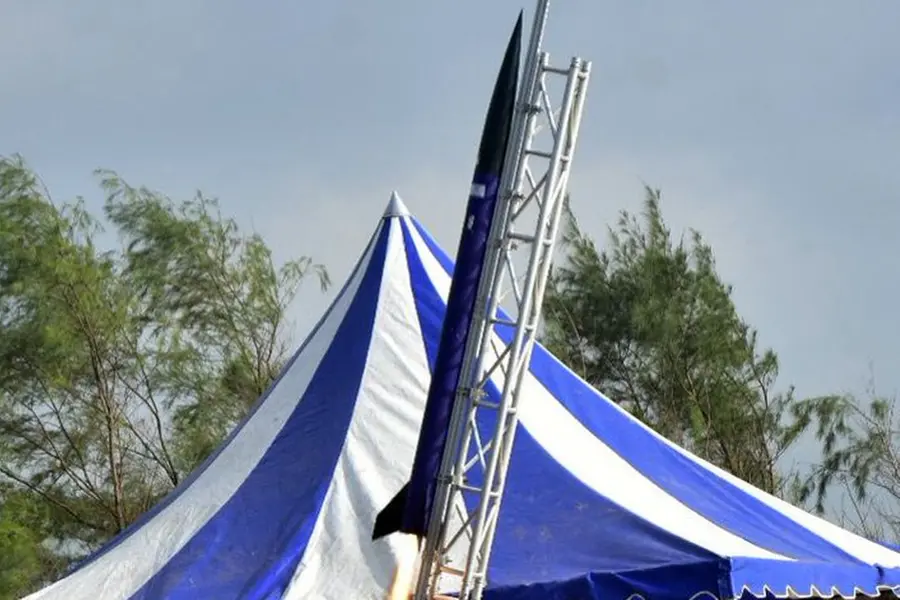
In a big step forward for India's growing space sector, a startup called Space Zone India from Tamil Nadu, working with Santiago Martin's Martin Group, launched its first reusable hybrid rocket, RHUMI 1, on Saturday.
The Martin group has provided Rs 8 crore from its CSR funds to support the early development of Space Zone's RHUMI rocket. The rocket took off from Thiruvidanthai beach near Mamallapuram, about 40kms from Chennai on the East coast road at 7 am.
Also Read

This innovative rocket, RHUMI 1, marked a breakthrough in reusable rocket technology by sending three cube satellites on a suborbital path.
RHUMI 1: Reusable Innovation in Space
RHUMI 1 is an Indian-made rocket used for space exploration and launching satellites. Standing at 3.50 meters tall as a single piece, it has a range of up to 80 kilometers.
What sets RHUMI 1 apart is its reusability feature, unlike traditional rockets. This is possible due to its combination of solid and liquid rocket engines, which enhance its flight capabilities.
This technology not only improves performance but also saves costs by allowing the rocket to be reused multiple times, reducing the need for new constructions.
Hybrid Rocket: Sustainable Space Exploration Solution
The rocket is propelled by a mixture of waxes and nitrous oxide as the oxidizer, creating a 'hybrid' vehicle. It will take off with an initial thrust of 2,500 newtons.
Most parts of the rocket are designed for reuse, with the exception of the nose cone, which is discarded after releasing the payload. The rest of the rocket returns to Earth with the help of a parachute, landing safely in the sea.
The launch is a big success for Space Zone India and the Martin Group, showing their dedication to coming up with new and affordable ideas in space technology.
By putting three cube satellites into orbit, the rocket has proven that it can be used for different purposes, like satellite communication and scientific research.
Versatile RHUMI 1: Bridging Space and Earth
While RHUMI 1 is mainly used for exploring space, it can also be helpful in other areas. The rocket and its technologies can be used in agriculture, monitoring the environment, and managing disasters.
For instance, satellites launched by RHUMI 1 could help farmers keep track of their crops, observe changes in how land is used, and give early warnings about natural disasters like floods or earthquakes.
This flexibility makes RHUMI 1 not only useful for space research but also for dealing with important issues here on Earth.
Adaptive Launch Angles: Precision in Space
One impressive aspect of RHUMI 1 is its ability to change the angle at which it launches, ranging from 0 to 120 degrees. This feature gives precise control over the rocket's path, making it suitable for different types of missions.
Being able to adjust the launch angle is especially helpful for placing payloads into specific orbits or carrying out specific experiments in outer space.
Efficient Parachute System: Ensuring Rocket Reusability
The rocket has a unique parachute system that is activated by carbon dioxide, which helps safely bring back the rocket parts after the mission. This descent system is affordable and environmentally friendly, offering a dependable way to retrieve the rocket.
The parachute system plays a key role in making RHUMI 1 reusable by reducing the chances of damage during descent. It allows for the safe retrieval and repair of the rocket for future launches.
RHUMI 1 Launch: Enhancing Environmental Understanding
The launch of RHUMI 1 from a mobile launcher at Thiruvidantha beach marked a significant milestone in India's space exploration.
The rocket carried three Cube Satellites and 50 individual Pico satellites are assigned to study different aspects of atmospheric conditions, including vibration, accelerometer data, altitude, ozone levels, toxic substances, and natural and synthetic molecular bonding of fibers.
This research aims to improve our knowledge of environmental processes and dynamics.
Space Zone India has announced that the rocket will be retrieved soon, demonstrating its reusability. This successful recovery will open the door for future launches, allowing the company to offer more affordable options for satellite deployment and other space missions.
Published: 24 Aug 2024, 01:47 pm IST
Related Topics
Disclaimer: Kindly avoid objectionable, derogatory, unlawful and lewd comments, while responding to reports. Such comments are punishable under cyber laws. Please keep away from personal attacks. The opinions expressed here are the personal opinions of readers and not that of Mathrubhumi.