
Madhya Pradesh loses two tigers in days, including famed 'Pujari' in Bandhavgarh, to territorial clash – pushing 2026 deaths to 32. Experts explain rising fights from overcrowding, sex ratios, space crunch in high-density reserves like BTR; corridors urged to ease pressure without disrupting natural ecology.
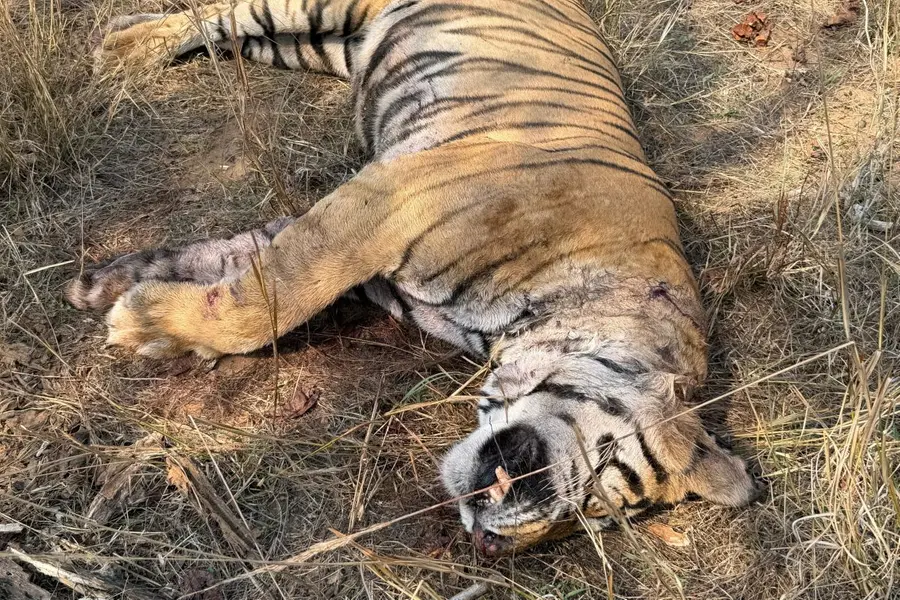
Days after the death of a sub-adult male tiger in Madhya Pradesh's Panna Tiger Reserve, the state lost another tiger on Monday morning, this time in Bandhavgarh Tiger Reserve (BTR), taking the total tiger mortalities in MP to 32 this year.
While confirming the death of the male tiger -- popular among wildlife filmmakers, photographers, naturalists, and tourists as 'Pujari' -- BTR Field Director Anupam Sahay said that preliminary findings point towards a territorial clash as the cause of death.
Speaking to Mathrubhumi, Sahay said: "On Monday, at around 6.30 AM, forest guards heard roaring between two male tigers. A while later, a forest patrolling team found the carcass of the male tiger in the Khitauli range of the tiger reserve. Attack marks were found on the body, while all its body parts were found intact."
Sahay said that this is the fourth territorial death in Bandhavgarh this year.
Also Read: Deadly shadow over Kanha: How a virus silently killed a tigress and her 4 cubs
The death of yet another tiger in the state due to territorial conflict has once again brought the spotlight on a little-understood reality of the wild: territorial fights among big cats. Forest officials say such encounters are natural in the wild, but are increasingly making headlines as tiger numbers rise and forests become more crowded.
As incidents of territorial clashes continue to rise, understanding what drives these violent encounters, why they sometimes turn fatal, and whether such conflicts can be reduced without disturbing the natural balance of the wild has become increasingly important.
Why do territorial fights happen?
Calling territorial fights a natural course of tiger ecology, L Krishnamoorthy, Additional Principal Conservator Forest (Wildlife), said, "Territorial fights happen where there is a high density of tigers in an area. Bandhavgarh is a fairly small tiger reserve in terms of area, but with a high density of tigers. That's why there is a territorial fight for space. It is one way that the population is also ecologically managed by natural means, wherein the weak (tiger) is removed, and the strong one survives in the jungle. It indicates a good, healthy habitat and a good population."
Explaining further, Krishnamoorthy said that age and dominance also play a major role in triggering such clashes.
"Another factor for fights among tigers is age. When a tiger ages and a young, strong male tiger comes into the same area, it engages in a fight with the older tiger and pushes it to the buffer. In these fights, tigers often get severely injured and killed," said Krishnamoorthy.
Territorial fights are more common among male tigers, though females fight too:
Further explaining the behavioural aspect behind territorial conflicts, R Sreeniwas Murthy, a retired senior forest official, who is known for the reintroduction of tigers in Panna Tiger Reserve in 2009, said that such fights are more commonly seen among male tigers.
"Territorial fights are largely seen among male tigers but also between females. But if they have their own daughters, then the females adjust to them a little. For instance, Ranthambore Tiger Reserve's famous tigress, Machhli, had a fight with her daughter. Tigresses also displace because prime locations are needed for the tigers in their prime time to find their mates and to move their progeny forward," said Murthy, adding, "What generally happens is that when both tigers feel that there is a lack of space and a lack of mates, they try to move out. Fight is the last resort. When both think that they can clash with each other, that is when they fight."
Murthy further pointed out that apart from space, mating opportunities and survival of progeny are also deeply linked to territorial behaviour among male tigers.
The sex ratio aspect of territorial fights
Apart from fights happening over space, Murthy highlighted that the sex ratio among tigers also plays a crucial role. "In today's situation, the sex ratio in almost all tiger reserves is one to three, meaning one male to three females. In prime time, male tigers have a lot of sexual urges because they have only four to five years with them. They want their cubs to keep growing continuously because as long as it stays, the other male tiger will not come; until then, it can move its offspring forward. If there is a changeover from the other male tiger, then it kills the offspring, and the new tiger takes over. It is called turbulence in changeover. So, every male tiger tries to at least let its progeny flourish there. These are all issues of tiger biology and ecology."
Also Read: How India's only tiger-reserve nature camps helped Panna win back its people
"Everybody should understand that our passion and affection in human communities is not there in tigers. Basically, by instinct, they take care of their children. The male tiger gives a security cover so that the other male tiger does not occupy that area, and does not bring turbulence in the growing population. Female tiger, by instinct, raises them, and as soon as they grow up, the female drives them away. This process is called weaning. Males are separated early on so that there is no inbreeding. The rest of the females settle somewhere nearby. Some females leave the territory by instinct. But the dispersion in female tigers is very little reported," the retired officer added.
Tiger reserves are overflowing
Experts say that one of the biggest reasons behind increasing territorial clashes is the growing pressure on tiger habitats due to rising tiger populations.
A major problem that is leading to frequent territorial clashes is the space crunch, happening due to the overflowing carrying capacity of tiger reserves not only in MP, but across the country.
Murthy said that after Sariska Tiger Reserve and Panna Tiger Reserve lost their tiger population, departments focused on the revival of the population by giving more attention to internal protection.
"This has led to a good population increase in the tiger reserves. But at the same time, it created stiff competition among the tigers for themselves. Also, the forest department is aware that the tigers are overflowing everywhere."
The importance of tiger corridors
While territorial clashes are a natural process, wildlife experts believe that better connectivity between forests can help reduce pressure on tiger habitats.
Murthy highlighted that the focus should be on strengthening tiger corridors that allow the population to grow further.
"If you strengthen the tiger corridors properly, the population will flourish further. Tigers tend to disperse after the monsoon, since water is an important factor. When a tiger migrates, it needs to drink water two to four times a day. Therefore, the migration or dispersal of the tigers, which especially happens in the majority of the males, happens around August. And then when the tigers reach the source population, they are saved from the territorial tigers there, and have a chance to make their own progeny there," he said.
Also Read: Legacy in Stripes: Remarkable tales of India's celebrated tigers
But tiger corridors also come with their own set of challenges. "The second issue is that there are sinks. The sink means that tigers go out in the corridor, but there is no future for them to survive. For some reason, either they get poached, or they die because of starvation or some other reason, such as injury or poisoning, or something else. In today's situation, the country is facing this problem in plenty," Murthy said.
Can forest departments intervene in territorial fights?
Though territorial fights are a part of tiger ecology, forest departments across the country can’t really intervene in these fights. The department comes into the picture only after a tiger is left severely injured after a fight.
"We can't intervene in such cases of territorial fights, since it's a natural process. Yes, if a tiger is severely injured in a fight, then we come into the picture, and of course, we try to save the animal by giving it medical treatment later," said Krishnamoorthy.
Published: 12 May 2026, 02:23 pm IST
Related Topics
Disclaimer: Kindly avoid objectionable, derogatory, unlawful and lewd comments, while responding to reports. Such comments are punishable under cyber laws. Please keep away from personal attacks. The opinions expressed here are the personal opinions of readers and not that of Mathrubhumi.
