
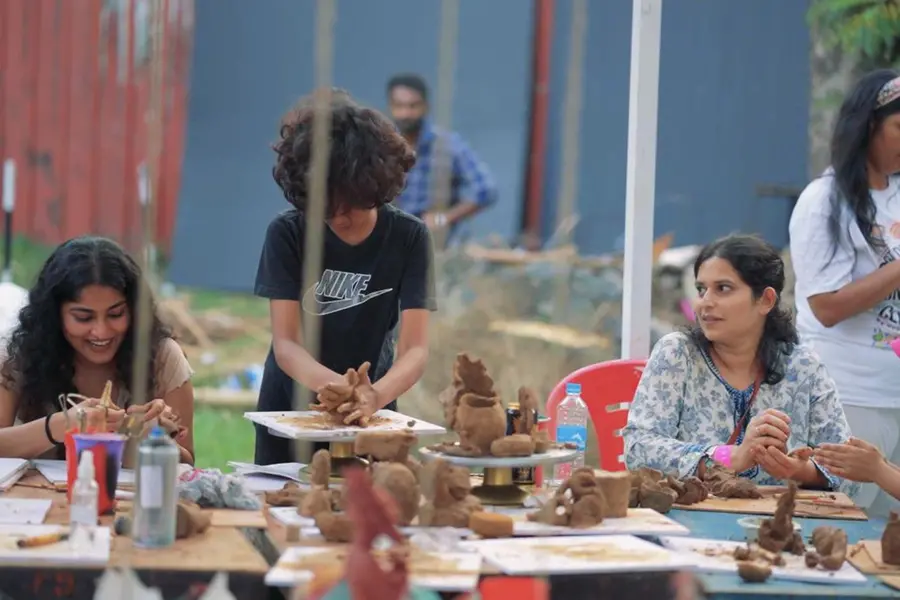
Pachakuth, one of Kochi’s favourite tattoo and piercing studios, is more than just ink and needles. For Eric, the founder, and his team at the collective, the creative journey transcends these two art forms. At CULTR 2025, Pachakuth created a lively universe of art that invited everyone to create without the fear of judgement.
Staying true to their core belief that "art is all about making mistakes," Pachakuth handed out paintbrushes to festival attendees—children, security staff, daily wage workers, artists, and anyone who happened to pass by their stall. We sat down with Eric and a few of his team members to explore their roots and identities as artists, their personal styles, dreams, challenges, and much more.
Eric Edward

His introduction to tattooing as an art was rather serendipitous, and it was this experience that led him to build Pachakuth. “My art often revolves around fish and the sea,” he shares. Growing up by the beach in Alappuzha, Eric’s childhood was filled with the sights, sounds, scents, and stories of fishes, fishermen, boats, and the ocean. His upcoming series, Pachameen, delves deeper into this connection. Pachameen draws and depicts fishes in various artistic concepts like the evolution of fish, their potential to fly, and more. “Whenever I draw intuitively, I end up drawing fish. It makes me feel connected to my roots and makes me happier than ever.”
Keerthi Mohan
Sunflower (Surya Gayathri)
Deepak
Vidhun
What Is Pachakuth & Pachakuth Tattoo School, Really?
Though primarily a tattoo and piercing studio, at Pachakuth, the team’s passion for art is palpable. Each member of the community is truly “high on art,” and creating together is their kind of ecstasy. They draw inspiration from one another, constantly learning and evolving as a collective. No one claims to know everything, and this openness keeps the atmosphere fresh and dynamic. While the CULTR team is different from the studio team, they all share the same creative mindset. Everyone is fully immersed in their craft, exploring new ideas and fully relishing the process at all times.
Pachakuth Tattoo School follows the same philosophy. Beyond a tattooing course, it’s a school of thought that challenges the conventional stream of consciousness and thinking. Students are encouraged to unlearn and relearn, connecting with their bodies and instincts. Instead of following a fixed path, they are encouraged to embrace mistakes and use them as tools for growth, ultimately enabling them to make confident creative decisions. On most weekends, artists gather for art jams, story sharing, collaborating, and creating in a relaxed, enjoyable environment.
Why the Name Pachakuth?
“What else could I name a tattoo studio in Kerala?” Eric responds nonchalantly when asked about the name. But the name Pachakuth was a deliberate choice. First, he wanted something memorable—something that stuck without repetition. Second, it had personal significance. When Eric returned to Kerala from Poland with a tattoo kit and started working in Alappuzha, locals referred to his work as Pachakuth instead of tattooing. “Jimmy Chettan’s son is now into Pachakuth,” they would say. Despite his efforts at correcting them, the term stuck. Third, Eric wanted to reclaim the word Pachakuth, which had long been associated with something cheap or substandard. He aimed to elevate it, giving it the respect, honour, and artistry it deserved. Finally, he drew inspiration from how businesses abroad proudly use regional names and expand globally. For Eric, Pachakuth is a clear statement of his roots, journey, and cultural identity.
Pursuing Art: Navigating Family Reactions
Family’s reactions play a major role in shaping the path to becoming a full-time artist, and for these artists, their journeys were met with a mix of understanding, support, and hesitation. Eric’s passion for art was clear and unwavering. “If I lose my hands, I’ll draw with my feet. If I lose those, I’ll use my mouth. If I lose that too, consider me dead,” he declared to his parents. This conversation led them to understand how deep his dedication was. On the other hand, Sunflower, whose father was a photographer, had a relatively easier time. Growing up with someone who valued creativity, she received unwavering support for her artistic pursuits.
In contrast, Deepak and Keerthi had more complex experiences. Deepak’s father, a former artist (painter and violinist) who gave up his creative career for a stable government job, never openly discouraged Deepak’s artistic ambitions. Despite concerns that he should choose a conventional career and settle down quickly, Deepak’s family eventually accepted that art was his true calling. Keerthi’s experience was different. Her parents were anxious as she explored various “odd jobs” in art after completing her engineering degree. But over time, Keerthi found her place in the world of art, embracing the unpredictable nature of the creative journey.
What Is Art?
What Does the Future Look Like?
As constant learners, every member of Pachakuth has things that they want to try out, experience, and learn in the future. Deepak is eager to experiment with new mediums, particularly metal, a material he has yet to explore. Sunflower is interested in trying her hand at tufting, an art form involving threads and fabric. Eric is captivated by the intersection of lights, sounds, and movement, and hopes to incorporate these elements into installations and other art forms. Keerthi, in contrast, doesn’t have this sort of a goal for the future. She prefers to live in the moment, taking each day as it comes, learning from whatever experiences present themselves.
Pachakuth's belief is simple: everyone is an artist. That's how we all were as children. As we grew up, societal pressures, criticism, and comparisons dulled that natural creativity. The idea that art must follow certain rules took root, suppressing the uninhibited expression we once had. Pachakuth aims to change that by encouraging individuals to rediscover childlike curiosity and the joy of creating with nothing to hold us back.
Published: 21 Jan 2025, 11:36 am IST
Related Topics
Disclaimer: Kindly avoid objectionable, derogatory, unlawful and lewd comments, while responding to reports. Such comments are punishable under cyber laws. Please keep away from personal attacks. The opinions expressed here are the personal opinions of readers and not that of Mathrubhumi.